



By: Dr. Alex Klein
Most people treat ice as the treatment. You roll an ankle, you grab a bag of frozen peas, you elevate, and you wait.
The problem is that the evidence for ice as a healing tool has never been strong, and the man who invented the acronym you learned it from spent the last decade of his career saying so. What has held up is something less satisfying and more useful: cold controls pain, movement drives recovery, and the two belong in a specific order.
That order is where a good clinician earns their fee.
What Cold Therapy Actually Does
Cold works through a short list of real, measurable effects. It constricts blood vessels, slows nerve conduction, reduces tissue metabolic rate, and dulls pain.
That last one is the reliable one. Every serious review that questions ice still concedes the analgesic effect, which tells you something about where the ground is solid.
Where it gets thin is healing. A systematic review of 22 randomised trials covering 1,469 participants found little evidence that adding ice to compression has any significant effect. A 2022 umbrella review of ankle sprain management went further, noting that the highest-quality review it examined found no evidence for the effectiveness of RICE at all.
Soreness is a different question with a better answer. A Cochrane review found some evidence that cold water immersion reduces delayed onset muscle soreness compared with doing nothing, though it rated the underlying study quality as low. Feeling less sore is a genuine benefit. It just is not the same thing as healing faster, and conflating the two is how people end up icing for six weeks and wondering why their ankle still feels unstable.
The Man Who Invented RICE Changed His Mind
Dr. Gabe Mirkin coined RICE in his 1978 Sportsmedicine Book. In 2015 he published a piece on his own site walking it back.
In his words: “Coaches have used my ‘RICE’ guideline for decades, but now it appears that both Ice and complete Rest may delay healing.” His reasoning was that inflammatory cells release insulin-like growth factor into damaged tissue, and that suppressing inflammation may suppress part of the repair signal along with it.
Worth being precise about what that was and was not. It was a post on his own website, not a retraction in a journal. RICE was never formally withdrawn. But when the person who named a protocol publicly reverses on half of it, that is worth more than an average opinion.
What Replaced It
The acronyms since have moved steadily away from rest and toward loading.
In 2012, a British Journal of Sports Medicine editorial proposed POLICE, swapping Rest for Optimal Loading, on the grounds that rest may be harmful and inhibit recovery. Those authors kept ice, and said exactly why: cold-induced analgesia and the reassurance of compression were enough to justify it. Not healing. Pain control.
Then in 2020, Dubois and Esculier published PEACE and LOVE in the same journal, and ice did not make the cut. Their assessment was that despite widespread use, there is no high-quality evidence on the efficacy of ice for soft tissue injuries, and that ice is mostly analgesic.
Read that carefully, because it is routinely overstated online. They did not say ice is proven harmful. They said the evidence for benefit is absent and the theoretical risk is real. Those are different claims, and the difference matters if you are deciding what to do with a swollen knee tonight.
Where Hands-On Care Fits
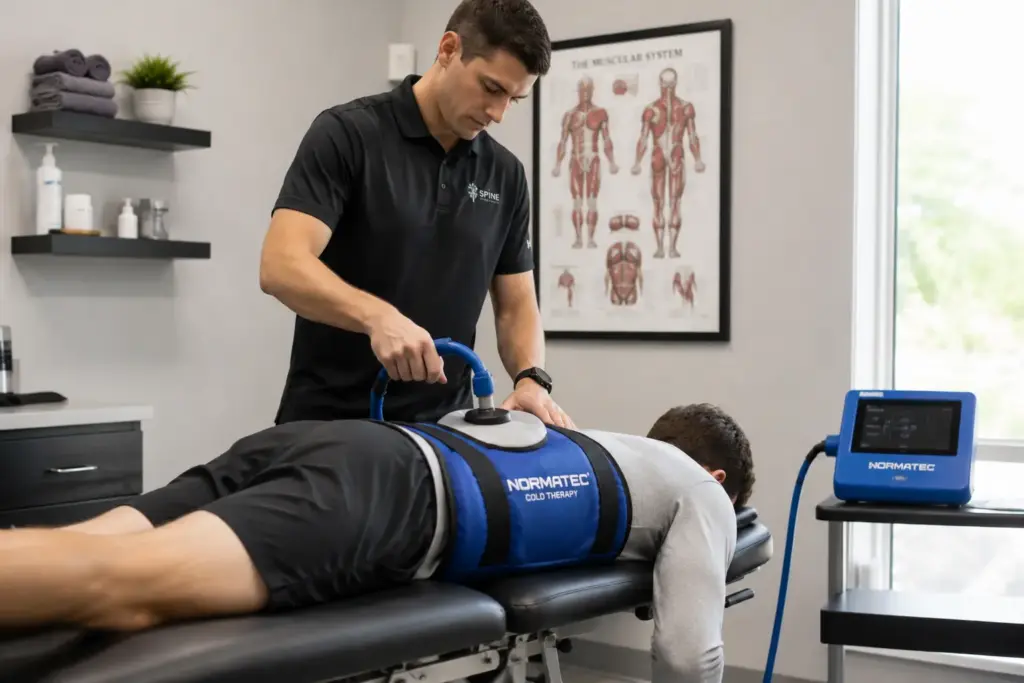
Here is the honest version, and it is more useful than the marketing version.
The most recent Cochrane review of spinal manipulative therapy for chronic low back pain, updated in January 2026, pooled 76 trials and 11,866 participants. Against a sham, it found manipulation about 7 points better for pain and 8.8 better for function on a 0 to 100 scale, on evidence rated low to very low certainty. Real, small, and at or below the threshold most researchers treat as clinically meaningful. For acute low back pain the picture is weaker still: the most recent Cochrane assessment, from 2012, found manipulation no more effective than sham.
So manipulation is not a shortcut. What guidelines support is the package. NICE recommends manual therapy only as part of a programme that includes exercise, which tells you where the value sits. Exercise is the foundation, hands-on work is the adjunct that makes the foundation possible sooner.
Which is the same job cold is doing.
“Cold is a pain management tool, not a healing tool. Where it earns its place is buying you a window where you can actually move the joint, because the movement is what changes the outcome,” says Dr. Alex Klein, a chiropractor and the owner of Cedar Park Chiropractic Relief in Cedar Park, Texas. “If ice is the whole plan, you have a plan to feel better today and no plan to get better.”
The practical version is unglamorous. Cold and manual work reduce pain and improve early range of motion, that makes loading tolerable, and loading is what restores function. Nobody has run the study proving cold causes better outcomes by enabling movement, so treat that as a rationale rather than a proven pathway. But every individual link in it is separately evidenced.
The strongest support comes from a 2010 trial in the BMJ. Researchers randomised 101 people with grade 1 and 2 ankle sprains, gave both groups ice and compression guidance, and had one group start structured exercise in week one. The early-exercise group finished with better function. Same ice, different movement, better outcome.
On combining the two directly, be sceptical of anyone claiming the research is settled. Exactly one small randomised trial has tested hands-on soft tissue work added to cold therapy for a sports injury. In 40 people with ankle sprains it found better pain and self-reported function than cold alone, but no difference in swelling or range of motion, and it ran in a chiropractic profession journal. That is a reason to keep looking, not a reason to claim anything.
When Cold Makes Sense, and When It Probably Doesn’t
Cold is a reasonable choice when:
- You are in the first 48 hours after an acute sprain or strain and want the pain down. Analgesia is the best-supported effect, and comfort is what makes early movement possible.
- Pain is stopping you doing your rehab exercises. A short application before the session is the one use case where reviews found even marginal evidence.
- You have back-to-back competition days, where tomorrow’s performance matters more than this week’s adaptation.
It is the wrong call when:
- You are reaching for it routinely after every strength session, because it may blunt the adaptation you just trained for.
- You are three weeks into an injury with no rehab plan. At that point you are managing a symptom instead of the problem.
- You are using it instead of getting a bad injury assessed. Cold tells you nothing about whether something is torn or broken.
That last set deserves the nuance most articles skip. A 2015 study in the Journal of Physiology had 21 men strength train for 12 weeks using either cold water immersion or active recovery after each session. Isokinetic work rose 19 percent, type II fibre cross-sectional area 17 percent, and myonuclei per fibre 26 percent, all in the active recovery group only. The authors concluded that regular post-exercise immersion should be reconsidered.
But “ice baths kill your gains” oversells it. A 2023 meta-analysis found that whole-body immersion, which is what most people actually do, had no statistically significant effect on strength. The attenuation showed up mainly with single-limb immersion, and the hypertrophy signal is small enough that reviewers describe it as “may attenuate” rather than does. So the read is about timing, not prohibition. Skip the plunge on days you are trying to build something.
The Sequence That Actually Works
Current thinking protects for days, not weeks. PEACE recommends restricting movement for one to three days to limit bleeding and avoid aggravating the injury, then LOVE adds mechanical stress early, resuming normal activity as symptoms allow.
In practice that looks like:
- Days one to three, protect and use cold for pain if it helps you rest and move around
- Within the first week, start gentle range of motion and muscle activation work, ideally guided rather than guessed
- From there, progressive loading, which is the part that determines how the injury turns out
- Cold from that point forward as an occasional comfort tool, not a daily ritual
Where a clinician adds value is in the middle. Assessment tells you what you are dealing with. Manual work and practitioner-applied passive range of motion can restore movement you cannot yet produce yourself. And someone watching the progression is what stops you loading too fast or, more commonly, far too slowly.
Before You Reach for the Ice
Cold has real contraindications. Skip it or check with a clinician first if you have reduced sensation, diabetes, peripheral vascular disease, Raynaud’s or cold urticaria. Numb tissue cannot tell you it is being damaged.
The FDA’s guidance on cold therapy products is worth following regardless: use a cloth as a barrier between the cold source and your skin, check the skin frequently, and stop immediately for numbness, burning, itching, blisters, welts, or changes in skin colour. Be particularly careful over the outside of the knee, where the peroneal nerve runs close to the surface and where nerve injuries from prolonged icing are documented.
Get the injury assessed rather than self-treating if any of these apply:
- you cannot bear weight for four steps
- there is obvious deformity
- you have bony tenderness rather than soft tissue soreness
- you felt a pop or a snap at the moment of injury
- you have numbness, pins and needles, or lost sensation
- the joint gives way or feels unstable
- nothing has improved after a few days
If you are choosing between practitioners, the same principles that apply to choosing a sports injury clinic apply here: look for assessment, a written plan, and exercises to take home.
One more thing if neck treatment is on the table. Serious adverse events from spinal manipulation are rare, and that 2026 Cochrane review reported none across 76 trials, with muscle soreness and temporary pain increasing the common complaints. The exception is cervical artery dissection. An American Heart Association and American Stroke Association statement concluded that most controlled studies find an association between neck manipulation and vertebral artery dissection in younger patients, that the evidence is insufficient to establish that manipulation causes it, that incidence is probably low, and that patients should be told about the association beforehand regardless. Ask about it.
Frequently Asked Questions
How Long Should You Leave Ice On?
Ten to twenty minutes is the widely used convention, though no major regulator or professional body actually specifies a number. Short repeated applications are safer than one long one, and the skin checks matter more than the stopwatch.
Does Ice Actually Delay Healing?
That is stronger than the evidence supports. The accurate position is that there is no high-quality evidence ice speeds healing, and a theoretical mechanism by which it could interfere. Using it for short-term pain relief is reasonable. Relying on it as your treatment is not.
Should You Ice After an Adjustment or a Rehab Session?
Routinely, probably not. If a chiropractic care session leaves you genuinely sore and cold helps you sleep or move the next day, using it is unlikely to hurt. Making it automatic is a habit rather than strategy. The same logic applies to managing sore muscles after exercise.
Can Cold Therapy Replace Rehab?
No. This is the central point of everything above. Cold manages how an injury feels. Loading determines how it ends up.
Ice Is a Painkiller, Not a Plan
Cold therapy is not useless and it is not magic. It is a decent short-term analgesic with weak evidence behind every claim beyond that, and its real value is making the first uncomfortable days manageable enough that you can start moving.
Hands-on care is in a similar position. The effect sizes for manipulation are modest and the certainty is low, but assessment, soft tissue work, restored range of motion and a properly progressed loading plan are exactly what guidelines put at the centre of recovery.
Neither one is the treatment. Together, in the right order, they get you to the part that is. If you want the fuller picture on the cold side specifically, this breakdown of how cold therapy helps with injury recovery covers the practical protocols in more detail.