





Over time, the way we watch sports has evolved a lot since very few people use regular cable TV. Instead, people stream matches online since they believe that it is more accessible because they can watch it anywhere.
In my opinion, soon watching games won’t be just about sitting and looking at a big screen; instead, we will be able to choose our own camera angles, check live stats, and chat with our friends.
High-speed connections, especially fiber internet plans, are making these streams faster and smoother than ever. It is completely changing the way we watch sports. That’s actually because of the underlying infrastructure that determines how good an experience fans get.
Moving on, in this article, I will be discussing the future of sports streaming and how it has evolved, and why internet technology matters.
From Cable to Streaming: The Rise of Direct-to-Consumer (DTC)
Gone are the days when people would sit on their couch and watch a game on cable. But the main problem was that cable packages cost a lot of money and forced people to pay for channels that they never watched. Personally, whenever I wanted to watch any game, I used to watch it live on ESPN or Sky Sports, but I had no need for other TV channels, which was quite a waste for me.
But over time, as internet technology evolved, smartphones became more powerful, and fans wanted something cheaper to watch and only what they liked.
Moreover, big sports groups realized that they could make more money by selling subscriptions directly to the fans with better quality and camera angles.
Major giants like Apple TV and Amazon Prime started buying rights to broadcast big games and tournaments, and services like NBA League Pass allow fans to watch matches live, choose different camera angles, and see old games on demand from their smart TVs or phones.
The Infrastructure Behind Next-Gen Tech

Next-Gen tech in streaming aims to offer viewers immersive viewing so that they can watch matches live on TV and feel like they are in the stadium. The future of streaming can be divided into three main parts, such as:
Ultra-Low Latency for Real-Time Viewing
Traditional streaming delays cause a lot of disconnection for viewers who use social media and stay active on group chats while watching.
When a goal or something interesting happens in real time, delayed streams or lag during a match means friends messaging in a group chat ruins the surprise. But ultra-low latency ensures that viewers see every moment in real time and chat with their friends simultaneously, which makes the game more interesting and interactive.
Moreover, live polling in stream chat heavily relies on synchronized timing. For example, if the latency of a viewer’s internet connection is high, they will see the events late. Their answers to a live poll will arrive after the moment has passed.
But ultra-low latency fixes this problem; it makes sure that viewers stay up to date and fans enjoy every moment of the match, which will make them feel like they are sitting in the stadium. In short, it depends on the connection type behind it; fiber internet with its symmetrical speeds handles data transfers better than cable connections, which are prone to disruption during peak hours.
Augmented Reality (AR)
AR brings advanced stats and graphics into live action. Such as, viewers can see players’ speeds instantaneously, and they can see ball trajectories and tactical maps. This helps fans understand complex games without looking away from the game.
Then, personalize camera angles in a new way, which can help fans watch matches from their own perspectives. They can pin virtual screens around their room, choose custom camera angles, or select which player to track. This will put them in charge of the broadcast and will tailor the experience to their personal preferences.
This also increases fan engagement as AR bridges the gap between passive watching and active participation, which means that fans can see live polling results or can play mini-games that are tied to the live score. These features will turn solo viewing into a shared and connected social event.
Virtual Reality (VR) and 360-Degree Camera Angles for Home-Stadium Experiences
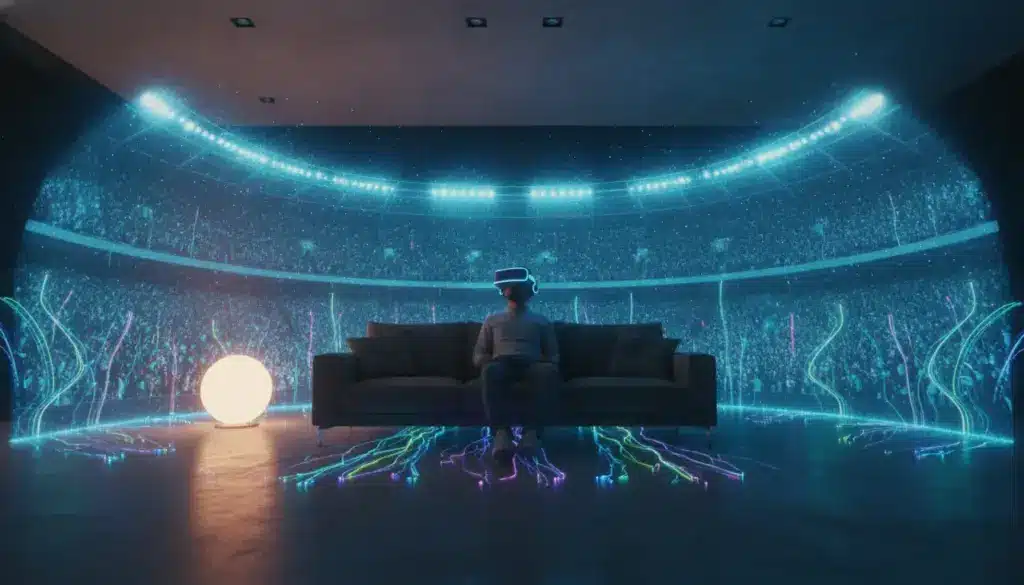
Virtual reality and 360-degree cameras have transformed streaming by placing fans inside the stadium through a simple headset or a mobile device. This enables them to control their viewing angles and look around as if they are watching the match in a stadium.
This technology has replaced traditional broadcasts where fans used to watch on a big screen, but due to technological advancements, fan engagement and excitement rates have increased more than ever before.
Moreover, fans no longer rely on a director’s cut, since with 360-degree video feeds, viewers can turn their heads to watch the reaction of the crowd, follow the match ball-to-ball, and experience the match atmosphere as if they are in the stadium. This creates an immersive and realistic environment that elevates the fan viewing experience.
Final Thoughts
Ultimately, the future of sports streaming is all about putting the viewers inside the game. Instead of just sitting and watching a game on a flat TV screen, new technology like VR headsets makes you feel like you are actually in the game.
The new technology has evolved sports from something you just watch into an exciting experience that you can feel and stay connected to every moment from anywhere in the world. But none of this works without the infrastructure behind it: fans who get the most out of sports streaming are the ones with reliable connections.