
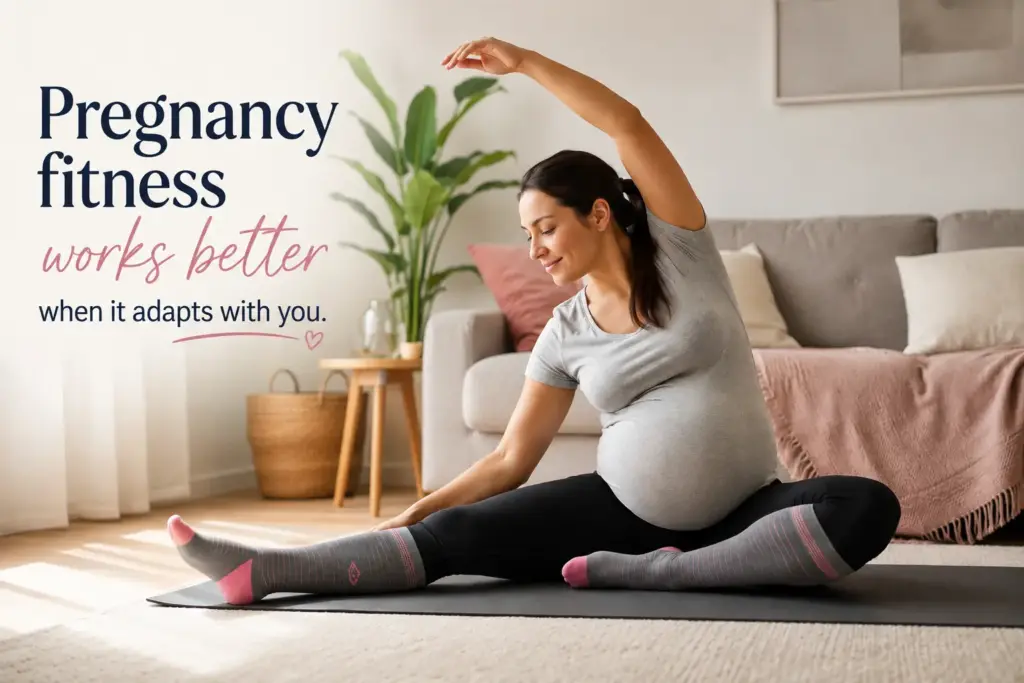



Pregnancy can change the way your legs feel during exercise surprisingly early.
A walk that previously felt effortless may leave your calves feeling heavy. Ankles can become more noticeably swollen toward the end of the day, and spending several hours sitting or standing can make the lower legs feel uncomfortable before a workout has even started.
For some women, compression socks become a useful addition to their maternity activewear.
In a healthy, uncomplicated pregnancy, compression socks can generally be worn during activities such as walking, stationary cycling, prenatal strength training and other moderate exercise. They are not required for exercising during pregnancy, but they may offer additional support for women dealing with swelling, tired legs or pregnancy-related changes in circulation.
The key is understanding what compression can realistically do, and when symptoms deserve more attention than simply pulling on another pair of socks.
Why Do Legs Become Swollen During Pregnancy?
Pregnancy creates several physiological changes that affect the lower body.
Blood volume increases, hormonal changes affect blood vessels, and as the uterus becomes larger, it can place additional pressure on veins carrying blood back from the legs.
Gravity adds another element.
After several hours spent sitting, standing or walking, fluid can accumulate around the feet and ankles. This is why mild swelling is often more noticeable later in the day or later in pregnancy.
Compression socks are designed to apply graduated pressure to the leg, usually with the greatest pressure around the ankle and gradually less compression higher up the calf.
The idea is fairly simple: provide external support that helps reduce fluid accumulation and assists venous return from the lower legs.
There is some evidence that this can translate into noticeable changes during pregnancy. In a randomized controlled study involving 60 pregnant women, those who wore compression stockings experienced significantly smaller increases in ankle and calf circumference through pregnancy than women who did not wear them.
Some women turn to compression stockings during pregnancy when swelling, tired legs, or long periods of standing start to become more noticeable. According to VIM & VIGR, the brand dealing with a wide range of graduated compression socks, these maternity socks work by applying controlled pressure from the ankle upward, supporting blood flow and helping the legs feel more comfortable during everyday movement and activity.
That doesn’t mean every pregnant woman needs compression socks. It does help explain why they may feel particularly comfortable on days when your legs are already feeling heavy.
Can You Actually Work Out While Wearing Them?
Usually, yes.
If you’ve been cleared for exercise and have an uncomplicated pregnancy, wearing compression socks doesn’t prevent you from participating in most pregnancy-appropriate activities.
That could include:
- Walking
- Stationary cycling
- Modified strength training
- Prenatal aerobics
- Stretching and mobility work
- Certain prenatal yoga or Pilates exercises
Regular exercise itself remains one of the most useful ways to keep the body moving during pregnancy. Current guidance recommends around 150 minutes of moderate-intensity aerobic activity per week for healthy pregnant women, with adjustments according to fitness level, pregnancy progression and individual medical circumstances.
Compression socks should therefore be thought of as a supporting garment rather than something that makes exercise safer by itself.
If an activity isn’t appropriate for your pregnancy, wearing compression socks doesn’t suddenly make it appropriate.
Where Compression May Be Most Useful
The benefit may be easiest to appreciate during the everyday activities surrounding your workout.
Imagine working at a desk for several hours and then taking a 30-minute walk in the evening. Your legs may already feel somewhat heavy before you put your trainers on.
Or perhaps you’re traveling, spending a long time in the car and then trying to fit some movement into your day.
Compression can be useful in situations where exercise is combined with:
- Long periods of sitting
- Extended periods of standing
- Mild ankle swelling
- Heavy or tired legs
- Pregnancy-related varicose veins
- Travel
Research into compression during pregnancy is still relatively limited, but newer studies continue to show potential benefits.
A 2025 study examining women with leg edema in late pregnancy found that wearing below-knee compression stockings increased blood-flow velocity through the popliteal vein behind the knee compared with not wearing compression.
Another study using ultrasound measurements found reductions in lower-leg edema after women wore elastic compression stockings for one week during late pregnancy.
The evidence shouldn’t be interpreted as proof that compression prevents every circulation problem. Earlier research reviews have found that the overall evidence around compression and pregnancy-related edema remains limited and sometimes inconsistent.
For most active women, that makes comfort and symptom management a more realistic reason for wearing compression socks than expecting a dramatic performance or medical benefit.
Compression doesn’t replace movement
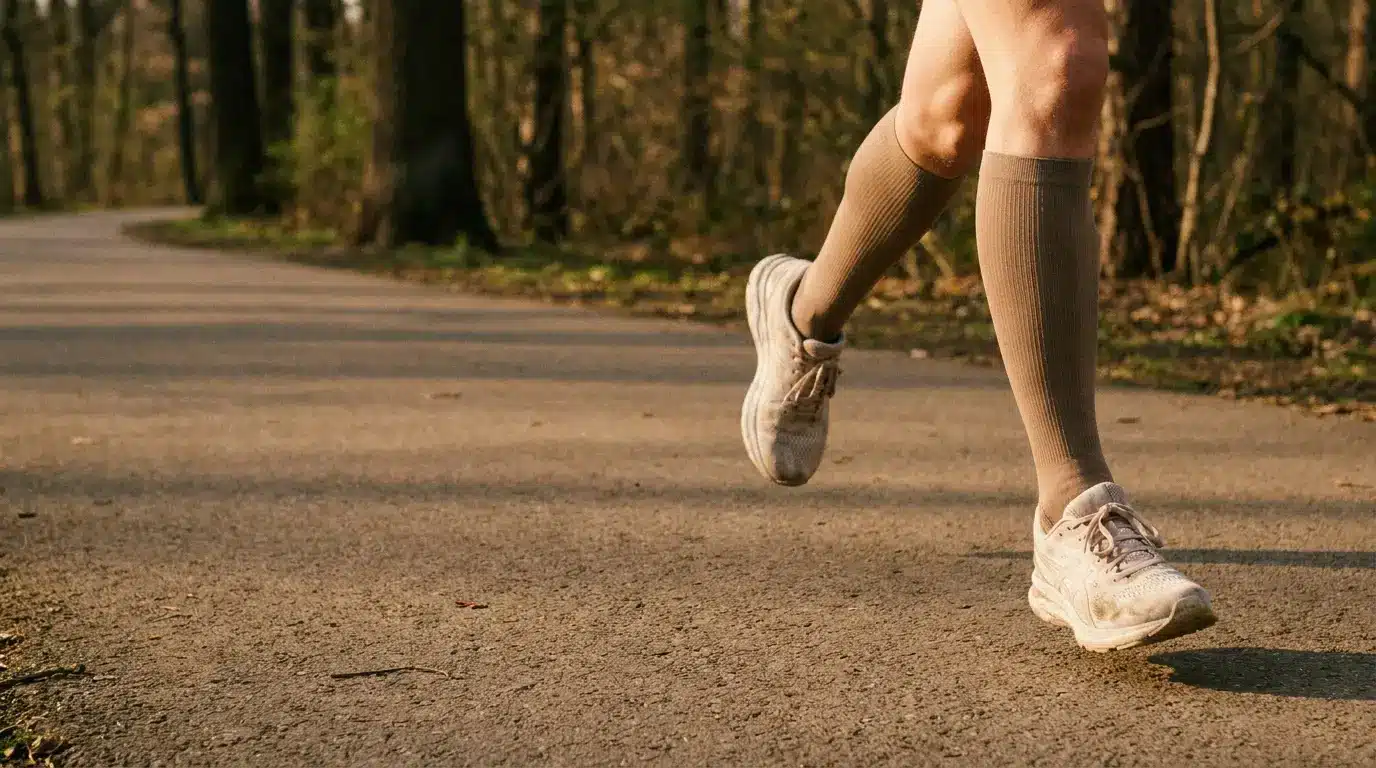
One easy misconception is that wearing compression socks gives you the same circulation benefits as being active.
It doesn’t.
Every time you walk, the muscles in your calves contract and help move blood through the veins of the lower leg.
This is one reason even short periods of movement throughout the day can be worthwhile.
You don’t necessarily need a formal hour-long prenatal workout. A morning walk, several short movement breaks during work and another walk later in the day can all contribute toward weekly activity.
Compression can complement that movement, particularly if your legs are uncomfortable, but it shouldn’t become a reason to remain sedentary for long periods.
What Level of Compression Should You Wear?
Compression socks aren’t all identical.
Some provide relatively gentle everyday compression while others are medical-grade garments designed to deliver considerably greater pressure.
Choosing the strongest pair available isn’t necessarily useful.
For general exercise and everyday comfort, many women use lighter or moderate graduated compression. If you’re experiencing significant swelling, have a vascular condition, have previously had a blood clot or have been specifically advised to use medical compression, the appropriate pressure should be discussed with your healthcare professional.
Pregnancy can also change your measurements over time.
A pair that fitted comfortably several months ago may feel very different later in pregnancy.
Follow the manufacturer’s measuring instructions rather than simply ordering your usual sock size. Compression garments are commonly sized using measurements around the ankle and calf rather than shoe size alone.
They should feel snug but shouldn’t cause pain, significant numbness, unusual tingling or changes in skin color.
They also shouldn’t repeatedly roll down and form a tight band around the calf.
Think About Heat and Fabric During Exercise
Compression socks add an extra layer to your workout clothing.
That becomes particularly noticeable during warmer weather or indoor workouts.
Breathable, moisture-managing fabrics can be much more comfortable than thick compression stockings designed primarily for clinical use.
Exercise during pregnancy already requires attention to hydration and overheating. Prolonged exercise in hot conditions should be avoided, and adequate fluid intake becomes especially important as exercise duration increases.
If compression makes you excessively hot or uncomfortable, there’s little value in forcing yourself to exercise in it.
The pre-workout snacks for maintaining energy provides a useful starting point, although pregnancy-specific dietary restrictions and nutritional advice should always take priority.
Use the Talk Test During Workouts
Pregnancy isn’t usually the ideal time to chase every previous personal best.
For moderate exercise, a simple test is whether you can still speak normally while moving. If you’re working so intensely that holding a conversation becomes difficult, your effort may have moved beyond moderate intensity.
Women who regularly participated in vigorous exercise before becoming pregnant may sometimes continue higher-intensity training during an uncomplicated pregnancy, but routines often need adjustment as pregnancy progresses.
Your compression socks don’t change those limits.
They may make your calves or ankles feel more supported, but they don’t prevent overheating, dehydration, balance changes or excessive exertion.
Know When Swelling Isn’t Simply Workout Discomfort
Some degree of swelling in both feet and ankles is common during pregnancy.
A sudden change deserves more attention.
Calf pain or swelling is specifically listed among the warning signs for stopping exercise during pregnancy. Chest pain, dizziness, unusual shortness of breath, vaginal bleeding and fluid leakage are also reasons to stop exercising and seek appropriate medical advice.
Pregnancy increases the risk of venous thromboembolism, so unusual one-sided leg symptoms need medical assessment.
Compression Can Simply Become Part of Maternity Activewear
There doesn’t have to be anything particularly clinical about wearing compression socks during pregnancy.
For an active woman, they can simply sit alongside supportive trainers, comfortable maternity leggings and a water bottle as another piece of workout clothing.
You might wear them for your morning walk, keep them on through a day that involves a lot of standing, or use them when your ankles tend to feel heavier toward the evening.
The goal isn’t to use compression to push through discomfort or maintain exactly the same workouts you were doing before pregnancy.
Pregnancy fitness works better when it adapts with you.
Keep moving when you can, adjust intensity when necessary and pay attention to what your body is telling you. If a comfortable, properly fitted pair of compression socks makes those walks and workouts feel a little easier on your legs, they can be a practical addition to an active pregnancy.