





One well-organized formation can make a huge difference in how a team plays on the field. It influences how a team attacks, defends, uses space, and supports teammates throughout a match.
As players move from 7v7 soccer formations to 9v9, they take on more tactical responsibilities, making positioning and teamwork more important than ever.
Choosing the right setup is not about finding a single perfect formation.
It is about selecting one that matches your players’ strengths, skill level, and style of play.
Understanding the benefits and limitations of different formations helps coaches and players make better decisions during both training sessions and competitive matches.
Why Is 9v9 Soccer Formation Important?
A good formation gives every player a clear role while helping the team stay balanced in both attack and defense.
In 9v9 soccer, the larger field and extra players create more tactical possibilities than smaller-sided games.
Coaches can build through the midfield, use wide areas more effectively, and organize defensive transitions with greater structure.
Instead of teaching players to memorize positions, coaches should help them understand spacing, movement, and teamwork.
This approach improves decision-making and prepares young players for 11v11 soccer as they continue to develop.
Quick Comparison of the Best 9v9 Soccer Formations
Each Formation offers a different balance between attack, defense, and midfield control. The table below provides a quick overview to help you compare the most popular 9v9 soccer formations before looking at each one in detail.
| Formation | Best for | Difficulty |
|---|---|---|
| 2-3-3 | Balanced attacking play | Easy |
| 3-2-3 | Defensive stability | Easy |
| 3-1-3-1 | Midfield control | Hard |
| 2-4-2 | Wide attacking play | Medium |
| 3-4-1 | Midfield dominance | Medium |
| 4-3-1 | Defensive organization | Medium |
| 4-2-2 | Counterattacking | Medium |
Different Types of 9v9 Soccer Formations
No single formation works for every team. Comparing different tactical setups makes it easier to find one that suits your players and coaching approach.
2-3-3 Formation
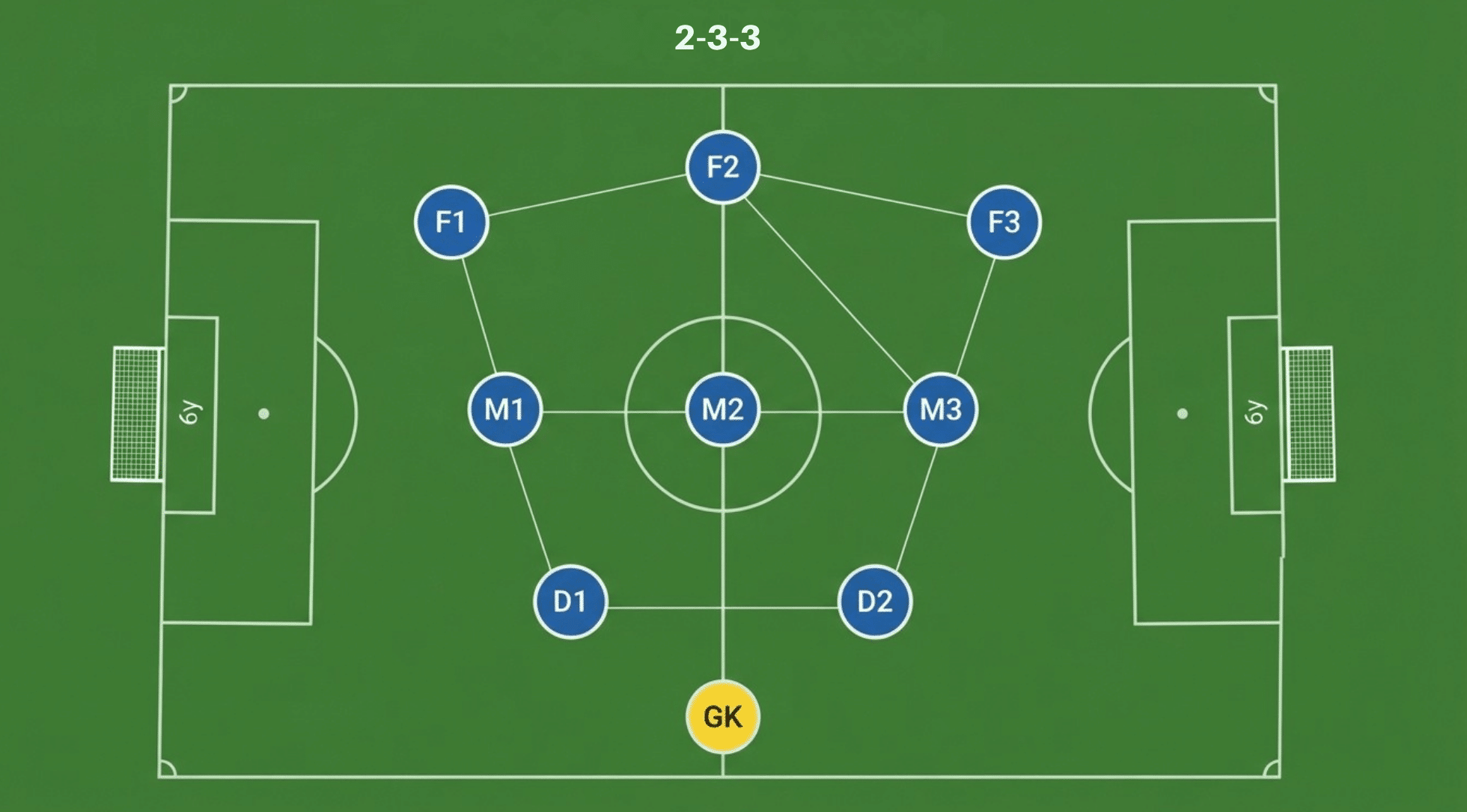

The 2-3-3 formation is one of the most popular 9v9 soccer formations because it provides a strong balance between attack and defense.
Two defenders stay compact at the back, three midfielders connect play across the field, and three attackers create width while stretching the opposition’s defense.
The extra forward gives teams more attacking options without sacrificing midfield support, making this formation a favorite for youth teams learning structured, possession-based soccer.
| Strengths | Weaknesses |
|---|---|
| Creates natural width in attack | Defenders can become exposed during quick counterattacks |
| Offers plenty of passing options | Wide attackers must help defensively |
| Supports balanced attacking and defending | Midfielders need to cover large areas of the field |
3-2-3 Formation

The 3-2-3 formation adds an extra defender, making it one of the safest systems for teams that want greater defensive stability.
Three defenders provide solid protection at the back, while two midfielders connect the defense and attack.
Three forwards stay high up the field to create scoring opportunities and stretch the opposing defense.
This formation allows teams to defend confidently while still offering dangerous attacking options.
| Strengths | Weaknesses |
|---|---|
| Creates natural width in attack | Defenders can become exposed during quick counterattacks |
| Offers plenty of passing options | Wide attackers must help defensively |
| Supports balanced attacking and defending | Requires midfielders to cover large areas |
3-1-3-1 Formation

The 3-1-3-1 formation adds a defensive midfielder in front of the back three, creating a strong link between defense and attack.
This holding midfielder helps win back possession, protects the defenders, and starts attacking moves from deeper positions.
Three advanced midfielders support the lone striker by creating passing options and making runs into the final third.
Teams that enjoy controlling the middle of the field often find this formation both flexible and effective.
| Strengths | Weaknesses |
|---|---|
| Strong protection for the back line | Relies heavily on a disciplined holding midfielder |
| Excellent control through central midfield | the striker can become isolated if midfielders do not push forward |
| Creates several passing options in attack | Requires good communication between midfield players |
2-4-2 Formation

The 2-4-2 formation is an attack-minded system that places four players across midfield to control possession and create width.
Two defenders stay back while the midfield supports both attack and defense. Two forwards work together to stretch the opposition’s defense and create more scoring opportunities.
This setup encourages quick passing, overlapping runs, and movement off the ball, making it a good choice for technically skilled teams.
| Strengths | Weaknesses |
|---|---|
| Strong midfield presence | Only two natural defenders |
| Excellent width in attack | Vulnerable to fast counterattacks |
| Two forwards create more scoring chances | Midfielders must recover quickly after losing possession |
3-4-1 Formation

The 3-4-1 formation places four midfielders across the center of the field, allowing teams to control possession while maintaining a solid defensive base.
Three defenders provide cover behind the midfield line, while a lone striker stays high to finish off attacks.
The extra midfielder makes it easier to switch play, retain possession, and support both attacking and defensive transitions.
This formation rewards teams that work well together and move the ball patiently.
| Strengths | Weaknesses |
|---|---|
| Excellent midfield controls | the lone striker may need additional support |
| Creates many passing options | Wide midfielders must contribute defensively |
| Helps maintain possession | Requires players to maintain good spacing |
4-3-1 Formation

The 4-3-1 formation is built around defensive organization and teamwork.
Four defenders create a solid back line that is difficult for opponents to break down, while three midfielders help control possession and support both ends of the field.
A lone striker leads the attack and relies on midfield runners for support.
Although this formation is more defensive than others, it allows teams to stay compact and launch controlled attacks when opportunities arise.
| Strengths | Weaknesses |
|---|---|
| Strong defensive stability | Can limit attacking numbers |
| Protects space in front of the goal | The striker may receive less support |
| Clear defensive responsibilities | Midfielders must contribute to both attack and defense |
4-2-2 Formation

The 4-2-2 formation combines a solid defensive foundation with quick attacking support.
Four defenders stay compact at the back, while two central midfielders help control possession and protect the defense.
Two attacking midfielders play behind the striker, creating chances through passing, movement, and late runs into the box.
This formation works well for teams that prefer quick transitions and direct attacks after winning the ball.
| Strengths | Weaknesses |
|---|---|
| Strong defensive structure | Limited natural width |
| Quick transitions into attack | Attacking midfielders must track back |
| Good support behind the striker | Requires disciplined positioning throughout the match |
Which 9v9 Soccer Formation Is Best?
No single formation is best for every team. The right choice depends on your players’ strengths, experience, and playing style.
Choose a formation that helps your squad stay organized and perform their roles with confidence.
| Goal | Recommended Formation |
|---|---|
| Balanced attacking play | 2-3-3 |
| Strong defensive shape | 4-3-1 |
| Midfield control | 3-1-3-1 |
| Wide attacking play | 2-4-2 |
| Counterattacking | 4-2-2 |
| Youth beginners | 2-3-3 |
| Strong opponents | 3-2-3 |
Tips for Choosing the Right Formation
The best Formation is one that fits your players, not one that looks good on paper. Consider your team’s strengths, experience, and playing style before deciding on a setup.
As players improve, you can adjust formations to match different opponents and game situations.
- Know your players: Build your Formation around your team’s strengths and skill level.
- Start simple: Use an easy formation first before introducing more advanced tactical systems.
- Adjust to the opponent: Change formations when facing stronger attacks or weaker defenses.
- Keep roles simple: Younger players perform better when responsibilities are easy to understand.
- Practice transitions: Train players to switch quickly between attacking and defending.
- Communicate constantly: Encourage players to talk and maintain their shape during matches.
- Review each game: Identify what worked well and make small tactical adjustments for future matches.
Signs Your Team Has Chosen the Right 9v9 Soccer Formation
A formation is working well when players understand their roles and the team stays organized throughout the match.
Good spacing, consistent passing options, and smooth transitions between attack and defense are all positive signs.
Players should feel confident moving into position without constant instructions from the coach, while the team should create scoring opportunities without leaving large defensive gaps.
If players frequently appear confused, lose their shape, or struggle to keep possession, it may be time to adjust the formation or spend more time practicing it.
Regularly reviewing team performance helps coaches identify what is working and where improvements are needed.
How to Transition from 7v7 Soccer Formations to 9v9 Soccer Formations?
Moving from 7v7 soccer formations to 9v9 soccer formations is an important step in a young player’s development.
Rather than learning a completely new style of play, players should build on the positioning, passing, and teamwork they developed in 7v7 while adapting to the larger field and additional responsibilities.
Coaches can make this transition easier by introducing new positions gradually, emphasizing team shape, encouraging constant communication, and practicing quick transitions after winning or losing possession.
Using small-sided drills and reviewing match performances also helps players improve their decision-making, positioning, and confidence in different tactical situations.
9v9 Soccer Formations vs 7v7 Soccer Formations
As teams move from 7v7 soccer formations to 9v9, the game becomes more tactical. The extra players and larger field require better positioning, teamwork, and understanding of space in both attack and defense.
| Feature | 7v7 Soccer Formations | 9v9 Soccer Formations |
|---|---|---|
| Players | 7 | 9 |
| Team shape | Simpler | More tactical |
| Midfield roles | Limited | More specialized |
| Width | Less | Great |
| Defensive organization | Basic | More structured |
| Passing options | Fewer | More combinations |
| Tactical flexibility | Lower | Higher |
Common Formation Mistakes to Avoid
Even a good formation can struggle if players are used incorrectly. Avoid these common mistakes to help your team stay organized and get the most from every formation.
- Choosing a Formation That Doesn’t Fit the Team: Build your tactics around your players’ ages, abilities, and strengths rather than copying professional teams.
- Changing Formations Too Often: Stick with one system long enough for players to understand their roles before making major tactical changes.
- Ignoring Defensive Shape: Teach players to recover their positions quickly so the team stays compact after losing possession.
- Overloading One Side of the Field: Use the full width of the pitch to make attacks less predictable and create more passing options.
- Giving Players Unclear Roles: Clearly explain each player’s responsibilities during training and matches to improve teamwork and decision-making.
- Forgetting About Transitions: Practice quick reactions after winning or losing the ball so players can switch smoothly between attack and defense.
Conclusion
The right 9v9 soccer formations help players stay organized, support one another, and play with greater confidence.
Regular practice and clear communication are just as important as the formation itself. Players who understand their roles can adapt more easily during different match situations.
As players progress from 7v7 soccer formations to 9v9, learning different tactical setups becomes an important part of their development.
Start with a formation that suits your squad, practice it consistently, and make small adjustments as your team grows.
A clear tactical plan and strong teamwork will always have a greater impact than simply choosing the most popular Formation.
Frequently Asked Questions
What Is the Best 9v9 Soccer Formation for Beginners?
The 2-3-3 formation is a great choice for beginners because it provides a balanced team shape, clear player roles, and good support in both attack and defense.
Which 9v9 Formation Is Best for Attacking?
The 3-3-1 and 3-1-3 formations are strong attacking options. They create multiple passing opportunities and support quick movement into the final third.
How Is 9v9 Different from 7v7 Soccer Formations?
9v9 uses two additional players and a larger field, making positioning, teamwork, and tactical awareness more important than in 7v7.
Should Teams Change Formations During a Match?
Yes, if the game situation changes. Coaches may adjust formations to defend a lead, improve possession, or create more attacking opportunities.
How Often Should Youth Teams Practice Formations?
Teams should practice formations regularly during training, so players become comfortable with positioning, movement, and transitions before using them in matches.