






Have you ever tried to picture how big an acre really is? Most people hear land measurements in acres, but those numbers can feel hard to imagine. That’s why football fields are often used for simple size comparisons.
I used to think a football field and one acre were exactly the same size until I looked at the real measurements side by side.
A standard football field covers about 1.32 acres when you include the end zones. Still, many people think it is exactly one acre, which leads to confusion.
You may also see different numbers online because some measurements leave out parts of the field.
This guide explains football field size, acre measurements, and how fields compare to other sports grounds and real-world spaces. And by the end, the football field size will be easier for you to picture.
Quick Answer: A full football field (including end zones) = 1.32 acres / 57,600 sq ft / 120 yards × 53.3 yards. Without end zones = approximately 1.1 acres.
How Many Acres Is a Football Field?
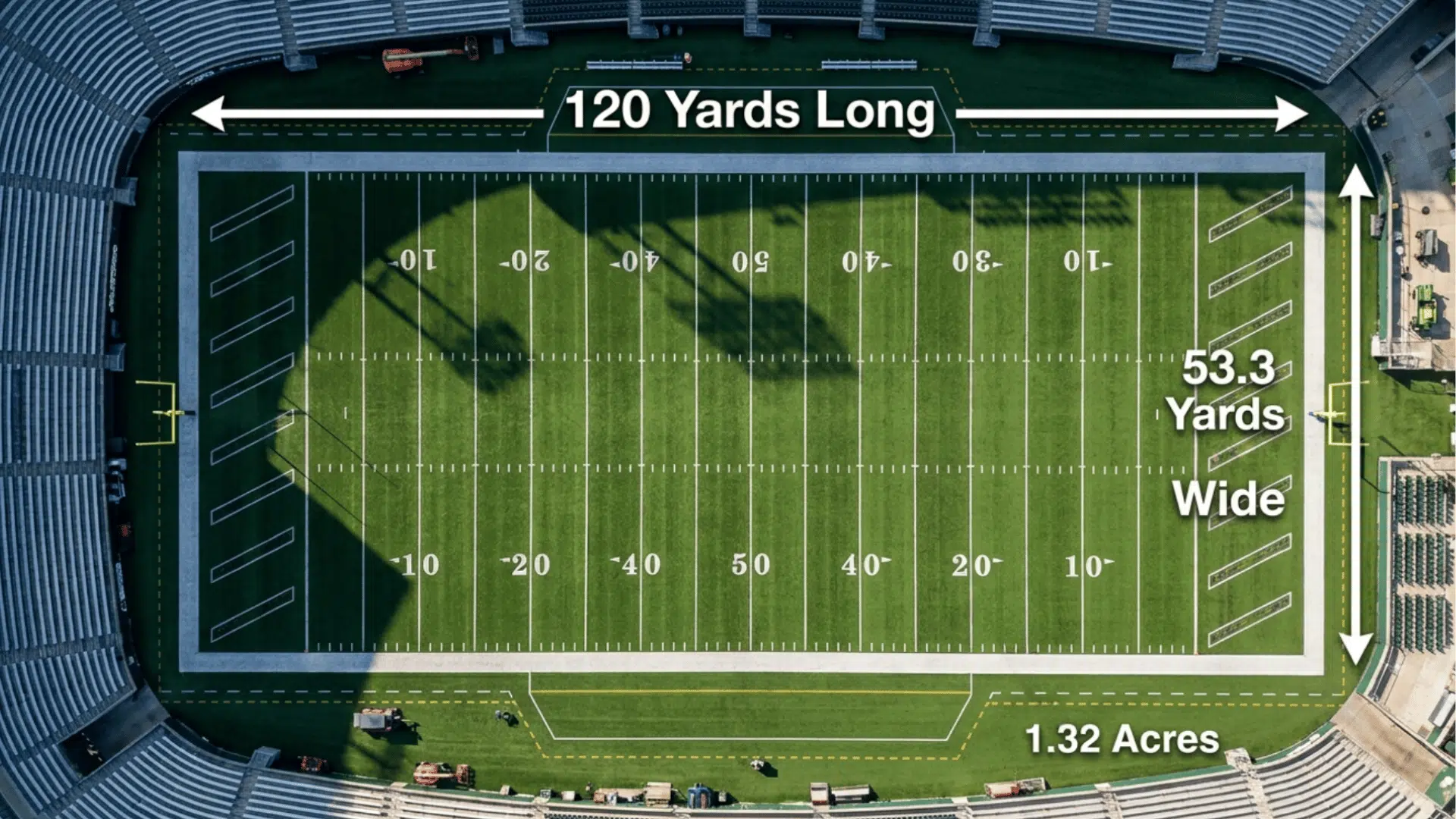
A standard American football field covers about 1.32 acres when the end zones are included. This is the official field size used in the NFL, college football, and most high school games.
The full field measures 120 yards long and 53.3 yards wide, which equals 57,600 square feet in total.
The total field size includes the 100-yard playing area, two 10-yard end zones, and the full official width of the field.
Many people use football fields as a simple way to picture large spaces because the size is familiar and easy to understand.
You may also notice that some websites mention a football field is about 1.1 acres. That number usually refers only to the main playing field without the end zones.
Once the end zones are added, the total size increases to around 1.32 acres. This is why different acre measurements sometimes appear online.
NFL, College, and High School: Do the Dimensions Change?
This is one of the most searched follow-up questions on this topic, and most competing articles skip it entirely.
The playing surface dimensions are the same across all three levels: 100 yards of playing field, two 10-yard end zones, and a width of 53 yards and 1 foot (roughly 53.3 yards).
What does change is the distance between the hash marks. NFL hash marks are 18 feet 6 inches apart.
College hash marks are 40 feet apart. High school hash marks are 53 feet 4 inches apart, nearly as wide as the field itself.
These differences do not affect total acreage, but they change how plays develop and how much field a quarterback has to work with on each side of the ball.
It is a detail that matters in sports coverage and is often missing from land-measurement explanations.
How Football Field Size Became Standard?
Football field dimensions have changed over time as the sport became more organized and professionally regulated. Standard field measurements help maintain fairness and consistency across every level of football.
- Early Football Fields: Football field sizes were not always standardized during the early years of the sport.
- Different Field Dimensions: In the late 1800s, teams often played on fields with varying dimensions, which sometimes led to confusion and unfair advantages during games.
- Growth of Organized Football: As football became more organized and popular across schools and professional leagues, officials realized the need for consistent field measurements.
- Need for Standard Rules: Standardized dimensions helped create fair competition, improve gameplay, and simplify rule enforcement for referees and teams alike.
- Addition of End Zones: In 1912, football officials added two 10-yard end zones to the original 100-yard playing area, creating the modern 120-yard football field.
- Modern Standard Layout: This layout quickly became the standard for the NFL, college football, and most high school football programs across the country.
Common Land Measurement Terms and Acre Conversions
Land measurements can seem confusing at first, especially when different units are used for homes, farms, sports fields, and large properties.
| Measurement Term | What It Means | Equal to Acres |
|---|---|---|
| Square feet | Used for homes, rooms, and smaller spaces | 43,560 sq ft = 1 acre |
| Acres | Common for land, farms, and large properties | Standard land measurement |
| Hectares | Metric land measurement is used in many countries | 1 hectare = 2.47 acres |
| Yards | Often used in sports field dimensions | 4,840 sq yd = 1 acre |
| Miles | Used for long distances and larger land areas | 1 square mile = 640 acres |
| Football field | Common size comparison for land | About 1.32 acres |
| Square meters | A metric unit commonly used worldwide for property size | 4,047 sq meters = 1 acre |
| Sections | Large land divisions often used in rural areas | 1 section = 640 acres |
Why Large Areas Are Measured in Football Fields?
Football fields are often used for size comparisons because most people already have a rough idea of how large one looks in real life.
Hearing that a wildfire burned “50 football fields” is easier to picture than hearing it covered dozens of acres.
You will often hear football field comparisons in news reports, wildfire updates, flood coverage, real estate listings, and stadium construction projects.
Reporters and property listings use this method because it gives people a quick visual idea of the area being discussed.
For example, saying a parking lot covers “two football fields” feels more relatable than listing only square footage or acreage numbers. Football field comparisons also work well because the field has a familiar shape and standard size.
Most people have seen a football game, school field, or stadium at some point, so the image is easy to picture.
Interesting Facts About Football Field Dimensions
Football fields may look simple, but they include many details that most people never notice. Their size, upkeep, and layout make them more interesting than many people expect.
- Goal Posts: Goal posts were once placed directly on the goal line in older football games. Today, they are positioned at the back of the end zone to improve player safety and gameplay.
- Turf Costs: Turf football fields can cost millions of dollars to maintain over time. Artificial turf also requires regular cleaning, repairs, and replacement every few years.
- Stadium Size: Some football stadium properties cover more than 50 acres, including parking and seating areas. Large stadium complexes often include training facilities, restaurants, and entertainment zones as well.
- Natural Grass: Natural football fields need thousands of square feet of grass to fully cover the surface. The grass must be carefully watered, fertilized, and trimmed to stay in playing condition.
- Field Maintenance: Grounds crews can spend several hours mowing and maintaining a football field. They also repaint field markings frequently to keep lines bright and clearly visible.
- Field Experience: Walking around the entire football field feels much longer in person than it looks on TV. The full length of a football field, including end zones, measures 120 yards in total.
What a Football Field Looks Like in Everyday Life?
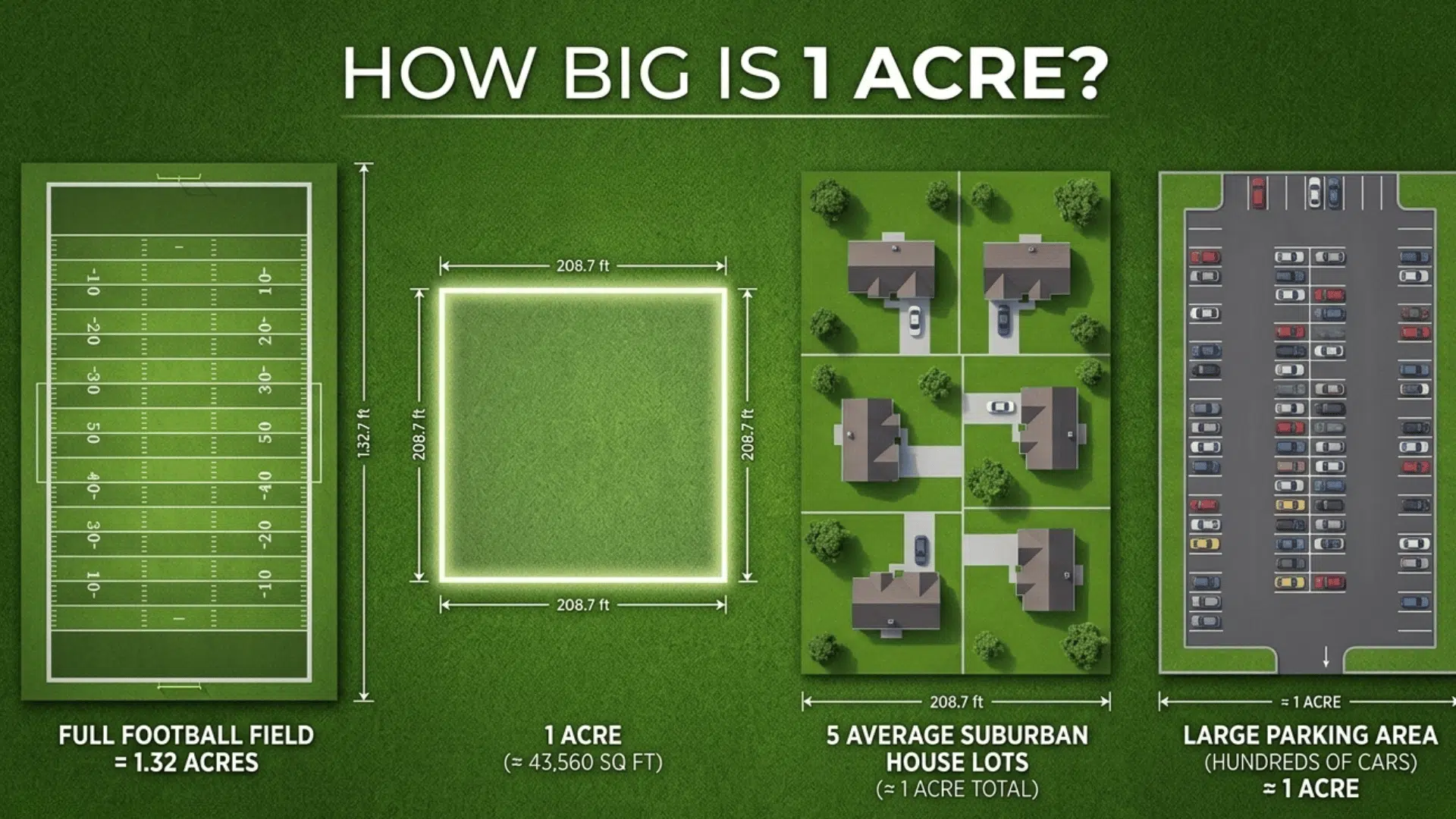
Comparing a football field to everyday places and objects makes it much easier to picture how large 1.32 acres really is.
Easy Size Comparisons
These simple comparisons help show how much space a football field actually covers. Many everyday places are smaller than a full football field without people realizing it.
- Basketball courts: About 13–14 basketball courts can fit inside one football field.
- Tennis courts: A football field is close to the size of 15 tennis courts.
- Average homes: Around 4–6 average-sized homes could fit in the same space.
- Parking spaces: More than 150 cars can fit on a football field.
The parking space comparison surprised me the most because most people would never guess a football field could hold more than 150 cars.
Real-Life Examples People Can Picture
Seeing a football field compared to common places makes the size easier to imagine. These examples give a more realistic picture of what 1.32 acres looks like.
- School playgrounds: Many school playgrounds are smaller than a full football field.
- Grocery store parking lots: Some medium-sized lots are about the size of a football field.
- Small farms: A football field covers enough land for a small farming area.
- Public parks: Neighborhood parks are often compared to football fields to show size.
Walking across a football field also helps people understand how large 1.32 acres really is. Most people can walk from one goal post to the other in about 1 to 2 minutes at a normal pace.
Comparing Football Fields to Other Sports Grounds
Different sports use different field sizes, and some are much larger or smaller than a football field. Comparing them side by side makes it easier to understand how much space a football field actually covers.
| Sports Field | Average Acres | Compared to a Football Field |
|---|---|---|
| Football | 1.32 acres | Standard size |
| Soccer | 1.5–2 acres | Usually larger |
| Rugby | 1.25–1.5 acres | Similar in size |
| Baseball | 2–3 acres | Larger because of the outfield |
| Cricket | 2.5–3 acres | Much larger |
| Hockey | Around 0.8 acres | Smaller |
| Basketball | Around 0.11 acres | Much smaller |
| Tennis | Around 0.15 acres | Much smaller |
Most Common Football Field Misunderstandings
Football field measurements can seem confusing because different sources use different ways to calculate the total area.
- One football field equals one acre: A full football field is actually larger than one acre and covers about 1.32 acres with end zones included.
- Forgetting the end zones: Some measurements only count the 100-yard playing area, which lowers the total acreage to about 1.1 acres.
- Mixing soccer and football field sizes: Soccer fields are usually larger than American football fields, so the acreage is not the same.
- Confusing stadium size with field size: The field itself is much smaller than the entire stadium property, which also includes seating, parking, and walkways.
- High school football fields are smaller: Most high school football fields follow the same standard dimensions as college and NFL fields.
- Different acre numbers online mean one source is wrong: Many websites use rounded numbers or different measuring methods, which is why acreage totals can vary slightly.
Why Soccer Fields Cover More Space than Football Fields?
Soccer fields are generally larger than football fields because the game requires more open space for continuous movement and player positioning.
Unlike football, which stops frequently between plays, soccer is played continuously across the entire field.
Players run longer distances, spread out more, and use wider passing lanes during the match.
Soccer field dimensions can also vary depending on the level of play, but many professional soccer fields are wider and longer than standard football fields.
This extra space helps support the fast-paced nature of the sport while giving players enough room for strategy, ball control, and teamwork. As a result, soccer fields usually cover more total acreage than traditional football fields.
International soccer organizations like FIFA provide recommended field size ranges for professional matches.
Conclusion
Before researching football field dimensions, I never realized how close a football field was to the size of an acre. At first, acre measurements felt confusing because large land sizes are hard to picture in real life.
Once I compared acres to football fields, parking lots, homes, and sports courts, the numbers started making much more sense.
A football field covers about 1.32 acres, making the land size easier to picture. A football field is one of the easiest ways to visualize acre measurements because it provides a familiar real-world size comparison.
Simple comparisons like these make large spaces feel more real, rather than just random numbers on paper.
The next time you hear someone mention acres or football-field comparisons, you will probably picture the size much more quickly.
Frequently Asked Questions
How Many Football Fields Make up 10 Acres?
10 acres equals about 7.5 football fields when using the full 1.32-acre football field measurement with end zones included in the total size calculation.
How Many Football Fields Fit Into a Square Mile?
One square mile equals 640 acres, which means around 485 standard football fields can fit inside a square mile using official football field dimensions.
How Many Football Fields Fit Inside Central Park?
Central Park covers about 843 acres, which is large enough to fit roughly 639 standard football fields with end zones included in the measurement.
Why Do Football Fields Look Smaller on TV?
Camera angles and stadium seating can make football fields appear smaller on television than they actually are in person.