
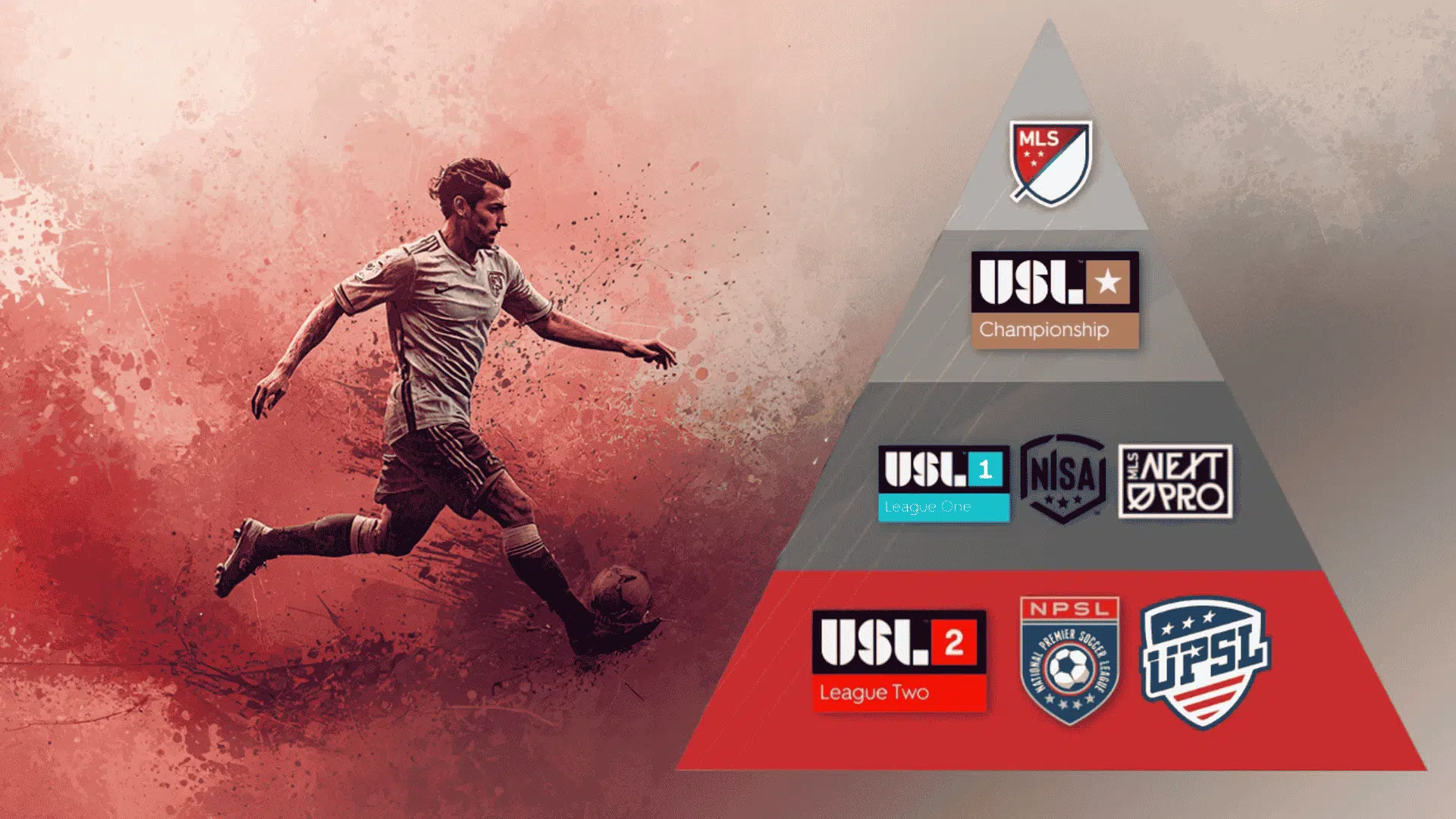



The US soccer pyramid is the framework that organizes every professional, amateur, and youth league in the United States into a clear hierarchy. At the top sits Major League Soccer.
Below it, multiple tiers of professional and semi-professional leagues run down to grassroots clubs.
Understanding how these levels connect helps you follow player careers, predict where rising talent goes next, and appreciate why the American system operates so differently from leagues in Europe or South America.
I’ve covered domestic soccer long enough to remember when most casual fans had no idea MLS had a second division, let alone five sanctioned tiers.
That’s changed fast. With the 2026 FIFA World Cup landing on US soil, interest in the full pyramid has spiked, not just the top league.
What Is the US Soccer Pyramid?
The US soccer pyramid shows how soccer leagues in the United States are organized. It places leagues in levels, starting with the highest professional leagues at the top and moving down to lower divisions and amateur teams.
Each level represents a different level of play, competition, and organization.
U.S. Soccer officially sanctions five division tiers for men’s professional leagues, plus additional levels for amateur and youth competition.
The pyramid is not a promotion-and-relegation system like in England’s football pyramid; teams do not automatically move between tiers based on results.
Instead, each tier has its own licensing standards, and clubs apply to operate at a given level.
That distinction shapes almost everything about how American soccer is structured.
How Does the US Soccer League System Work?
The US soccer league system is organized by U.S. Soccer, which is the official governing body of the sport in the country. U.S. Soccer assigns divisions to leagues and sets standards that leagues must follow to compete at each level.
These standards help keep the system structured and consistent. Teams compete within leagues grouped into division levels.
Each league runs its own season, schedule, and competition rules.
Leagues must meet licensing requirements related to finances, stadiums, and ownership to stay in their assigned division.
One thing that trips up new fans: U.S. Soccer sanctioning a league is different from U.S. Soccer running it. Sanctioning means the league meets the governing body’s standards for that tier.
The leagues themselves manage their own operations, contracts, and TV deals independently.
The US Open Cup, the oldest national soccer competition in the country, running since 1914, is one of the few events that cuts across all pyramid tiers, allowing amateur clubs to compete against MLS sides in the same bracket.
Top Professional Leagues in the US
At the top of the U.S. soccer pyramid are the professional leagues, which offer the highest level of competition and exposure.
Tier 1: Major League Soccer (MLS)
Major League Soccer is the top men’s professional league in the United States and Canada, sitting at the highest level of the U.S. soccer pyramid.
It launched in 1996 after the success of the 1994 FIFA World Cup and has continued to grow steadily over the years.
The league includes well-known clubs such as LAFC, Atlanta United, and New York Red Bulls, along with teams from many major cities.
MLS uses a franchise model, meaning clubs join through league expansion rather than promotion.
The league also participates in international competitions such as the CONCACAF Champions Cup, helping raise the level of play and global exposure.
Tier 2: USL Championship
The USL Championship is officially sanctioned as a Division II league by U.S. Soccer and sits directly below MLS in the U.S. soccer pyramid.
It features clubs from across the country and serves as a highly competitive professional environment.
The league plays an important role in player development, with many athletes using it as a step toward MLS or international leagues.
USL Championship teams also focus on building strong local fan bases, helping grow the sport in cities and communities outside the top-tier markets.
Tier 3: MLS NEXT Pro and NISA
These leagues operate at the third professional level of the U.S. soccer pyramid and play an important role in player growth and club development.
MLS NEXT Pro, launched in 2022, focuses on developing young players connected to MLS academies and reserve teams, helping bridge the gap between youth soccer and first-team play.
USL League One brings professional soccer to smaller markets, giving local communities access to high-level competition.
NISA operates as an independent league and has competed at the third-tier professional level, though its U.S. Soccer sanctioning status has changed over time
Lower Division and Amateur Soccer Leagues
Below the professional levels are semi-professional and amateur leagues that support player growth and community involvement. These teams compete at a strong level while operating outside full-time professional structures.
1. National Leagues
USL League Two is a pre-professional league for college players, offering a competitive summer season where many future MLS and USL players begin their careers.
The National Premier Soccer League (NPSL) focuses on community-driven clubs and supports both college and post-college players.
NISA Nation provides an amateur pathway for independent clubs looking to grow.
The United Premier Soccer League (UPSL) is one of the fastest-growing leagues, known for its wide reach and accessibility across regional divisions.
2. Regional and Local Leagues
Organized by the U.S. Adult Soccer Association (USASA), these leagues provide players with opportunities to remain competitive at the regional and state levels.
I have a friend who joined one of these local teams after college because he did not want to stop playing. He told me it gave him the same match-day excitement, just without the pressure of going pro.
The leagues vary in competition, ranging from highly competitive clubs to more casual, recreational teams.
They serve as a vital local bridge, keeping players involved in the sport and connected to their communities, whether they’re looking for a competitive challenge or simply enjoying the game with friends and neighbors.
3. Grassroots and Local Soccer
Many players begin their soccer journey through community clubs, which offer an easy and welcoming entry point into the sport. These local clubs help players learn basic skills, build confidence, and develop a love for the game.
Alongside community clubs, recreational leagues provide a more relaxed environment for players of all skill levels.
These leagues focus on fun, participation, and teamwork rather than strict competition.
They allow children and adults to enjoy soccer at their own pace while staying active, social, and connected to their local community.
4. Youth Soccer
U.S. Youth Soccer is the largest youth soccer organization in the country, offering a clear pathway for young players to develop their skills.
The Elite Clubs National League (ECNL) is a top-level league focused on developing elite talent.
MLS NEXT is another key part of the system, providing strong training and competition through MLS academies for future professional players.
Along with these programs, school teams and community initiatives help introduce children to soccer, keeping the sport accessible and open to players from all backgrounds.
How Does the U.S. Soccer System Differ from Others?
These differences shape how soccer is organized and developed in the United States. They explain why the system works differently in many countries around the world.
| Key Difference | Description |
|---|---|
| No Promotion and Relegation | In the U.S., teams don’t move up or down divisions based on performance. Instead, teams buy into leagues, focusing on financial stability and controlled growth. |
| Franchise and Expansion Model | Leagues like MLS and USL grow by awarding franchises to new cities and ownership groups, rather than promoting teams based on success. |
| College Soccer as a Pathway | College soccer plays a key role in player development in the U.S., unlike other countries, where academy systems dominate. |
| Growing Investment and Infrastructure | The U.S. soccer system is expanding rapidly with more academies, better stadiums, and youth programs. The 2026 World Cup will further drive investment and growth. |
Building a Better Pathway for Everyone in U.S. Soccer
The United States is at a key moment for soccer. With major global events like the 2026 FIFA World Cup, the LA 2028 Olympics, and the 2031 Women’s FIFA World Cup on the horizon, there is a chance to shape the future of the sport.
I have seen the shift myself. A few years ago, most of my friends barely followed domestic leagues.
Now they are asking about match schedules, youth academies, and how players move up the system. The interest feels different and bigger.
Interest is growing fast, and more people are paying attention to soccer at every level. This is the right time to build a system that truly supports players, parents, coaches, referees, and volunteers.
Across the U.S., millions of people give their time and energy to soccer each day. Youth programs, local clubs, and amateur leagues keep the game alive in communities.
Still, the system can feel confusing, costly, and hard to understand.
Creating clearer pathways can help make soccer more welcoming, affordable, and easier to follow for everyone involved.
Conclusion
The U.S. soccer pyramid may look different from systems in other countries, but that difference is what makes it worth understanding.
From top professional leagues like MLS to semi-pro, amateur, and grassroots levels, each part plays an important role in developing players and growing the sport nationwide.
This structure supports youth development, local communities, and long-term growth, even without promotion and relegation.
Whether you follow soccer closely or are just learning how the system works, knowing these layers makes the game easier to follow and more meaningful to watch.
Understanding the pyramid also helps explain how players progress and why each level matters.
What are your thoughts on the U.S. soccer system? Share your perspective in the comments below.
Frequently Asked Questions
Does the U.S. Soccer System Use Promotion and Relegation?
No, the U.S. system does not have promotion and relegation. Teams buy into leagues rather than move up or down based on performance.
What Are the Main Professional Leagues?
The top leagues are MLS, USL Championship, and MLS NEXT Pro, with USL League One and NISA also in the mix.
How Does College Soccer Fit In?
College soccer is a major path for player development, with many moving to professional leagues after college.
What Is the Role of Amateur Leagues?
Amateur leagues, like USL League Two and NPSL, give players a chance to develop and move up to higher levels.
What Is the Women’s Soccer Pyramid in the US?
The women’s pyramid is led by the NWSL in Division I. The USL Super League joined as Division II in 2024, with college and amateur leagues below it.