
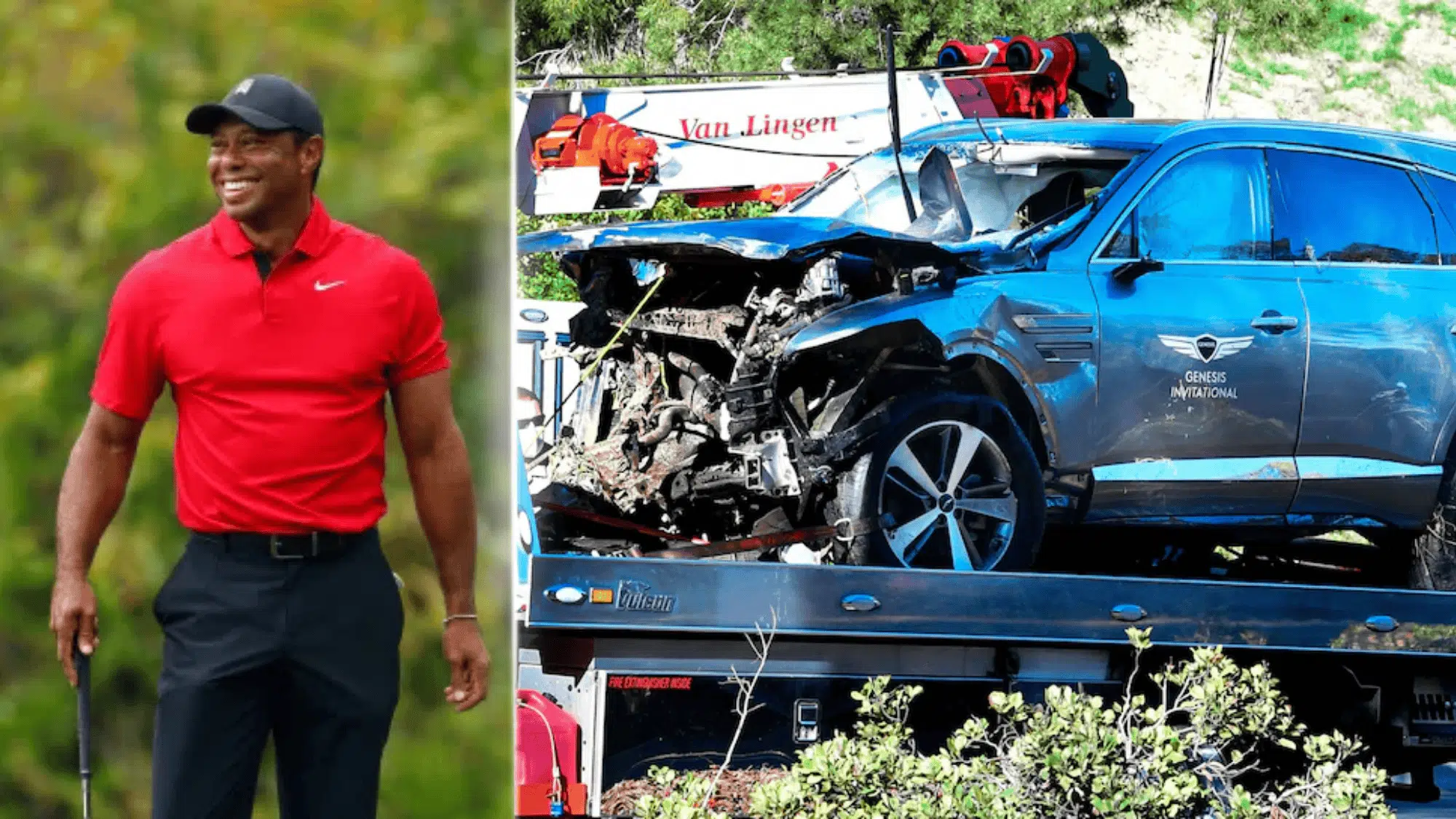




Tiger Woods is one of golf’s biggest legends, but his career has been shaped by serious injuries, especially to his right leg.
If you’ve ever wondered what really happened to Tiger’s leg, why he walks with a limp, or how he’s still playing golf after nearly losing his leg in a 2021 car crash, you’re in the right place.
This blog breaks down everything about the car accident that changed everything, the surgeries that saved his leg, his other injuries throughout his career, and whether he can make a full comeback.
Learn about Tiger’s injurious times.
Tiger Woods Car Crash
On February 23, 2021, Tiger Woods’ life changed forever. Early that morning, around 7:12 a.m., Tiger was driving a Genesis SUV when it crossed through two oncoming lanes, struck a curb, and uprooted a tree near Los Angeles.
The crash happened on a dangerous, curvy stretch of road in Rolling Hills Estates, California, a place known for accidents.
What Happened During the Crash
Here’s how the accident unfolded that morning:
| Crash Detail | What Happened |
|---|---|
| Speed | Tiger was traveling 84-87 mph in a 45 mph zone, nearly double the speed limit |
| Impact Speed | His vehicle hit the tree at about 75 mph |
| What the Car Hit | Center median, then a curb, then a tree |
| Rollover | The SUV flipped over multiple times before landing on its side |
| Tiger’s Condition | He was conscious but couldn’t remember the crash |
Investigators later found out that Woods did not brake before he crashed the car. The vehicle’s data recorder showed he may have accidentally hit the gas pedal instead of the brakes, a common mistake in panic situations.
The Devastating Leg Injuries

When rescue crews pulled Tiger from the wreckage, doctors quickly realized how serious his injuries were. Woods suffered open fractures affecting both the upper and lower portions of the tibia and fibula bones in his right leg.
In simple terms, both major bones in his lower leg were broken in multiple places, and the bones had actually broken through his skin.
Think of it like snapping a stick in several places; that’s what happened to Tiger’s leg bones. These weren’t clean breaks either.
They were what doctors call “comminuted fractures,” which means the bones shattered into multiple pieces.
Emergency Surgery to Save His Leg
Tiger was rushed to Harbor-UCLA Medical Center, where a team of trauma doctors performed emergency surgery that lasted hours. Here’s what they had to do:
The surgical procedures:
- Inserted a metal rod down the center of his tibia (shin bone) to hold it together
- Placed screws and pins in his foot and ankle bones to stabilize them
- Performed muscle surgery to relieve dangerous swelling that was building up in his leg
The muscle surgery was critical. When bones break badly, the surrounding muscles swell up fast. If doctors don’t release that pressure, the swelling can cut off blood flow and kill the muscle tissue.
Without that procedure, Tiger could have lost his leg.
The Amputation Risk
In November 2021, Tiger revealed something shocking during a press conference. Woods said it was “50-50” whether part of his leg might have been amputated.
For several hours after the crash, doctors weren’t sure if they could save his leg at all. Tiger stayed in the hospital for three full weeks, a long time that shows just how serious his injuries were.
He needed multiple follow-up procedures and was transferred to a second hospital, Cedars-Sinai Medical Center, for more specialized treatment on his leg.
How the Crash Changed Everything
The emotional impact hit Tiger hard. When he finally spoke publicly months later, he said he felt “lucky to be alive and also have a limb.”
For someone who had dominated golf for decades, suddenly facing the possibility of never walking normally again was devastating.
The career impact was immediate:
- Tiger couldn’t put weight on his leg for months
- He spent weeks in a wheelchair, then slowly graduated to crutches
- His golf career, which was already fragile from back problems, now faced its biggest challenge ever
- He had to accept that returning to full-time professional golf might never happen
The crash also affected Tiger mentally. He admitted later that his initial goal wasn’t about golf; it was simply about being able to walk outside again. For an athlete who had won 15 major championships, that’s a humbling reality.
Tiger Woods went from being one of golf’s greatest champions to someone fighting just to keep his leg.
The February 2021 crash didn’t just injure his body; it forced him to completely reimagine what the rest of his career and life would look like.
Timeline of Tiger Woods’ Major Leg, Knee, and Achilles Injuries
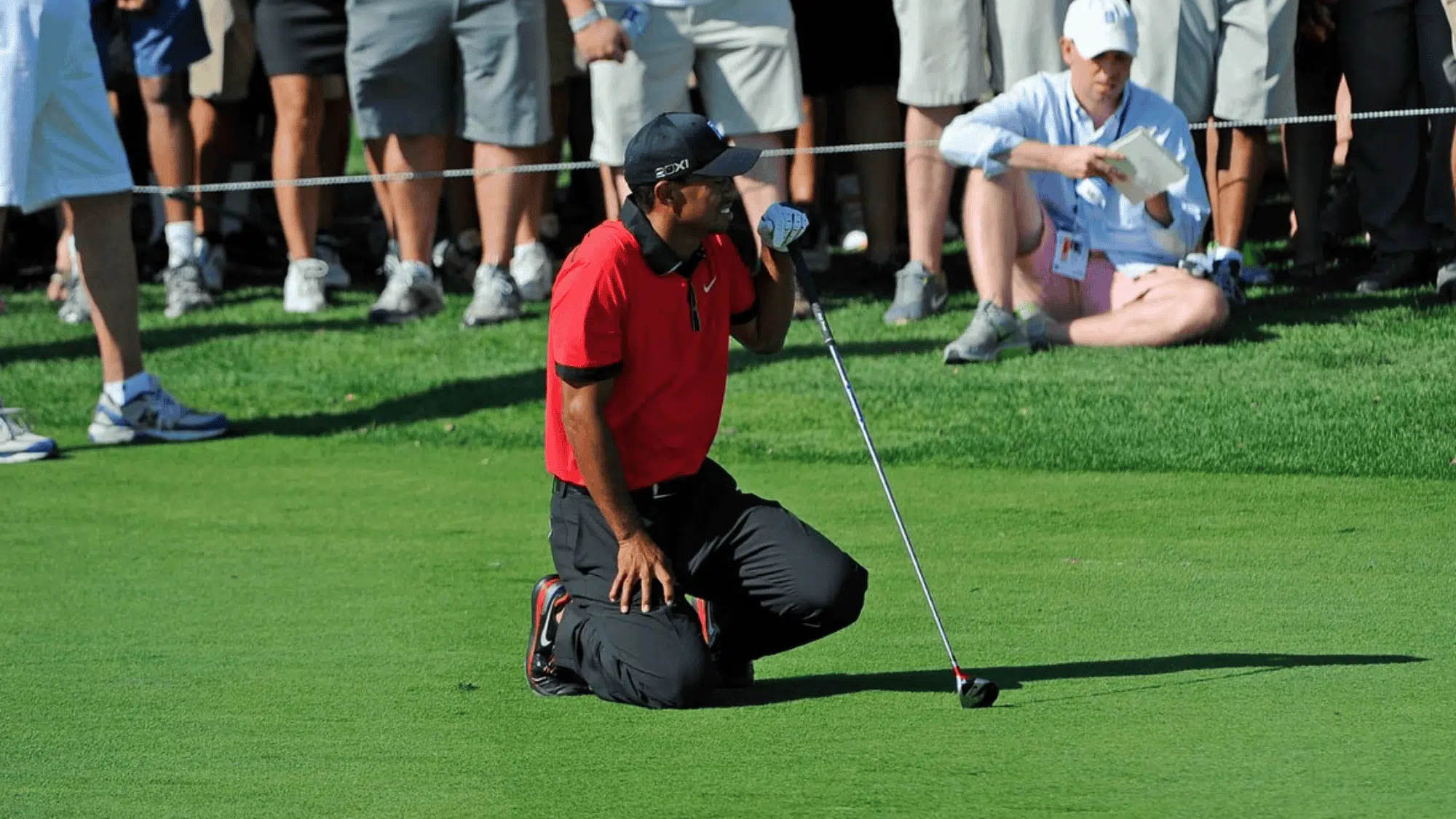
Tiger Woods’ leg problems didn’t start with the 2021 car crash. His lower body has been battling injuries for nearly two decades.
Understanding this timeline helps explain why his comeback has been so difficult, and why each new injury compounds the damage from old ones.
2007–2011: Early Knee and Achilles Problems
In July 2007, after the Open Championship, Tiger ruptured the ACL in his left knee while running on a golf course.
The ACL (anterior cruciate ligament) is like a strong rubber band that keeps your knee stable when you twist and turn. When it tears, your knee becomes unstable and painful.
Here’s what made Tiger’s decision shocking: instead of getting surgery right away, he kept playing. He won five of his next six tournaments, including the PGA Championship for his 13th major.
But playing with a torn ACL wasn’t just brave; it was slowly destroying his knee from the inside.
Why playing on a torn ACL is dangerous:
- Your knee can’t handle the twisting motion of a golf swing properly
- The cartilage (cushioning tissue) in your knee breaks down faster
- Other parts of your leg have to work harder to compensate
- You’re basically setting yourself up for more injuries down the road
The pain also spread to his Achilles tendons, the thick cords that connect your calf muscles to your heel bones.
Tiger revealed at the 2010 Masters that he tore his right Achilles tendon in 2008 and reinjured it several times in 2009, yet he continued competing. These injuries would haunt him for years.
2012–2019: Recurring Achilles and Knee Procedures
Tiger’s Achilles problems kept coming back like a bad dream. In April 2011, he suffered an MCL sprain in his left knee and a strain to his left Achilles tendon during the Masters.
Just a month later, he withdrew from The Players Championship after shooting 42 on nine holes, saying “everything started getting tight” in his knee, Achilles, and calf.
This pattern repeated throughout the decade:
- March 2012: Tightness in his left Achilles forced him to withdraw from a tournament
- Multiple years: Chronic Achilles inflammation that required constant treatment
- Ongoing issues: His left knee never fully recovered, leading to more compensating injuries
The 2019 Knee Procedure
In August 2019, after his Master’s comeback victory earlier that year, Tiger needed another procedure. Woods underwent arthroscopic surgery to repair minor ligament damage in his left knee.
Even though he called it “minor,” it showed that his knee still wasn’t right after all those years.
The bigger problem? All these left leg injuries were making Tiger change how he walked and swung the club. His right leg and back were working overtime to make up for his weak left side, a recipe for disaster.
2021–Present: Leg Trauma, Ankle Fusion, and Limited Schedule
Then came February 23, 2021. The single-car accident that shattered Tiger’s right leg made all his previous injuries look minor.
As covered earlier in this article, the crash left him with open fractures to his tibia and fibula, requiring emergency surgery with rods, screws, and pins.
For the first time, Tiger’s right leg, the one that had been compensating for his damaged left leg, was now worse than the left.
The 2023 Ankle Fusion Surgery
Two years after the crash, Tiger faced another major procedure. In April 2023, he underwent a subtalar fusion procedure to address post-traumatic arthritis from his previous talus fracture.
In simple terms, the bones in his ankle joint had developed severe arthritis from the crash injuries, causing constant pain.
What a Subtalar Fusion Means:
- Doctors permanently fuse two ankle bones together with screws
- The joint no longer moves, but the pain goes away
- Recovery requires 6-8 weeks without putting any weight on the foot
- The procedure carries a 90% success rate, but athletes lose some ankle mobility
Tiger later said his fused ankle was pain-free, but “the other areas that have been compensated for” were still causing problems. Once again, fixing one problem created stress on other parts of his leg.
Walking Limitations Today

Tiger’s playing schedule has become extremely limited. Since the 2021 crash, he’s played in just a handful of tournaments and rarely completes all four rounds. Walking 18 holes on hilly courses like Augusta National is brutally difficult for him.
Here’s what Tiger faces now:
- Limited ankle mobility affects his balance and swing
- He can’t walk long distances without pain
- Uneven lies and slopes are especially difficult
- His leg gets tired quickly, affecting his performance over four days
- He focuses mainly on major championships, not regular tour events
The timeline shows a painful truth: Tiger’s leg injuries built on top of each other for 18 years. Each surgery helped one problem, but created stress that led to the next injury.
His 2021 crash didn’t just damage his right leg; it was the final blow to a body that had been breaking down for nearly two decades.
Can Tiger Woods Fully Recover From His Leg Injury?
Tiger Woods has worked incredibly hard to recover from his leg injury, and he has already achieved more than many doctors once thought possible.
He can walk, practice, and compete at the highest level again. That alone shows how far his recovery has come. However, a full recovery does not mean his leg will ever feel the same as it did before the 2021 car crash.
Realistic expectations
- His right leg has metal rods, screws, and pins
- Ankle movement is limited due to fusion surgery
- Long tournament weeks cause swelling and pain
- Cold or uneven courses make walking harder
Because of this, his leg needs constant care, rest, and monitoring. Even on good days, pushing too hard can lead to setbacks.
A full-time PGA Tour return is difficult because professional golf is demanding. Walking 18 holes for four days in a row, especially on hilly courses, puts heavy stress on the injured leg.
Recovery time between events is also longer now, which makes weekly competition unrealistic.
Final Thoughts
Tiger Woods’ story shows what true toughness looks like. A right leg that suffered major damage in 2021 is now strong enough to handle practice, travel, and even tournament pressure.
But that doesn’t mean everything is back to normal. With rods, screws, and a fused ankle, the leg will always need extra care. That’s why a full PGA Tour schedule is unlikely, even if he feels good on certain weeks.
Still, Tiger can pick moments that matter most, major championships, special events, and appearances that protect his health while keeping his legacy alive.
Want more injury updates like this? Leave a comment or share this blog with a fellow golf fan.