
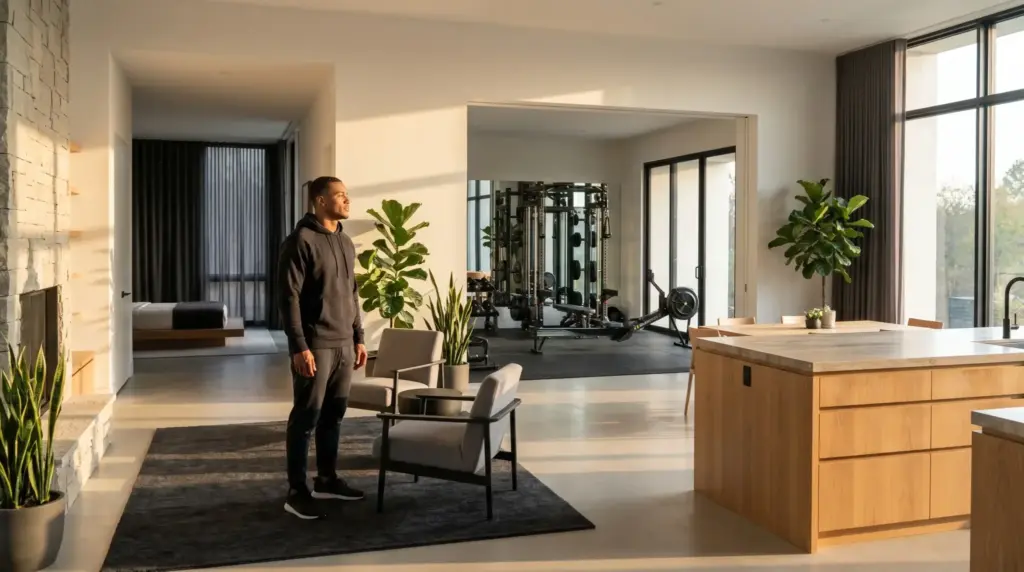



The performance gap between athletes competing at the highest level has never been smaller. In almost every professional sport, the margins that separate podium finishes from near-misses are measured in fractions — of a second, of a percentage point, of a degree. When talent and training volume are roughly equivalent, which at the elite level they usually are, the advantages that compound over a career tend to come from somewhere less obvious: sleep quality, cognitive recovery, the environment in which an athlete spends the hours they are not competing or training.
This is why the world’s best-performing athletes have become so deliberate about their living spaces. It is not aesthetic vanity. It is an extension of the same logic that governs every other performance variable in their lives.
Recovery Is Where Adaptation Happens
There is a persistent misconception in sports culture that the training session is where improvement occurs. It is not. Training is where the stimulus is applied. Improvement — the physiological adaptation that produces stronger muscles, faster reaction times, and greater endurance capacity — happens during recovery. Sleep, specifically deep sleep, is the most productive phase of that process.
Which means that the bedroom of a serious athlete is not simply a place to sleep. It is a recovery tool. And like any tool, its effectiveness depends on how well it is designed for its purpose.
The environmental factors most strongly associated with sleep quality are temperature, sound, and light. Of these, light is the most disruptive and the most commonly underestimated. The human circadian system is acutely sensitive to light exposure, particularly in the hour before sleep and the early morning hours. A bedroom that allows light to enter before an athlete is ready to wake — through inadequate window treatments, a gap at the edge of a curtain, the thin linen that looked good in the shop but offers almost no block — is a bedroom that is subtly but consistently undermining recovery.
Providers like Sedar Global, who specialise in curtains, blinds and window solutions, understand the functional side of this equation in a way that purely decorative approaches do not. The difference between a treatment that manages light properly and one that merely covers a window is the difference between a recovery environment and a room with curtains in it.
The Training Space at Home
For professional athletes, the home gym is no longer a modest row of dumbbells in a spare room. It is a specifically designed environment built around the demands of their discipline. A swimmer’s strength and conditioning setup looks nothing like a boxer’s. A tennis player’s mobility and reaction training space has different requirements from a cyclist’s. The thoughtfulness that goes into professional training facilities is increasingly being replicated at home, because home training removes the variables — commute time, facility availability, the energy cost of being around other people — that training centres cannot.
What this means in practice is that athletes are asking more of their domestic spaces than any previous generation did. A dedicated training room needs flooring that absorbs impact, lighting that can shift between high-intensity and recovery modes, ventilation that keeps the space usable in all seasons, and acoustic treatment that allows full focus without disturbing the rest of the household.
These are design requirements, not afterthoughts. And they sit alongside the same considerations that apply to the rest of the home: proportion, material quality, the relationship between spaces. The athlete who has invested in a performance-oriented bedroom and a well-designed training environment is applying the same systematic thinking to their living space that they apply to their sport.
What Offshore Sport Teaches About Performance Environments
Some of the most demanding performance environments in the world are found not on land but at sea. Offshore sailing, powerboat racing, and yacht-based sport ask athletes and their support teams to perform under conditions of constant physical instability, noise, weather variation, and spatial constraint. The vessels that support these campaigns — whether competing or supporting — have to enable peak performance while remaining liveable across extended periods.
The design intelligence required to solve that problem is considerable. Luxury yacht manufacturers like Gulf Craft, whose portfolio spans superyachts, catamarans, and performance vessels, build interiors that have to function under conditions that would disqualify most residential design solutions outright. Weight, structural integrity, the management of movement and noise, the provision of genuine comfort within tight spatial limits — every element has to work simultaneously and continuously. The interiors that result from that level of constraint-driven design thinking represent some of the most concentrated problem-solving in the built environment.
For athletes accustomed to thinking systematically about performance variables, there is something immediately legible about this approach. The logic is the same: understand the demands of the environment, design for those demands without compromise, and accept no element that does not contribute to function or genuine wellbeing. The aesthetic coherence that results is a consequence of that discipline, not a starting point.
The Mental Environment
Performance psychology has established clearly that cognitive state affects physical output. Anxiety, distraction, and environmental disorder all measurably degrade performance under pressure. The corollary — that deliberately designed environments can support focus, composure, and confidence — is less consistently acted upon, but equally well evidenced.
Elite athletes who have the means to design their environments from scratch tend to prioritise calm over stimulation. Clean visual fields, materials that absorb rather than reflect noise, lighting that can be modulated for different phases of the day, and spatial arrangements that create genuine separation between rest, work, and training. These are not luxury preferences. They are performance decisions.
The principle extends to colour, texture, and the quality of the materials an athlete encounters daily. There is a reason the best professional training facilities invest in their environments rather than simply providing equipment in a warehouse. Human attention and emotional state respond to physical context in ways that compound over time. A space that supports focus will, across a career, produce meaningfully different outcomes from one that merely tolerates it.
Designing for the Long Game
The athlete’s relationship with their body is inherently long-term. The training decisions made at twenty-two affect what the body can do at thirty-two. The recovery investments made consistently across a career determine not just peak performance but longevity within a sport. Most elite athletes understand this intuitively, which is why they accept short-term discomfort — early mornings, dietary discipline, load management — in service of long-term outcomes.
The same logic applies to their environments. A bedroom designed for genuine recovery, a training space built for the specific demands of a discipline, a living environment that supports mental clarity and genuine rest — these are investments that pay returns across the full arc of a career, not just in any given season.
The athletes most likely to maximise that return are the ones who apply to their environment the same systematic, evidence-informed thinking they apply to everything else. Not because a well-designed room will win a championship on its own. But because, in a sport decided by margins, nothing that can be optimised should be left to chance.