
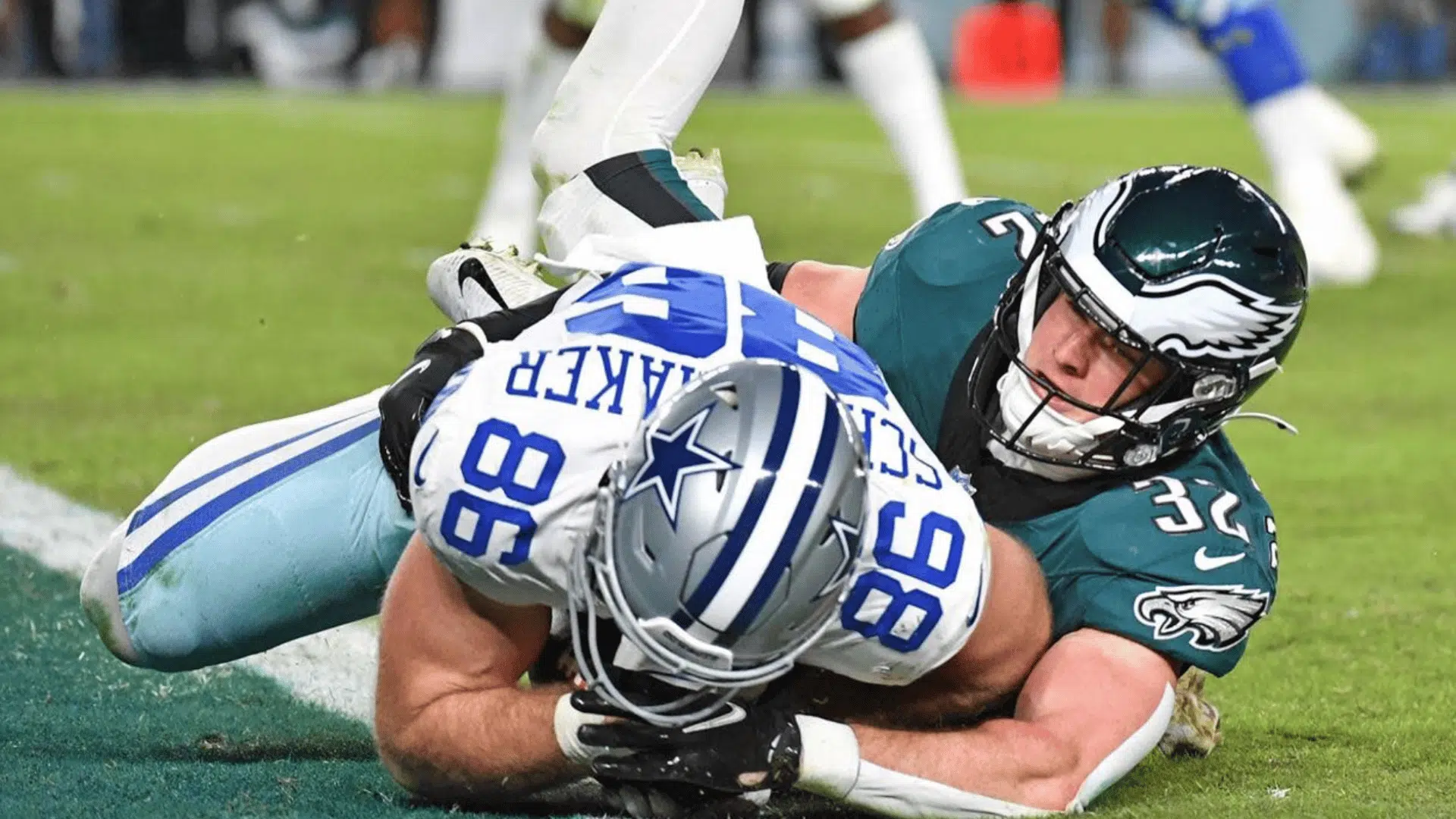



Football rules can be confusing, and illegal touching is one penalty that many fans struggle to understand.
You often hear it mentioned after catches, punts, or when a receiver steps out of bounds, but the call is not always easy to spot during a game.
In simple terms, illegal touching happens when a player who is not allowed to touch the ball becomes the first player to make contact with it.
The rule can apply in several situations, and the details differ slightly between the NFL and college football.
In this guide, I will explain how the rule works, common examples, and why it causes confusion for fans and players.
By the end, you will have a clear understanding of what illegal touching means and how the rule affects football games.
What Is Illegal Touching in Football?
Illegal touching is a football penalty called when an ineligible or out-of-bounds player becomes the first to touch the football.
The rule applies during forward passes and special teams plays. In short, certain players must stay eligible and stay in bounds before they can legally touch the ball.
The most common situation involves a receiver who steps out of bounds on his own and then returns to catch the pass first.
It also happens when an ineligible player, like an offensive lineman, touches a forward pass without being declared eligible before the snap.
Referees call this penalty to keep passing plays fair and prevent teams from gaining an advantage through illegal positioning or player movement.
The call sounds simple, but it gets complicated fast once you account for deflections, push-outs, and trick formations.
When Do Referees Call Illegal Touching?
Referees call illegal touching when a player illegally becomes the first person to touch the football during a play. The penalty usually happens during passes, punts, or sideline situations.
1. Receiver Steps out of Bounds
Illegal touching occurs when a receiver steps out of bounds on their own and returns to catch the football first.
Once a player voluntarily leaves the field, they cannot legally become the first to catch the pass after returning. Officials watch these plays closely near the sidelines during deep throws.
This is the scenario that generates the most debate in broadcast booths, because the step out is often barely visible without slow-motion replay.
Example: A receiver steps on the white sideline during a route, comes back in, and catches a touchdown pass that is later overturned for illegal touching.
2. Illegal Touching on Punts
Illegal touching can happen during punt plays when the kicking team touches the football before the receiving team makes contact. This rule protects the return team from losing possession unfairly after a bouncing punt.
Officials usually stop the play immediately after the illegal touch happens.
In practice, this call tends to occur when a coverage player is running downfield at full speed and cannot stop before reaching the rolling ball.
Example: A punt rolls near the goal line, and a coverage player accidentally touches the football before fully stopping his momentum, leading to an illegal touching call.
3. Offensive Lineman Catching the Ball
Offensive linemen are normally ineligible receivers because of their position before the snap. If a lineman catches or touches a forward pass without reporting as eligible, referees call illegal touching.
These plays often happen during tipped passes or broken plays under pressure.
The lineman does not have to intentionally catch the ball for the penalty to apply. Accidental possession still counts.
When covering games, I have seen this call come down to whether the referee judged that the lineman “possessed” the ball, even for a split second, before it hit the turf.
Example: A quarterback’s pass gets deflected at the line of scrimmage and lands directly in an offensive lineman’s hands for an illegal touching penalty.
4. Player Re-Entering the Field During a Play
A player who leaves the field voluntarily cannot return and become the first person touching the football. This rule usually appears near the sideline during scramble plays or deep routes.
Officials must decide whether the player stepped out on purpose or was forced out by contact. That judgment call is where the controversy lives.
The key distinction is intent, and it is nearly impossible to determine without multiple replay angles.
Example: A receiver loses balance near the sideline, steps outside the field, returns during the play, and catches a long pass before anyone else touches it.
5. Ineligible Player Touching a Deflected Pass
Illegal touching may still apply after a pass changes direction during the play. If an ineligible player becomes the first offensive player touching the deflected ball, referees can still throw the flag.
Many fans believe a tipped pass wipes out all eligibility restrictions. That is not correct under NFL rules.
The restriction on ineligible offensive players remains even after a deflection. I made that same mistake early in my coverage and had a rules editor correct me after filing a game story.
It is one of those rules that reads clearly in the rulebook but gets scrambled during live action.
Example: A pass bounces off a defender’s helmet and directly reaches an offensive guard, who catches it for an illegal touching penalty.
6. Goal Line Trick Play Example
Goal-line trick plays can also result in illegal-touch penalties when players line up incorrectly before the snap.
A player may appear eligible based on their jersey number, but their position in the formation can make them ineligible under the rules.
Officials closely check formations during short-yardage plays near the end zone, particularly on plays where the offense shifts or motions multiple players before the snap.
Example: A team runs a fake goal-line play, and an improperly lined-up receiver catches a touchdown pass that is later wiped out for illegal touching.
Illegal Touching vs Illegal Contact: Key Differences
Illegal touching and illegal contact are two different football penalties that involve player restrictions during a play. One focuses on who may touch the ball, while the other deals with unlawful physical contact between players.
| Aspect | Illegal Touching | Illegal Contact |
|---|---|---|
| Meaning | Ineligible player touches a forward pass | Defender makes unlawful contact with a receiver |
| Who Commits It | Usually offensive linemen | Defensive players |
| Timing | During or after the pass | Before the pass is thrown |
| Main Violation | Touching the ball illegally | Restricting or hitting a receiver illegally |
| Result | Penalty and possible loss of down | Defensive penalty and automatic first down |
| Common Example | A tackle catches a pass without reporting eligible | A cornerback pushes a receiver beyond 5 yards |
| Affects | Offensive team | Defensive team |
What Is the Penalty for Illegal Touching?
Illegal touching penalties vary by football level, but the NFL usually enforces a 5-yard penalty and loss of down for forward-pass violations.
- NFL: 5-yard penalty and loss of down if the shift is not corrected before the snap.
- College Football: Usually a 5-yard penalty for improper player movement before the snap.
- High School Football: Commonly enforced as a 5-yard penalty for illegal pre-snap movement.
- Punt situations: The receiving team can take possession at the spot of illegal touching
- Onside kicks/free kicks: The receiving team can take the ball where the kicking team illegally touched it before 10 yards
- Illegal participation cases: Some out-of-bounds return situations may result in a separate 15-yard illegal participation penalty instead of standard illegal touching
The loss-of-down element is what makes this penalty especially costly in the red zone. A team can be inches from the goal line and lose a down entirely because a lineman’s hands got involved on a tipped ball.
I have seen drives stall completely because of exactly that scenario in high-stakes games.
NFL vs. College Football: How the Rules Differ?
The NFL and NCAA handle illegal touching differently in a few key areas.
In the NFL, a player who is pushed out of bounds by a defender is not subject to the illegal touching penalty if they return to catch the ball.
The officials must confirm the push-out occurred. In college football, any player who goes out of bounds, regardless of cause, cannot return to be the first to touch a forward pass.
There is no push-out exception at the college level. This distinction catches fans off guard when they watch both leagues.
A catch that stands in an NFL game would be illegal touching on a college field for the exact same reason.
What Is a Reported Eligible Lineman?
Offensive linemen are ineligible receivers by default because of their position on the line of scrimmage. However, an offensive lineman can become eligible to catch a pass by reporting to the referee before the snap.
The lineman must verbally notify the head official, who then announces the change to the defense.
Once reported, the lineman is treated the same as any other eligible receiver for that play.
Teams use this tactic on goal-line plays, field-goal fakes, or fourth-down trick plays. If the lineman touches a forward pass without reporting, it is illegal touching.
If they reported correctly and are the first to touch the ball, the play is legal.
This is one of the more misunderstood mechanics in football, and it often causes confusion even when broadcasters try to explain it in real time.
Famous Illegal Touching Calls in NFL History
Illegal touching penalties have created several confusing moments in NFL history. Many of these plays became widely discussed because the violations were difficult to notice during live actions.
| Famous Illegal Touching Call | Team / Player | Detail |
|---|---|---|
| Tyler Lockett Sideline Review vs Rams | Seahawks vs Rams | Lockett was reviewed for stepping out before making a catch. |
| Patriots Punt Touching Mistake | New England Patriots | A Patriots player touched the punt too early near the goal line. |
| Leon Lett Thanksgiving Game vs Dolphins | Cowboys vs Dolphins | Leon Lett touched a blocked punt, helping Miami win the game. |
| Saints Onside Kick Touching Violation | New Orleans Saints | Officials reviewed an early touch on an onside kick. |
| Offensive Lineman Deflected Pass Penalties | Multiple NFL Teams | Ineligible linemen caught tipped passes and drew penalties. |
| Sideline Re-Entry Touchdown Reversals | Multiple NFL Receivers | Receivers stepped out and returned to catch passes illegally. |
Why the NFL Has Never Changed the Illegal Touching Rule?
The NFL has retained the illegal-touching rule to maintain fairness and control during passing plays. The rule prevents ineligible players from gaining an unfair advantage by catching passes.
League officials believe the rule is important for keeping player positions organized and making the game easier for referees to manage.
Offensive linemen are mainly responsible for blocking, while eligible receivers are designated to catch passes.
Without the rule, offenses could use confusing formations that would make defensive coverage much harder.
Although the NFL has updated many passing rules over the years, illegal touching has remained mostly unchanged because it protects the balance between offense and defense.
The league also sees the rule as important for maintaining order, safety, and competitive integrity during fast-moving plays.
What Reddit and Football Fans Say About Illegal Touching?
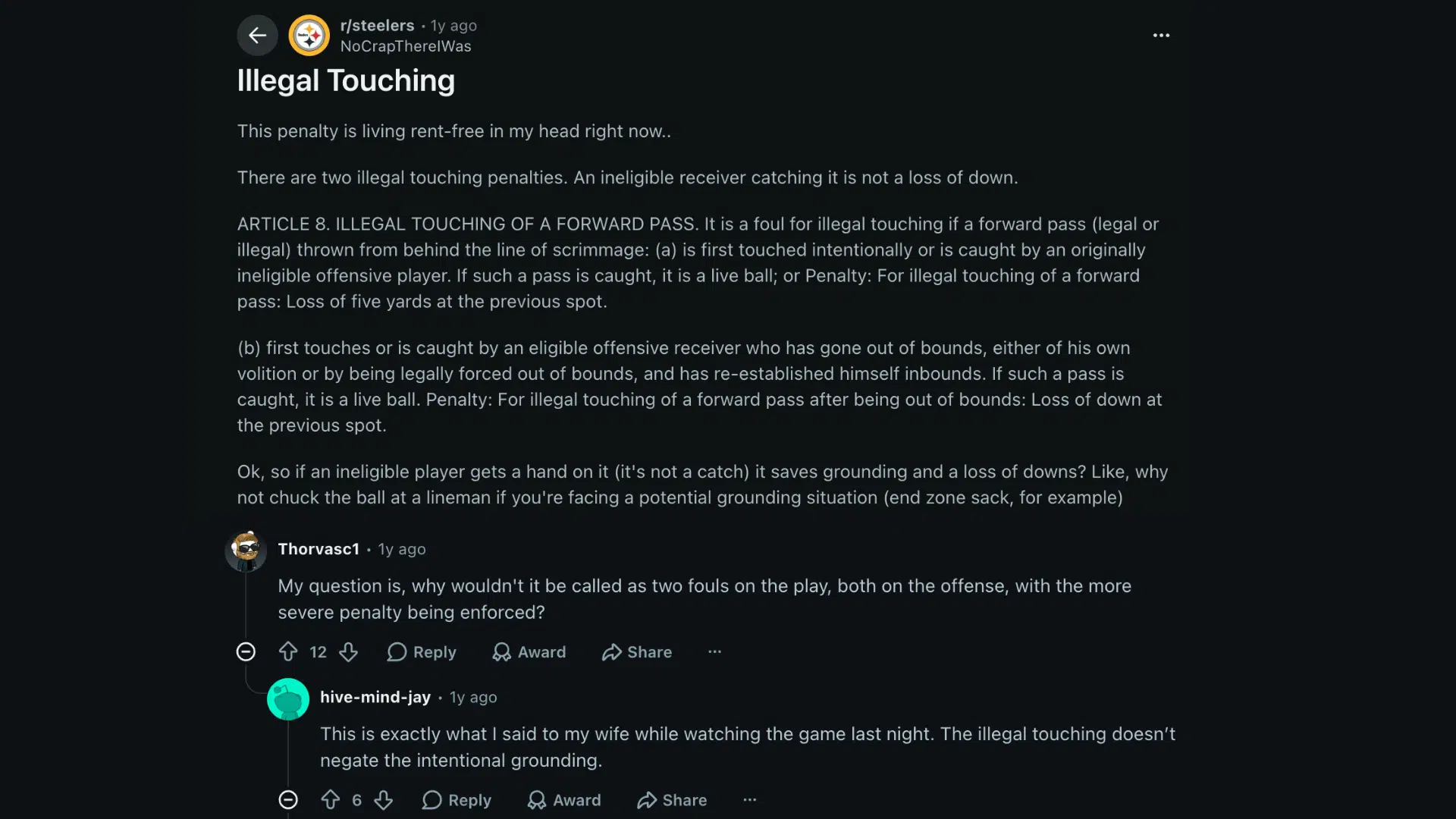
Football fans on Reddit often call illegal touching one of the most confusing NFL penalties.
Most discussions happen after controversial sideline catches, punts, or tipped passes, where viewers struggle to understand why officials threw the flag.
Many fans debate sideline plays where receivers barely step out of bounds before returning to catch the football.
Others question why offensive linemen still get penalized after accidentally catching deflected passes during broken plays.
Punt plays also confuse fans because many do not know why the kicking team cannot touch the ball first.
Replay reviews create even more debate, as illegal touching violations are often difficult to detect during live broadcasts. This is one of those penalties that feels confusing in real time.
Some Reddit users said the NFL should use clearer replay angles and slow-motion clips to help fans understand illegal-touching calls.
Why the Illegal Touching Rule Exists?
The illegal touching rule helps keep football fair by controlling who can legally touch the ball during passing and special teams plays.
- Keeps Passing Plays Fair: The rule prevents teams from gaining unfair advantages by allowing only eligible players to catch or touch forward passes.
- Stops Illegal Player Positioning: Players cannot step out of bounds and return to the play freely, helping maintain proper sideline and boundary rules.
- Controls Eligible and Ineligible Receivers: Referees use the rule to determine which players can legally receive passes based on formation and positioning before the snap.
- Protects Teams During Special Teams Plays: The rule stops the kicking team from illegally touching punts or onside kicks before the receiving team.
- Reduces Confusion During Trick Plays: Illegal-touching rules help prevent deceptive formations that feature hidden or ineligible receivers near the goal line.
Who Is Eligible to Catch a Pass in Football?
In football, only certain players are allowed to catch or touch a forward pass during a play. The rule depends on the player’s position, jersey number, and where they line up before the snap.
| Player Type | Eligible? | Can Catch Pass? | Why |
|---|---|---|---|
| Wide Receiver | Eligible | Yes | Lines up in a legal receiving spot. |
| Tight End | Eligible | Yes | Can catch passes when lined up correctly. |
| Running Back | Eligible | Yes | Usually lines up behind the line and can receive passes. |
| Offensive Tackle | Ineligible | No | Linemen cannot catch passes unless reported eligible. |
| Offensive Guard | Ineligible | No | Guards are blocking players and cannot receive passes. |
| Reported Eligible Lineman | Eligible | Yes | A lineman can catch passes after reporting to the referee. |
| Center | Ineligible | No | The center is normally not allowed to catch forward passes. |
| Quarterback | Eligible | Yes | Can catch a pass if they become an eligible receiver during the play. |
How Replay Review Has Changed Illegal Touching Calls?
Replay review has changed how officials handle illegal touching calls in football. In the past, referees had to make quick decisions during live action, which often led to missed penalties or confusion about who touched the ball first.
Today, replay cameras help officials slow down the play and check every detail.
They can review a player’s feet, body position, and the exact moment the football was touched.
This is especially helpful during close sideline catches, punts, and tipped passes. In the National Football League, replay review has helped correct several illegal touching mistakes during important games.
Fans still debate some calls, but replay has reduced many obvious mistakes and helped explain difficult rules to viewers.
Television broadcasts now show multiple camera angles and slow-motion clips, making it easier for fans to understand why officials called illegal touching on a play.
Conclusion
Illegal touching may seem like a small football penalty, but it can completely change the outcome of a game.
One call can erase touchdowns, shift field position, stop drives, or change momentum during important moments.
From receivers stepping out of bounds to ineligible players catching passes, the rule exists to keep football fair and organized for both teams.
That is why these calls create so much debate among NFL and college football fans.
Understanding illegal touching makes football easier to follow, especially during confusing sideline catches, punts, and trick plays.
The next time referees throw the flag, you will better understand what happened and why the penalty was enforced.
Frequently Asked Questions
Can Defensive Players Commit Illegal Touching?
Defensive players normally do not commit illegal touching. The penalty usually applies to offensive players or the kicking team during passes, punts, and special teams situations in football.
Can a Receiver Step out of Bounds if Pushed?
Yes, a receiver can return and catch the football if a defender forces them out of bounds. Officials review contact carefully before calling illegal touching on sideline plays.
What Happens if Both Teams Touch the Punt?
If both teams touch the punt, possession usually depends on who controls the football at the end of the play. Illegal touching rules no longer apply after the receiving team touches it first.
What Is the Difference Between Illegal Touching and Illegal Formation?
Illegal touching happens when an ineligible or out-of-bounds player touches the ball first. Illegal formation happens when players line up incorrectly before the snap.