
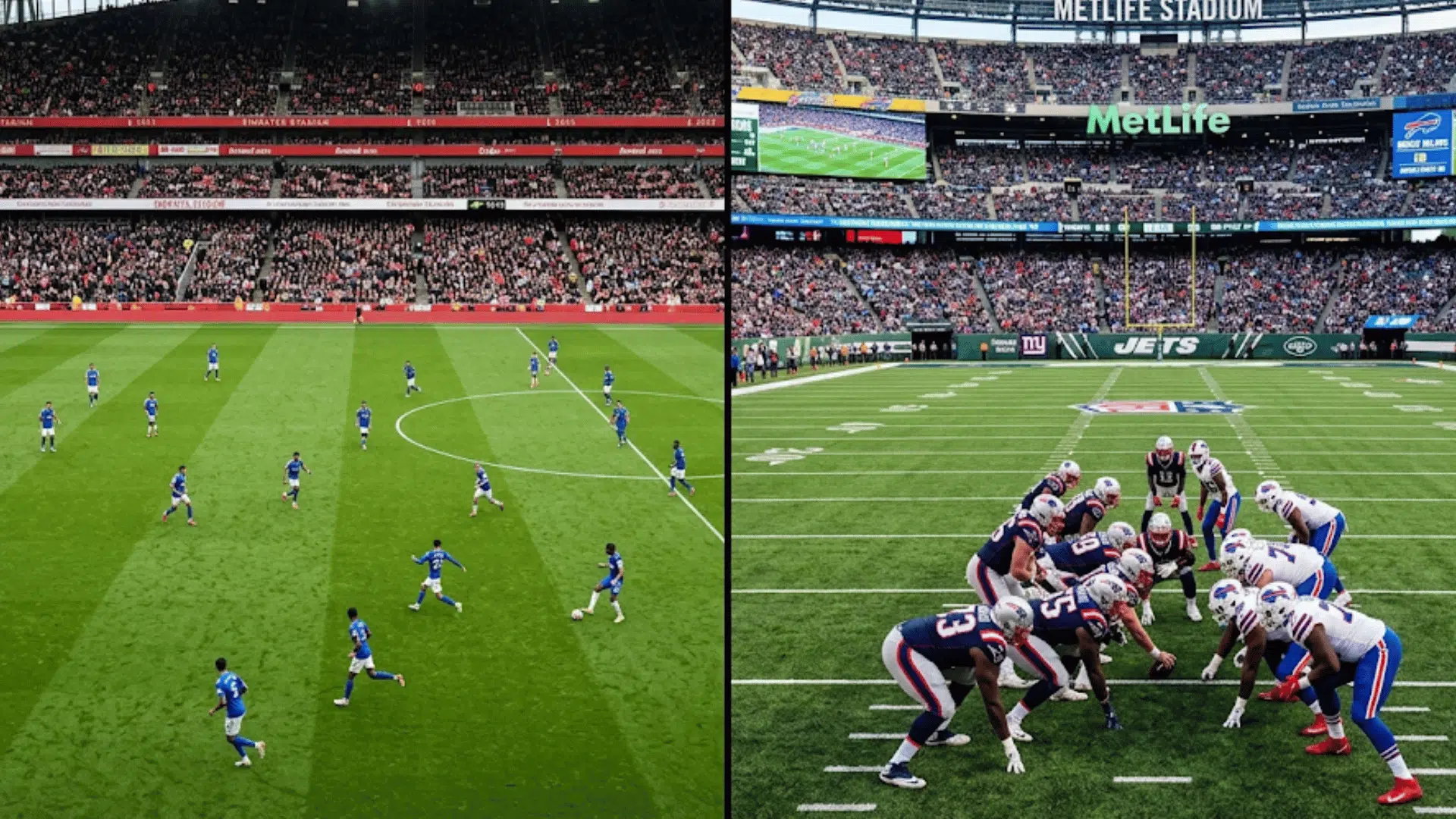





Most people never stop to think about how much space their favorite sport actually needs. A basketball court feels huge when you’re on it, but place it next to a soccer pitch, and it disappears.
Field size shapes everything: how far players run, how physical the game gets, and which strategies actually work.
While most of that comes down to how each sport is designed to be played, the soccer and football field differences in markings, goals, and surface all play into why each game needs the space it uses.
This blog will break down how different sports fields compare in size, why those dimensions matter, and how they shape the way each game is played.
How Field Size Is Measured Across Sports
The simplest way to compare fields is by total playing area, length multiplied by width, usually expressed in acres or square yards.
The tricky part is that not every sport uses a rectangle. Cricket uses an oval. Australian Rules Football uses an oval, too. Soccer allows flexible dimensions.
Only a few sports, like American football, lock in exact measurements every single time.
To make fair comparisons, most analysts use the maximum allowed dimensions or the typical professional size for each sport.
Biggest Fields in Sport Ranked
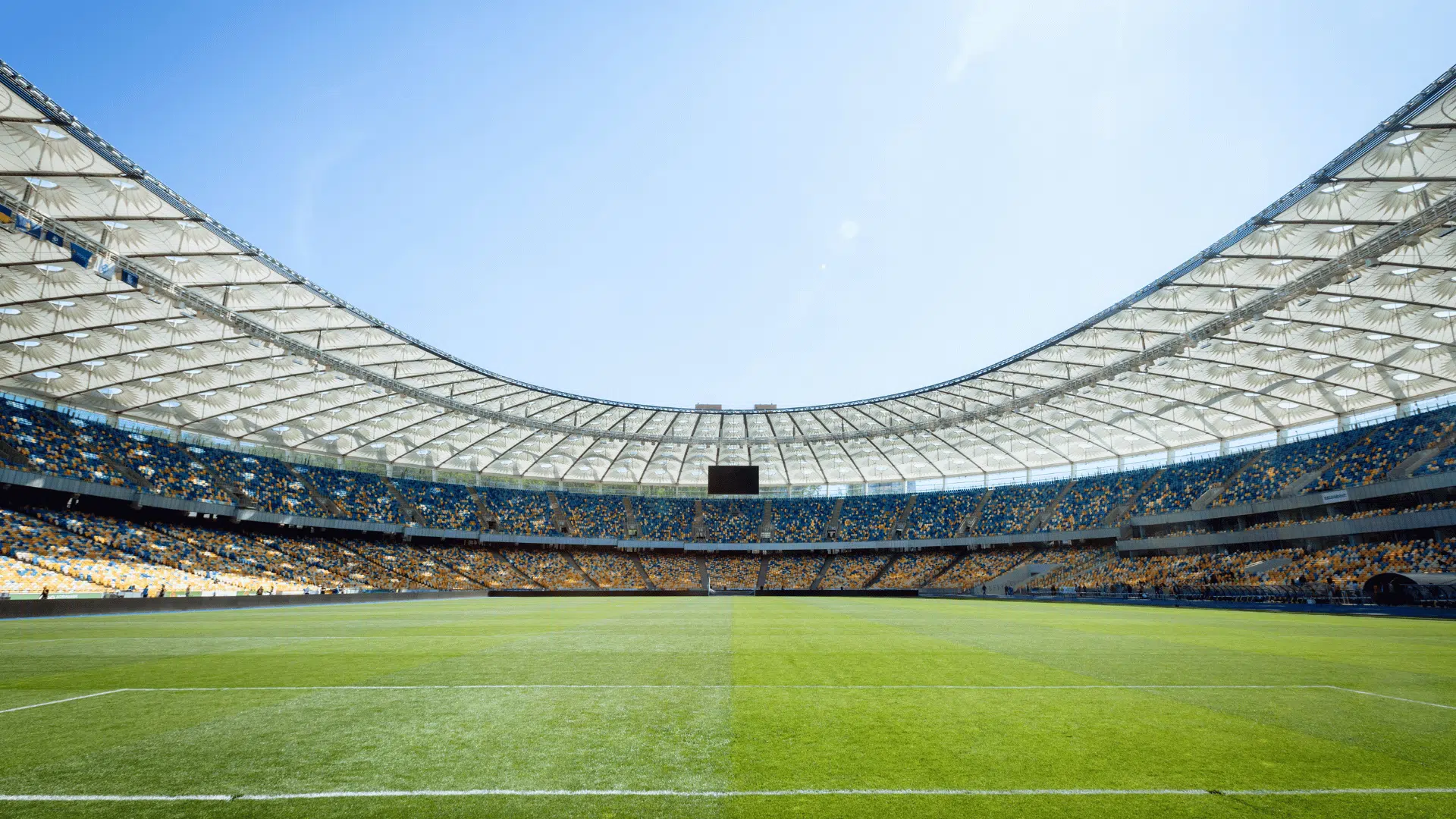
Sports fields vary widely in size, shaping how each game feels, how players move, and how much ground they must cover during every full, intense match.
1. Cricket
Cricket fields are oval-shaped with no fixed dimensions, which makes them one of the hardest to pin down. The playing area can stretch up to 180 yards at its longest point.
The outfield alone covers more ground than most full soccer pitches, and boundary ropes are often used just to shrink the effective playing area to something manageable.
2. Australian Rules Football
Aussie Rules is played on a massive oval that can run up to 185 yards long and 155 yards wide.
That makes it one of the largest standardized playing surfaces in any team sport.
Players cover extraordinary distances per game — often 12 to 15 kilometers — largely because of how much open space the field creates.
3. Soccer
Soccer fields range from 100 to 130 yards long and 50 to 100 yards wide, with most professional pitches sitting around 115 x 75 yards.
That works out to roughly 1.6 to 2.4 acres of playing surface. The flexibility in dimensions is unique to soccer and means no two stadiums are guaranteed to offer the same experience.
4. Rugby
A rugby field measures 100 meters long and up to 70 meters wide, plus in-goal areas at each end.
It sits close to a standard soccer pitch in terms of total area, but feels different in use because the action tends to be concentrated near the breakdown zones.
5. American Football
Football fields are fixed at 120 yards long and 53.3 yards wide, every single one, from high school to the NFL.
At about 1.32 acres, it is the smallest major field sport by playing area. That narrowness is intentional, concentrating action and collisions into a tighter corridor.
| Sport | Typical Length | Typical Width | Approx. Area |
|---|---|---|---|
| Cricket | Up to 180 yards (diameter) | Oval | 3.0+ acres |
| Aussie Rules Football | Up to 185 yards | Up to 155 yards | 4.0+ acres |
| Soccer | 100–130 yards | 50–100 yards | 1.6–2.4 acres |
| Rugby | 109 yards | 76 yards | 1.9 acres |
| American Football | 120 yards | 53.3 yards | 1.32 acres |
Why does Field Size Matter?
Field size is not just a number on paper. It directly shapes how the game is played and how hard it is on the players. Larger fields demand more endurance; soccer and Aussie Rules players regularly cover 7 to 10 miles per game.
Smaller, narrower fields like those in football concentrate players into tighter spaces, leading to more direct collisions and less open running. Field size also drives strategy. A wide soccer pitch opens up wing play and lateral passing.
A narrow football field pushes teams to fight for every yard in a straight line. The space available changes everything from formation choices to substitution patterns.
Soccer vs Football: The Size Gap Explained
Side by side, a professional soccer pitch can be nearly twice the total area of an American football field. A typical MLS pitch runs 115 x 75 yards — that is 8,625 square yards of playing surface.
A football field covers 6,360 square yards. That difference is not accidental. Soccer needs width for wingers to operate and length for through balls and counterattacks. Football’s design keeps everything compact and collision-heavy compared to other sports.
Interestingly, some of the largest soccer-only stadiums in the US were built with wider-than-average pitches specifically to give their teams a tactical edge at home, stretching opposing defenses that were not used to that kind of space.
Does Field Size Change at Different Levels?
Yes, significantly. Youth soccer fields are much smaller, scaled to the age group playing on them. A field for under-8 players might only be 25 x 20 yards.
High school soccer fields are usually shorter and narrower than pro dimensions.
Football fields are consistent in size across high school, college, and the NFL, all measuring 120 x 53.3 yards. However, slight differences in hash mark spacing at each level significantly impact play-calling.
Fun Facts About Field Sizes
Field sizes are not just numbers; they come with surprising details that highlight how different each sport is and how much space they truly use.
- A standard soccer pitch can fit roughly one and a half American football fields inside it
- The Maracana in Brazil originally had a running track around the field, making the pitch smaller than modern FIFA standards
- Some MLS stadiums differ by more than 15 yards in field length from each other, which is longer than a full first down in football
- The largest cricket grounds have outfields so big that a soccer match could technically be played inside the boundary rope
Wrapping Up
Cricket, Australian rules football, and soccer take the crown for sheer size, but soccer is the largest of the mainstream global sports in terms of field dimensions.
American football sits at the bottom of that list by design; its narrow, fixed field is built for a completely different kind of game.
Size is not about which sport is better. It is about what each game needs to work the way it does.
Which sport’s field surprised you the most? Drop your thoughts in the comments below and share this with a sports fan who would never guess the answer.