
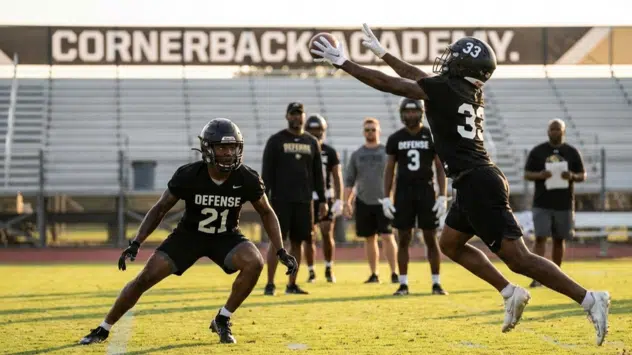



A cornerback (CB) is a defensive back who lines up on the outside of the defense and covers wide receivers.
Their main job is to break up passes, make tackles, and create turnovers when possible, using man or zone coverage depending on the play call.
Because cornerbacks often match up against the fastest receivers on the field, the position demands speed, awareness, quick reactions, and strong coverage technique.
Here, I’ll explain what a cornerback does on each play, the coverage techniques and skills the position requires, and the different types of corners.
What is a Cornerback in Football?
Cornerbacks, often called “corners” or “CBs,” are part of the secondary along with the safeties. Cornerbacks have several critical responsibilities during each play.
Their first job is to cover wide receivers and prevent them from catching the ball using various techniques to stay close and break up passes.
They also tackle receivers who catch the ball, limiting the yards they gain after the catch. When they see an opportunity, cornerbacks try to intercept passes thrown by the quarterback.
Many corners also help defend against running plays, especially when runs come to the outside of the field.
Cornerbacks typically line up on the outside edges of the defensive formation, directly across from wide receivers. Most defenses use two cornerbacks on the left and right sides.
Cornerback Coverage Techniques

Man-to-man coverage requires shadowing one receiver wherever he goes, while zone coverage means defending a specific area of the field and picking up any receiver who enters it.
Press Coverage: The corner lines up nose to nose with the receiver and jams him at the snap to throw off the timing of the route. NFL rules only allow that contact within five yards of the line of scrimmage.
Off Coverage: The corner starts several yards back, giving the receiver a cushion so he can read the route and break on the ball.
Bail Technique: The corner shows press before the snap, then turns and retreats at an angle to protect against the deep throw.
In Cover 2 defense, outside corners are usually responsible for containment, keeping receivers and ball carriers from getting between them and the sideline while two safeties handle the deep part of the field.
What are the Skills Every Cornerback Needs?
To succeed at the cornerback position, players must master several physical and mental skills that set great corners apart from good ones.
Speed and Agility: Cornerbacks need elite speed to keep up with fast wide receivers, but reaction time and technique decide how often that speed actually shows up in coverage.
Backpedal and Hip Turn: A corner starts most plays facing the receiver, so he has to backpedal smoothly and flip his hips to run with the route without losing a step.
Tackling Ability: Solid tackling skills keep receivers from gaining extra yards, since missed tackles often lead to long touchdown runs.
Different Types of Cornerbacks in Football
Different cornerback positions require specific skill sets, and teams use various types of corners based on the situation and formation.
Cornerback Type | Where They Play | Main Role | Key Skills |
|---|---|---|---|
Outside Cornerback | Near the sidelines, opposite outside receivers | Cover outside receivers on deep and short routes | Speed, coverage skills, and ball tracking |
Slot Cornerback (Nickel Corner) | Inside, opposite slot receivers | Cover quick routes and help stop runs | Quick feet, agility, and strong tackling |
Dime Cornerback | Alignment varies in a six-defensive-back formation | Provide extra pass coverage, often on passing downs | Coverage awareness, quick reactions, and versatility |
How Cornerbacks Impact Game Outcomes?
A single cornerback can completely change how an offense approaches a game. When one corner can handle the opponent’s top receiver alone, the offense becomes one-dimensional and predictable.
Cornerbacks who can win one-on-one matchups allow their team’s defense to send extra pass rushers or double-cover other receivers.
One interception returned for a touchdown can swing momentum and decide close games. The best cornerbacks also set the tone physically, making receivers think twice about going over the middle.
Conversely, weak cornerback play forces defenses to provide extra help in coverage, which limits their ability to pressure the quarterback or stop the run.
Famous Cornerbacks in NFL History
Darrelle Revis was so dominant in man coverage that his side of the field became known as “Revis Island.” Charles Woodson was the first primarily defensive player to win the Heisman Trophy, at Michigan in 1997.
Mel Blount played so physically that the NFL introduced the 1978 “Mel Blount Rule“, the five-yard contact limit still in effect today.
Here are more of them:
Player | NFL Years | Career INTs | Pro Bowls | Super Bowl Wins | Hall of Fame |
|---|---|---|---|---|---|
Deion Sanders | 1989–2005 | 53 | 8 | 2 | 2011 |
Rod Woodson | 1987–2003 | 71 | 11 | 1 | 2009 |
Darrelle Revis | 2007–2017 | 29 | 7 | 1 | 2023 |
Charles Woodson | 1998–2015 | 65 | 9 | 1 | 2021 |
Champ Bailey | 1999–2013 | 52 | 12 | 0 | 2019 |
Night Train Lane | 1952–1965 | 68 | 7 | 0 | 1974 |
Mel Blount | 1970–1983 | 57 | 5 | 4 | 1989 |
Darrell Green | 1983–2002 | 54 | 7 | 2 | 2008 |
Ty Law | 1995–2009 | 53 | 5 | 3 | 2019 |
Mike Haynes | 1976–1989 | 46 | 9 | 1 | 1997 |
Source: Career stats from Pro-Football-Reference; Hall of Fame years from the Pro Football Hall of Fame.
Final Thoughts
The cornerback position requires a special combination of speed, skill, and mental toughness that few athletes possess. These defensive players face the challenge of covering the NFL’s fastest and most talented receivers on every snap.
The greatest cornerbacks of all time, from Deion Sanders to Ty Law, proved that elite corner play can define championship teams.
Want to learn more about NFL positions? Check out our guides to what a safety does and how nickel and dime defenses work.
Frequently Asked Questions
What Number Does a Cornerback Usually Wear?
NFL cornerbacks can wear jersey numbers from 0–49, although many still choose single-digit numbers or numbers in the 20s.
Why Is It Called a Cornerback?
The name comes from where the player lines up. Cornerbacks start at the outside corners of the defensive formation and are part of the defensive backfield.
Is Cornerback Harder than Wide Receiver?
Both positions are difficult in different ways. Cornerbacks must react to routes without knowing where the receiver is going, while receivers know the planned route before the snap.


