





Volleyball is easy to enjoy, but the first time I watched a match, the language felt like a different sport.
I kept hearing calls and cues that meant nothing until a coach explained them simply.
Since then, covering games has shown me how much the right terms change what you see: a “free ball” isn’t just a send-over, and a “rotation” isn’t just players moving around.
Knowing volleyball terms helps you understand what’s happening on the court and why athletes choose certain moves.
It also makes practice, coaching, and teamwork smoother because everyone is speaking the same language.
In this guide, I shared some of the most common volleyball terms in clear, simple words.
These are made for beginners, casual fans, and anyone who wants to get better, focusing on the terms you will often hear during games, practice sessions, and live play.
Important Volleyball Terms

Volleyball has many terms that players, coaches, and fans use during every match. Below are the most important volleyball terms you will hear regularly on the court and in daily play.
1. Serve
A serve starts every rally in volleyball and gives one team the first chance to score. The server stands behind the end line and sends the ball over the net into the opponent’s court.
A strong serve can limit the other team’s options right away.
Players use different styles, such as underhand, overhand, float, and jump serves.
Each type has its own purpose. Serving with control and power can lead to direct points or weak returns that make the next play easier to finish.
2. Ace
The ball may land untouched or be mishandled, showing strong serving skill and smart placement.
Servers often target weak passers or empty areas on the court. Timing, accuracy, and confidence all play a part.
Once, I saw a player serving during a tight set at 24–23. She noticed the passer leaning forward, aimed deep to the back corner, and delivered a perfect serve that landed untouched for an ace, sealing the set.
A well-placed serve can shift momentum and energize the team while putting pressure on the receiving side during crucial match moments.
3. Spike
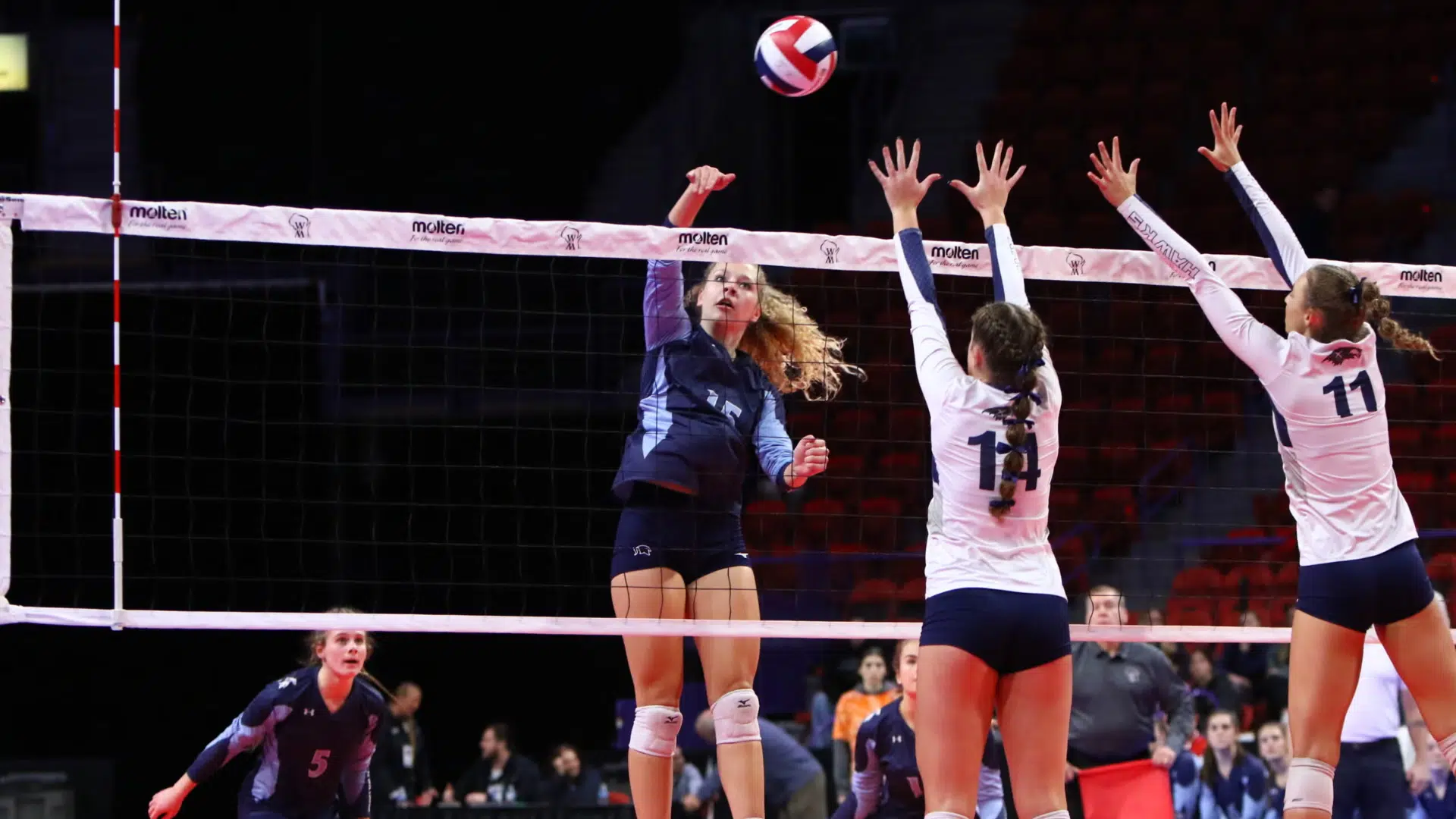
A spike is a forceful attacking hit meant to send the ball sharply into the opponent’s court.
It usually follows a pass and a set, making it the third contact in a rally. The hitter jumps high, swings their arm fast, and aims for open space. Spikes are key scoring moves in volleyball.
Power and timing are important, but control matters too.
A well-placed spike can avoid blockers and defenders, ending the rally quickly and giving the team an advantage.
4. Set
A set is typically the second touch in a team’s offensive play. The setter uses their fingertips to guide the ball upward and place it near the net for a hitter.
Accuracy is important because a good set makes spiking easier.
The setter decides which teammate will attack, shaping the team’s strategy. Quick thinking and communication help the offense run smoothly.
A clean, well-timed set keeps defenders guessing and increases the chances of a strong and successful attack.
5. Pass
A pass is often the first contact after receiving a serve or attack. Players usually use a forearm pass, known as a bump, to control the ball.
The goal is to send it accurately to the setter. Good passing builds the foundation for an effective offense.
If the pass is off target, it limits attack options. Strong passing skills require steady posture, good timing, and awareness of the court.
Consistent passing helps teams stay organized and maintain control during rallies.
6. Block
A block is a defensive action taken by front-row players at the net to stop an opponent’s spike. One or more players jump with their hands raised to intercept the ball.
A successful block can send the ball back into the attacker’s court for a point. Timing and positioning are key.
Blockers study the hitter’s approach and arm swing to react quickly. Working together closes gaps over the net and reduces scoring angles for the opposing team.
7. Dig
A dig is a defensive play used to prevent a spike from hitting the floor. It usually happens in the back row after a powerful attack.
Players must react quickly, often diving or sliding to keep the ball alive.
A good dig controls the ball enough for a teammate to continue the rally.
Strong digging skills show quick reflexes and focus. By saving tough hits, players give their team another chance to organize an attack and compete for the point.
8. Rotation
Rotation occurs when a team wins the serve from the opponent, and players move one position clockwise.
This shift changes each player’s spot on the court, including front-row and back-row roles. Understanding rotation is important because certain positions allow blocking or attacking near the net.
Teams must rotate correctly to avoid penalties.
Players need to stay aware of their assigned positions while still adjusting for defense and offense during the rally.
9. Rally
A rally begins with a serve and continues as teams exchange the ball over the net. It ends when the ball touches the ground or a rule violation happens.
Rallies can be quick if one team makes a mistake, or long if both sides defend well.
Long rallies show teamwork, communication, and stamina.
Each rally offers a chance to score. Winning more rallies helps teams gain control of sets and build confidence throughout the match.
10. Libero
The libero is a defensive specialist who plays only in the back row. They wear a different colored jersey to stand out on the court.
This player focuses on passing, digging, and improving ball control.
The libero cannot spike the ball above the net height or serve in some leagues. They can replace any back-row player without counting as a regular substitution.
Strong defensive skills and quick movement make the libero an important part of team stability.
11. Setter
The setter directs the team’s offense and is often seen as the leader on the court.
They usually take the second contact and deliver clean, accurate sets to the hitters. A strong setter must think fast and choose the best attacker based on the defense.
Good communication helps keep everyone organized. Hand control, balance, and quick footwork are also important.
The setter’s decisions shape each rally and often decide how effective and unpredictable the team’s attack will be.
12. Outside Hitter
The outside hitter plays on the left front side and is often the main attacking option. They receive many sets, especially in tough situations.
Outside hitters also pass serves and play defense in the back row.
Because they rotate through all positions, they must handle both offense and defense well. Strength, timing, and consistency are key qualities.
This player is often relied on during long rallies and pressure moments, making them one of the most important roles.
13. Opposite Hitter
The opposite hitter plays on the right side of the net, directly across from the setter. This position focuses heavily on scoring and blocking.
Opposites are usually strong attackers who can hit from different angles.
They often face the opponent’s outside hitter, so blocking skills are very important.
While they may not pass as often, they must stay ready for quick sets. In close matches, the opposite hitter is often a dependable scoring option.
14. Middle Blocker
The middle blocker plays at the center of the net and anchors the team’s defense. Their main role is to block quick attacks and close gaps against opposing hitters.
They must read the setter and move fast along the net. Middle blockers also run quick offensive plays near the setter.
Speed, timing, and jumping ability are essential skills.
Strong communication with teammates helps form solid double blocks and makes it harder for opponents to find open space.
15. Double Hit
A double hit is a violation that happens when a player touches the ball twice in succession or handles it unevenly.
This fault often occurs during a set if the ball spins too much or rests briefly in the hands. Referees watch closely for clean contact.
When called, the opposing team earns a point.
To avoid double hits, players must use proper technique and steady hand position. Practicing clean ball control helps reduce this common mistake during games.
16. Fault
A fault is any action that breaks the rules during a rally.
Common faults include hitting the ball out of bounds, touching the net, stepping over the line while serving, or carrying the ball.
When a fault happens, the other team gains a point and possibly the serve. Even small errors can affect momentum. Players must stay focused and disciplined to limit mistakes.
Reducing faults helps teams stay competitive and maintain steady performance throughout the match.
17. Side Out
A side out occurs when the receiving team wins a rally and earns the right to serve. After gaining the serve, the team rotates clockwise into new positions.
Side outs are important because they stop the opponent’s scoring run.
Winning a side out also gives a team a chance to regain control of the game.
Strong passing and smart attacks increase the chances of earning one. Consistent side outs help teams stay balanced and confident during tight sets.
18. Free Ball
A free ball is a controlled return sent over the net without a strong attack. It usually happens when a team cannot organize a full offensive play.
Instead of risking an error, they send an easy ball to reset their defense.
The receiving team should treat a free ball as an opportunity. With good communication, they can run a planned attack.
Staying alert during free balls prevents missed chances and allows teams to turn simple returns into points.
19. Kill
A kill is recorded when an attack leads directly to a point. It happens when the opposing team cannot return the ball after a spike.
Kills show how effective a hitter is during a match. Players aim for open areas, sharp angles, or powerful hits to increase success.
Smart shot placement is just as important as strength.
Consistent kills help build momentum and confidence. Teams often rely on their top hitters to deliver kills during crucial points.
20. Timeout
A timeout is a short pause requested by a coach or team during a set. It gives players a moment to rest and regain focus.
Coaches use this break to adjust tactics, discuss weaknesses, or calm nerves. Timeouts are often called to stop the opponent’s scoring streak.
I once saw a team down by five points regroup during a calm timeout and quickly rally back to tie the score.
Good communication during this time can reset team energy. Players return to the court with clearer roles and better focus, ready to respond to the current match situation.
Other Common Volleyball Terms to Know
These volleyball terms may not be used in every rally, but they are still common in games and practice. Understanding them will help you follow strategies, player roles, and match situations more easily.
21. Jump Serve: A powerful serve where the player jumps before hitting the ball. It adds speed and spin, making it harder to receive.
22. Float Serve: A serve with little to no spin on the ball. It moves unpredictably in the air, confusing passers.
23. Overpass: A pass that accidentally goes over the net. It often gives the opponent an easy scoring chance.
24. Back Row Attack: An attack made by a back-row player from behind the attack line. It allows more offensive options without breaking rotation rules.
25. Pancake: A defensive move where a player places their hand flat on the floor. The ball briefly hits the hand and pops back up to stay in play.
26. Cross-Court: A spike hit diagonally across the court. It is commonly used to avoid blockers and find open space.
27. Line Shot: A spike hit straight down the sideline. It requires accuracy and strong ball control.
28. TipA: soft touch over the blockers instead of a full spike. It is used to surprise defenders expecting a hard hit.
29. Stuff Block: A block that sends the ball straight back to the attacker’s floor. It often results in an immediate point.
30. Assist: A set that leads directly to a kill. It measures a setter’s effectiveness in running the offense.
31. Carry: An illegal move where the ball rests too long in a player’s hands. It results in a fault and a point for the opponent.
32. Substitution: The act of replacing one player with another during a match. Teams use it for strategy, rest, or defensive strength.
33. Attack Line: A line that separates the front row from the back row. Back-row players must jump from behind this line to attack.
34. Back Set: A set delivered behind the setter’s head. It is often used to confuse blockers and vary attacks.
35. Match Point: A point that can end the entire match if won. It creates high-pressure moments for both teams.
36. Set Point: A point that can end the current set. Teams focus intensely on securing or defending this point.
37. Roof: A slang term for a strong, dominant block. It usually stops the spike completely.
38. Shank: A badly controlled pass that goes off target. It often makes it difficult to continue the play.
39. Approach: The footwork steps taken before jumping to spike. A good approach builds power and timing.
40. Coverage: Player positioning to recover a blocked or deflected ball. Strong coverage keeps rallies alive after attacks.
41. Joust: When two opposing players push the ball at the net simultaneously. The stronger or better-positioned player wins control.
42. Tool: When a hitter purposely hits the ball off a blocker’s hands. It helps score by sending the ball out of bounds off the block.
43. Short Serve: A serve aimed to land close to the net. It forces passers to move forward quickly.
44. Deep Serve: A serve that lands near the back line. It pushes receivers away from the net.
45. Transition: The shift from defense to offense during a rally. Quick transitions create strong scoring opportunities.
46. Quick Set: A fast and low set near the net. It reduces the blocker’s reaction time.
47. Dump: When the setter unexpectedly sends the ball over the net. It surprises defenders expecting a set.
48. Let Serve: A serve that touches the net but still goes over. It remains in play if it lands inside the court.
49. Defensive Specialist: A player who focuses mainly on back-row defense. They improve passing and digging performance.
50. Warm-Up: Pre-match practice before the game begins. It prepares players physically and mentally.
Basic Volleyball Strategies Every Player Should Know
Strong strategy turns basic skills into consistent points. Understanding positioning, timing, and decision-making helps players compete smarter, not just harder.
1. Control the First Contact
Every strong rally begins with a controlled first pass. Whether receiving a serve or digging an attack, the goal is to deliver a clean ball to the setter.
A steady platform, balanced stance, and clear communication prevent confusion.
Teams that control serve receive can run faster offenses and avoid predictable plays. Poor first contact forces limited options and easy blocks.
Prioritizing accurate passing creates rhythm, builds confidence, and allows the offense to operate with multiple attacking choices.
2. Serve with Purpose and Not Just Power
Serving is more than hitting the ball hard. Smart servers target weak passers, open zones, or seams between players.
Mixing short and deep serves keeps opponents off balance and disrupts their timing. A consistent serve puts pressure on the receiving team and limits their offensive options.
Even a controlled float serve can create hesitation and poor passes.
Strategic serving forces predictable sets, making it easier for blockers and defenders to prepare for the next attack.
3. Communicate on Every Play
Clear communication prevents errors and builds trust. Calling “mine,” “help,” or “free” avoids collisions and hesitation.
Players should constantly share information about hitters, open space, or defensive adjustments. Strong teams talk before, during, and after rallies to stay organized.
Communication also improves coverage after blocks and keeps everyone aware of rotation responsibilities.
When players speak confidently and consistently, they react faster, reduce mistakes, and maintain structure even during long, high-pressure rallies.
4. Transition Quickly from Defense to Offense
Winning teams shift smoothly from defense to attack. After a dig or block touch, players must reset quickly and prepare to score.
Setters move to target zones, hitters approach aggressively, and teammates cover for tips or deflections.
Quick transitions catch opponents out of position and create scoring opportunities.
Hesitation allows the other team to reorganize. Practicing fast defensive recoveries and immediate offensive setups helps maintain momentum and keeps pressure on the opposing side.
5. Close the Block and Protect the Angles
Blocking is not only about jumping high but also about sealing space effectively. Front-row players must align their hands to close gaps and guide the ball toward defenders.
Reading the hitter’s shoulder and approach improves timing. Meanwhile, back-row defenders position themselves to cover cross-court or line shots.
Coordinated blocking and defensive positioning shrink the opponent’s scoring options.
When blockers and defenders work together, they turn powerful attacks into controlled digs and counterattack chances.
How Do Volleyball Terms Help Beginners Improve Faster?
Understanding game language builds confidence and clarity during practice and matches. It supports smoother learning, stronger teamwork, and smarter reactions during live play.
- Clear Communication: Knowing key terms helps beginners understand instructions instantly, reducing confusion and keeping plays organized.
- Faster Skill Development: When players understand drill terminology, they connect instructions to movements and improve technique more quickly.
- Better Court Awareness: Recognizing common terms helps beginners anticipate plays and understand positioning during rallies.
- Stronger Team Coordination: Shared vocabulary helps new players fit smoothly into rotations and team systems.
- Increased Confidence During Matches: Understanding referee calls and team cues makes beginners feel prepared and less overwhelmed.
Conclusion
Learning volleyball terms makes the game easier and more fun. When I understand the language, I react faster and feel more confident.
Knowing these terms helps you follow plays, talk with teammates, and understand calls.
It also makes matches more fun to watch. You do not need to memorize everything at once. Start with the most common words and build from there.
Over time, these terms will feel natural and easy to use. Volleyball is a fast game, and knowing the language helps you keep up.
With this guide, you have a solid foundation for playing smarter and enjoying the game more.
Learn volleyball terms faster and play with confidence. Save this and share it with teammates, and use it on the court.
Frequently Asked Questions
What Are the Basic Rules of Volleyball?
Volleyball is played by two teams, who try to send the ball over a net without it touching the ground on their side. Each team has up to three touches to return the ball; rally scoring is used, and matches are usually best of five sets.
What Do Different Court Positions Mean?
Court positions indicate where players stand in the rotation, such as the front row and back row. These positions help determine a player’s role in passing, attacking, and defense.
How Is Volleyball Scored?
Volleyball uses rally scoring so that either team can score a point on any rally. A team must win a set by at least two points, and matches are usually played to 25 (or 15 for the final set).
What Is the Difference Between a Libero and Other Players?
A libero is a defensive specialist who wears a different colored jersey and can substitute freely in the back row. Liberos cannot attack above the net or block, but they excel at passing and defense.
What Equipment and Skills Are Required to Start Playing?
Basic volleyball gear includes a ball, a net, appropriate shoes, and protective items such as knee pads. Core skills to learn first include serving, passing (bumping), setting, hitting (attacking), and blocking.