


Forearms are the muscles most people forget about until something slips out of their hands. A grocery bag, a heavy pan, the last rep of a deadlift.
I trained arms for years before I gave my forearms any real attention, and once I did, almost everything else got easier. Pull-ups felt more secure. Carrying stuff around the house stopped being a chore.
The good news is that forearm training doesn’t need its own gym session. Most of these workouts take five to ten minutes, and a few of them can happen while you’re doing something else entirely.
Here are eight that actually fit into a packed day.
Best At Home Forearm Workouts
Here are the top 8 of them;
1. Wrist Curls With a Dumbbell
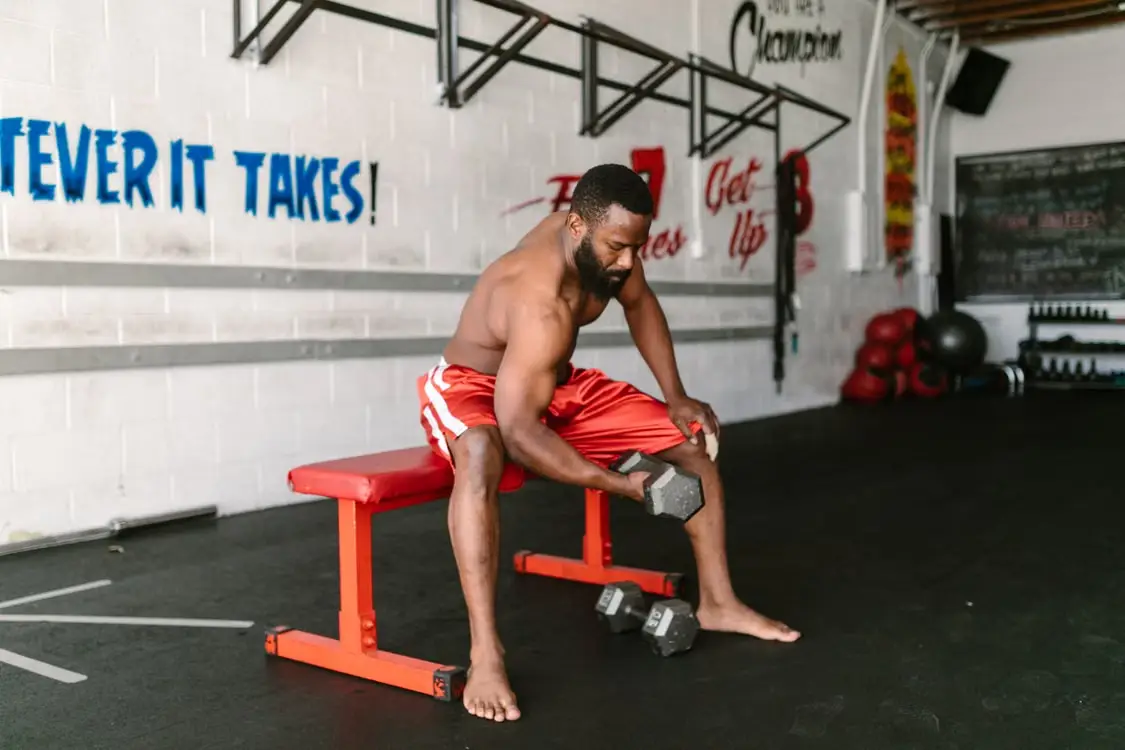
The classic, and still one of the best. Sit on a chair, rest your forearm on your thigh with your palm facing up, and let a light dumbbell roll down toward your fingers. Curl it back up slowly. That slow part matters more than the weight does.
Do 3 sets of 12 to 15 per arm. If you only own one pair of dumbbells, that’s fine.
Forearms respond well to lighter weight and higher reps, and you can fold these into any of the upper body dumbbell exercises you’re already doing.
No dumbbell? A filled water bottle or a bag of rice works. Not glamorous, but your wrist flexors can’t tell the difference.
2. Reverse Wrist Curls
Same setup, palm facing down this time. Lift the back of your hand toward you, lower it slowly, repeat.
This one trains the extensors, the muscles on top of your forearm that almost nobody works directly.
Skipping them is how people end up with achy wrists and elbows down the line. Go lighter than you think you need to. Even 2 or 3 kilos will humble you here.
3. Wrist Roller Work
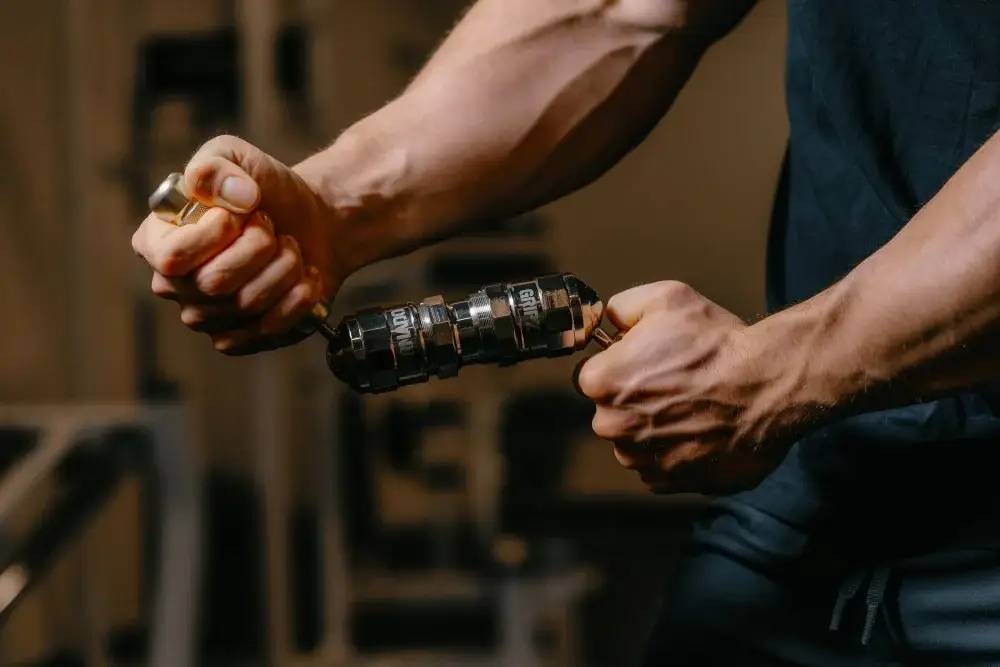
The wrist roller is the old-school forearm builder, and there’s a reason it never went away. Nothing pumps the forearms quite like it.
The classic version is a stick with a rope and a hanging weight, which you can rig up at home, though it gets awkward in small spaces.
If you’d rather skip the DIY, a compact forearm builder does the same job without any hanging weights. You adjust the resistance with two knobs and rotate the handles against it, so you can use it on the couch, at your desk, wherever.
Two or three minutes of steady rotations, forward and reverse, and your forearms will let you know about it.
Either way, roll until fatigue, rest, and repeat 3 times.
4. Farmer’s Carries Around the House
Grab the two heaviest things you can hold safely, one in each hand, and walk. Down the hallway, around the living room, out to the mailbox and back. Keep your shoulders back and your grip tight the whole way.
Farmer’s carries hit your grip, forearms, traps, and core all at once, which makes them the most time-efficient exercise on this list.
Three or four trips of 30 to 45 seconds is plenty. I do mine while the kettle boils.
5. Towel Wringing
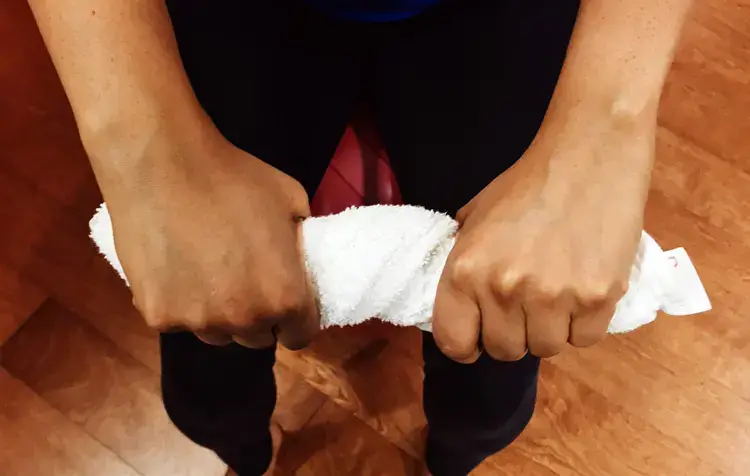
Take a bath towel, soak it, and wring it out over the sink like you mean it. Twist one direction until your forearms burn, then reverse. Do this for 4 or 5 rounds.
It sounds too simple to count as training. It isn’t. The twisting motion works your forearms through rotation, which regular curls never touch, and rotation is how your hands actually work in daily life.
Opening jars, turning wrenches, gripping a racket. All rotation.
6. Dead Hangs
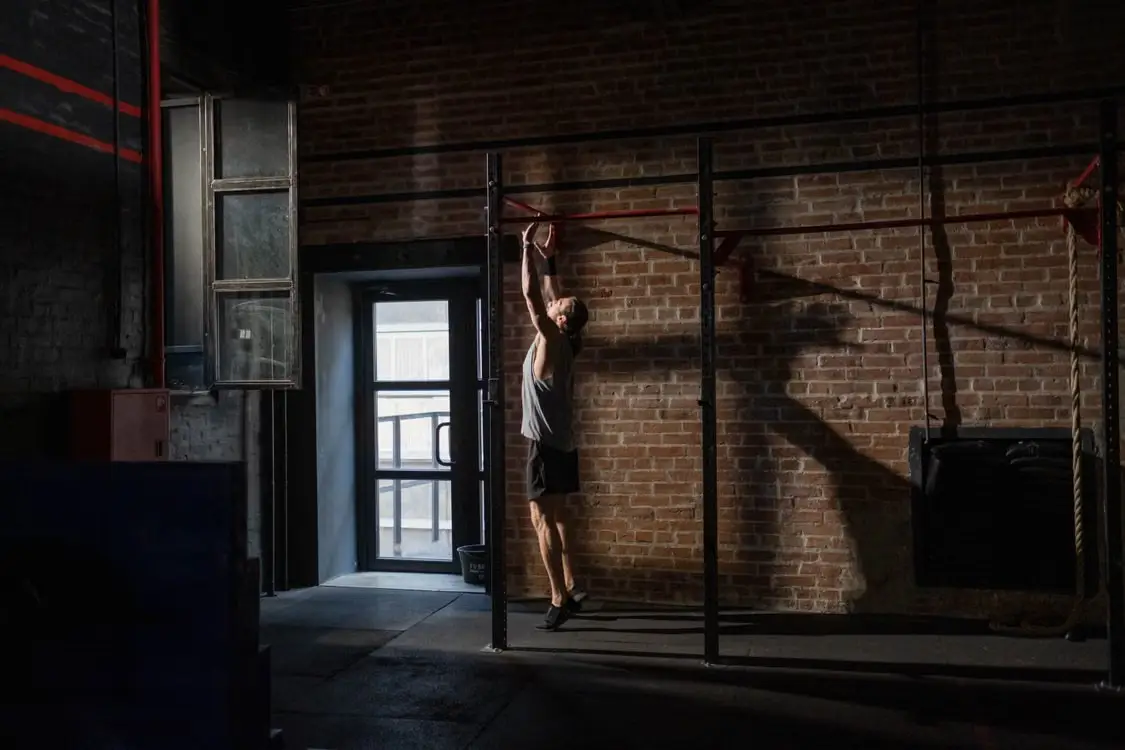
Hang from a pull-up bar with straight arms for as long as you can. That’s it. That’s the exercise.
Dead hangs build raw grip endurance, decompress your spine a little, and expose exactly how strong your hold really is. If you can’t hang for 30 seconds yet, don’t sweat it.
Keep your feet lightly on a chair and build up. They’re also the fastest way to improve your pull-ups, since grip is usually the first muscle to give out on the bar, long before your back does.
Aim for 3 hangs, resting a minute or two between each.
7. Pinch Holds
Pinch a weight plate, a thick hardcover book, or two thin books stacked together between your thumb and fingers. Hold for 20 to 30 seconds per hand.
Most grip work trains the crushing motion. Pinch holds train your thumb, and a weak thumb quietly caps your whole grip.
This is the exercise climbers and arm wrestlers swear by, and it needs zero setup. I keep an old textbook near my desk for exactly this.
8. Rubber Band Finger Extensions
Loop a thick rubber band around all five fingertips and open your hand against the tension. Do 15 to 20 reps per hand, a few times a day if you like.
This is the smallest exercise on the list and possibly the most important one. Everything we do closes the hand.
Typing, gripping, lifting, phone scrolling. Finger extensions are the counterbalance, and they take about 40 seconds. Keep a band on your desk and do a set whenever you notice it.
How to Fit These Into a Real Week
You don’t need all eight every day. Pick two or three and rotate:
- Monday: wrist curls, reverse wrist curls, dead hangs
- Wednesday: farmer’s carries, towel wringing
- Friday: wrist roller, pinch holds
- Daily filler: rubber band extensions whenever
Ten minutes a session, three sessions a week, and you’ll feel the difference within a month. Your grip will hold longer on pulls, your wrists will feel sturdier, and jars will stop winning.
One warning from experience: forearms get sore in a way that surprises people, especially the first two weeks.
Ease in with lighter resistance, and if you overdo it, give them a couple of rest days and some basic muscle recovery care before your next session. Forearms recover fast, but they don’t like being rushed.
Small muscles, small time investment, big payoff. Start with two of these this week and build from there.