
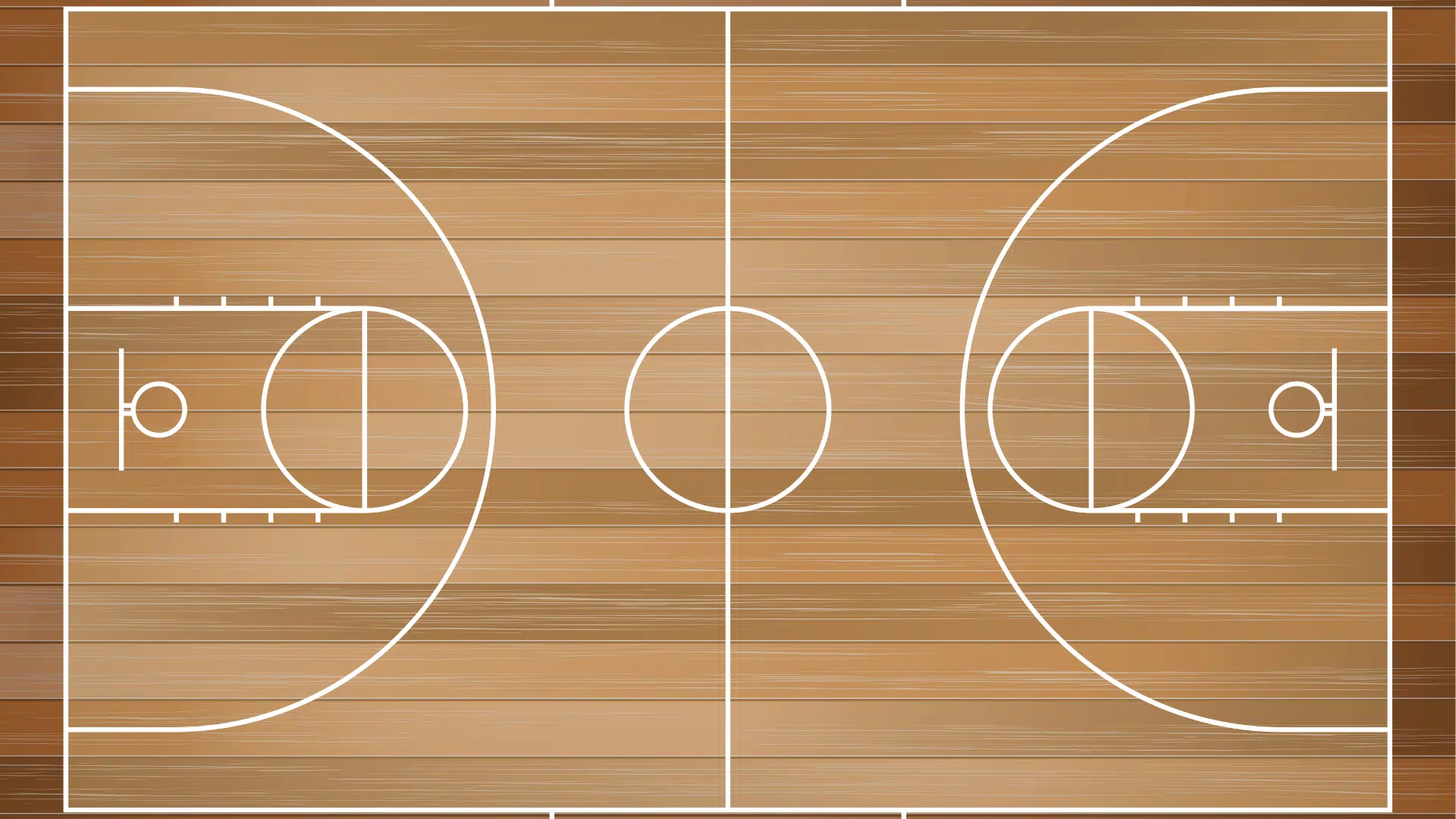
When it comes to basketball, the size of the court plays a big role in how the game is played.
Even if you’re watching the NBA, playing in a local league, or just shooting hoops at home, knowing the standard court dimensions is important.
In this blog, I’ll walk you through the different court sizes used in the NBA, FIBA, NCAA, and high school games.
We’ll also look at how these measurements affect the playing style and strategy. Plus, I’ll cover the key markings on the court, including the three-point line, free-throw lane, and backboard specs.
If you’re planning to build a court or just curious, this guide has all the details you need!
Standard Basketball Court Dimensions
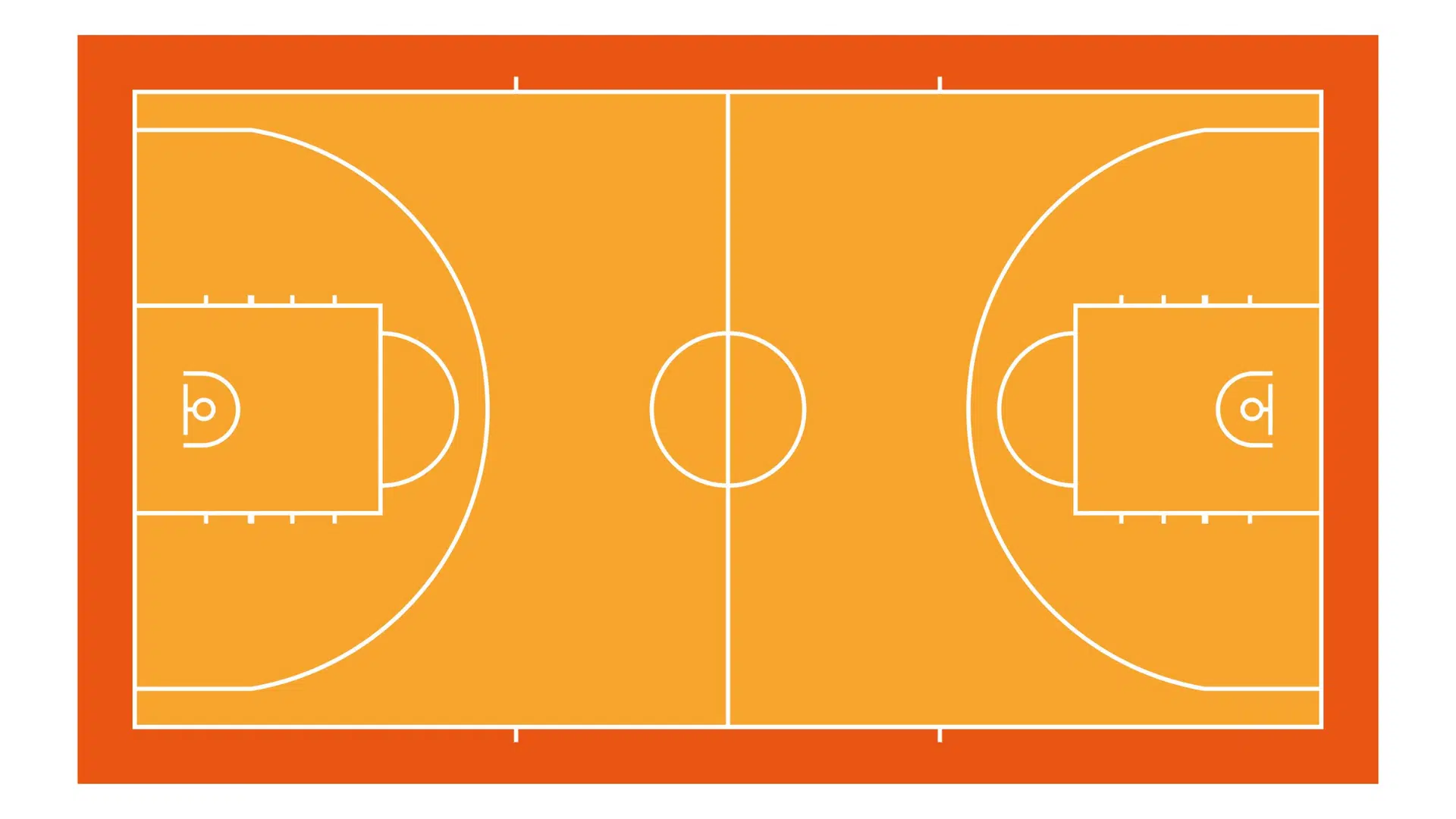
Basketball courts aren’t one-size-fits-all. Different leagues use different measurements based on the level of play and regional standards.
NBA Court Size
The NBA uses the largest court in competitive basketball. It measures 94 feet long and 50 feet wide.The three-point line sits 23.75 feet from the basket at its farthest point, while the free-throw lane spans 16 feet wide.
This extra space encourages fast breaks, long-range shooting, and high-scoring games. The basket height remains 10 feet, consistent across all levels.
These dimensions create the fast-paced, athletic style NBA fans love.
FIBA Court Size
FIBA governs international basketball, which uses slightly smaller courts. They measure 28 meters long and 15 meters wide, which converts to roughly 91.9 feet by 49.2 feet.
The three-point line is closer at 22.15 feet, and the free-throw lane width matches the NBA at approximately 16 feet.
This compact layout promotes team play and ball movement over individual drives.
Having covered both NBA and international competitions, I’ve observed how FIBA courts emphasize strategy, making international games feel more structured and deliberate compared to NBA contests.
NCAA Court Size
College basketball courts match NBA length and width at 94 by 50 feet. However, the three-point line sits closer at 22 feet, 1¾ inches; the same distance as FIBA.
The key is narrower at just 12 feet wide, which opens up the paint for more defensive presence. This creates a hybrid playing style that blends professional spacing with tighter interior play.
NCAA courts prepare athletes for the transition to professional basketball while maintaining collegiate standards of play.
High School Basketball Court Size
High school courts are shorter to accommodate younger players. They measure 84 feet long and 50 feet wide. The three-point line is set at 19 feet, 9 inches, making long-range shots more achievable for developing athletes.
The key width is 12 feet, identical to the NCAA. These reduced dimensions help students learn fundamentals without the physical demands of full-sized professional courts.
The shorter length also fits better in standard school gymnasiums.
Quick Comparison Table
| Level | Length | Width | 3-Point Line | Key Width | Basket Height |
|---|---|---|---|---|---|
| NBA | 94 ft (28.65 m) | 50 ft (15.24 m) | 23.75 ft | 16 ft | 10 ft |
| FIBA | 91.9 ft (28 m) | 49.2 ft (15 m) | 22.15 ft | 16 ft | 10 ft |
| NCAA | 94 ft (28.65 m) | 50 ft (15.24 m) | 22.1 ft | 12 ft | 10 ft |
| High School | 84 ft (25.6 m) | 50 ft (15.24 m) | 19.9 ft | 12 ft | 10 ft |
Basketball Court Layout and Key Markings
A basketball court isn’t just a rectangle with hoops. It contains specific zones that define how the game is played.
The center circle, located at mid-court, is where jump balls occur and measures 12 feet in diameter. Sidelines run the length of the court, while baselines mark the ends behind each basket.
The mid-court line divides the playing area into two halves, preventing backcourt violations.
Each marking serves a purpose; from determining out-of-bounds calls to establishing three-second violations in the paint.
These lines aren’t decorative; they’re the rulebook drawn onto the floor, guiding referees and players through every possession.
Understanding the Free-Throw Lane
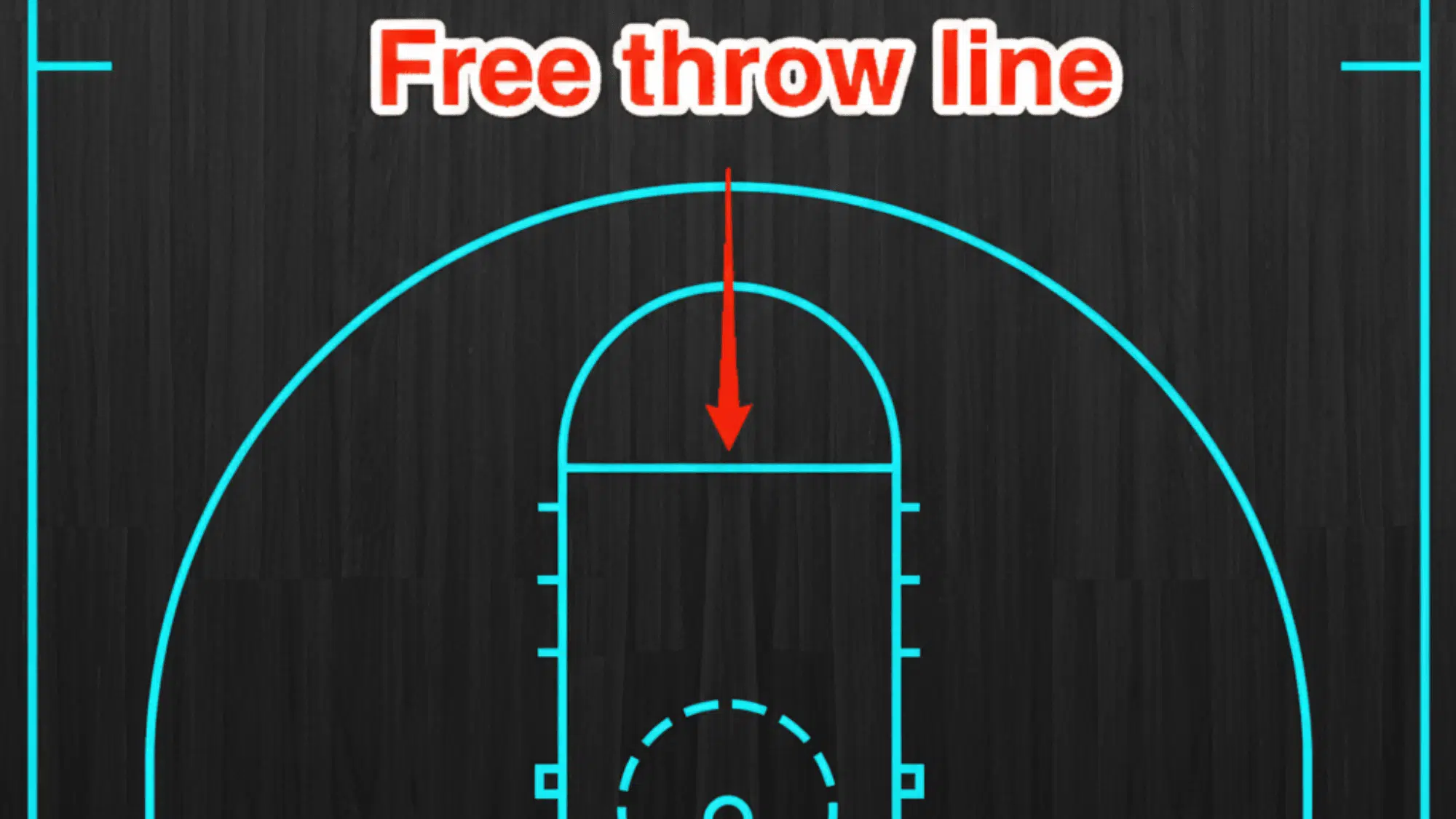
The free-throw lane, often called “the paint” or “the key,” is one of the most critical areas on any basketball court.
Free Throw Lane Across Different Levels
In the NBA, the lane measures 16 feet wide, providing more space for offensive players to operate. FIBA and high school courts use a narrower 12-foot lane.
The lane extends 15 feet from the baseline to the free-throw line in NBA and FIBA play, while high school dimensions remain similar.
This rectangular zone is where players line up for free throws and where three-second violations are enforced to prevent camping under the basket.
Why Lane Width Matters
A wider lane changes the game significantly. NBA players enjoy more room to drive, post up, and create spacing for shooters.
Narrower lanes in high school and NCAA play allow defenders to pack the paint more effectively, making inside scoring harder.
This forces teams to rely more on perimeter shooting and ball movement.
The lane width directly influences offensive strategy; wider lanes favor individual skill, while narrower ones reward teamwork and outside shooting.
Three-Point Line Measurements
The three-point line distance varies by level and has a major impact on game strategy:
- NBA: 23.75 feet (7.24 meters) from the basket at the arc’s farthest point
- FIBA: 22.15 feet (6.75 meters) uniformly around the arc
- NCAA: 22 feet, 1¾ inches (6.75 meters), matching FIBA standards
- High School: 19 feet, 9 inches (6.02 meters) for more accessible long-range shooting
The NBA’s deeper line rewards elite shooters and spreads defenses thin.
International and college games use closer lines, encouraging more three-point attempts and making perimeter defense crucial.
Basket Height and Backboard Specs
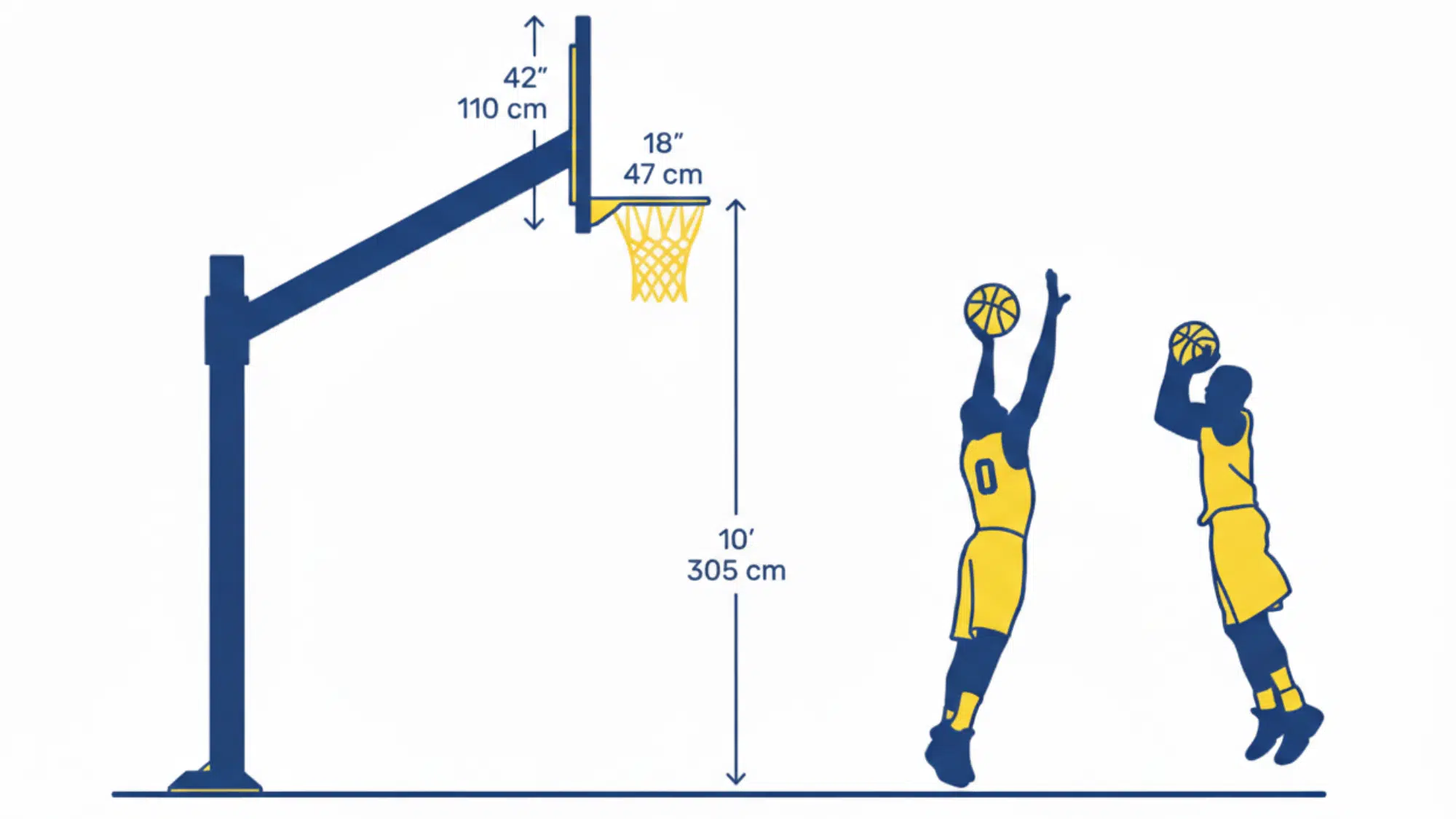
One measurement stays consistent across all levels of basketball: the basket height. Whether you’re playing in the NBA, FIBA, NCAA, or high school, the rim sits exactly 10 feet above the floor.
This universal standard ensures players develop consistent shooting mechanics regardless of where they train.
Regulation backboards measure 72 inches wide by 42 inches tall, with the rim diameter fixed at 18 inches.
The backboard’s rectangular shape and size create predictable bank-shot angles, which are essential for layups and close-range scoring.
This consistency allows players to transfer skills seamlessly from practice courts to competitive arenas.
Indoor vs Outdoor Basketball Court Differences
Indoor and outdoor courts serve different purposes, and their construction reflects those needs.
| Feature | Indoor Courts | Outdoor Courts |
|---|---|---|
| Surface Material | Hard maple hardwood | Concrete, asphalt, or synthetic acrylic |
| Ball Bounce | Consistent and predictable | Varies; synthetic acrylic provides the best consistency |
| Weather Resistance | Requires climate control | Must withstand rain, sun, and temperature changes |
| Maintenance | Regular refinishing and polishing are needed | Minimal maintenance; occasional cleaning is sufficient |
| Durability | Susceptible to moisture and warping | Highly durable with synthetic surfaces |
| Traction | Excellent grip for quick cuts | Good with synthetic acrylic; poor with plain concrete |
| Cost | Higher installation and upkeep costs | Lower long-term maintenance expenses |
| Playing Conditions | Controlled environment, year-round play | Weather-dependent unless covered |
| Shock Absorption | Natural cushioning from wood | Best with synthetic acrylic layers |
Synthetic acrylic surfaces bridge the gap between indoor quality and outdoor durability, making them ideal for schools and community facilities.
Half-Court Basketball Dimensions
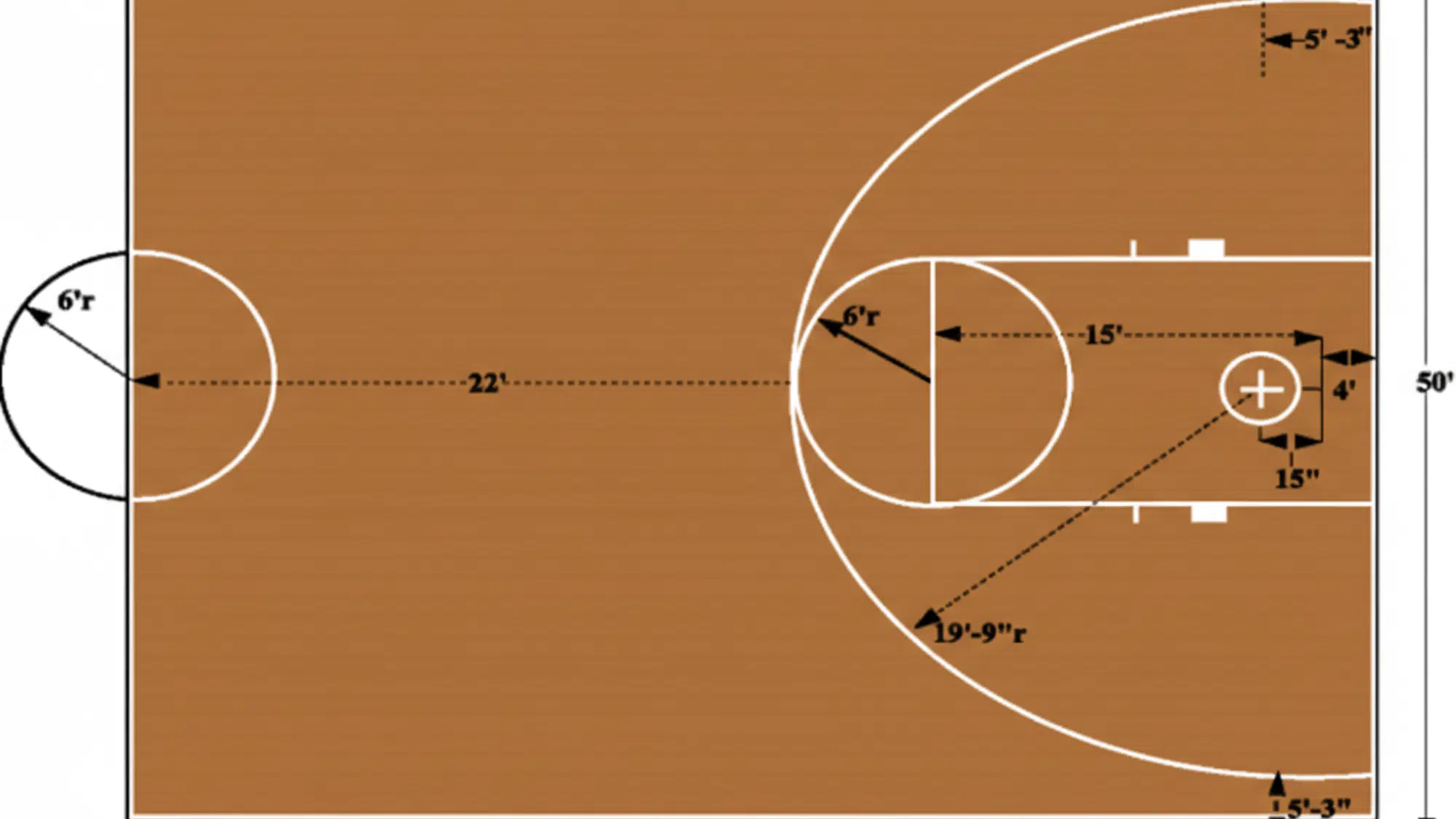
Half-court basketball has become increasingly popular for recreational play, especially in spaces with limited space.
A typical half-court measures approximately 47 feet long (half the NBA length) by 50 feet wide, maintaining the full court width.
The key, free-throw line, and three-point arc remain at one end, allowing players to practice shooting, work on offensive moves, and play competitive 3-on-3 or 4-on-4 games.
Many driveways and backyard courts use even smaller dimensions, sometimes as compact as 30 by 50 feet, while still including the essential markings.
Half courts are cost-effective, easier to maintain, and perfect for skill development without requiring a full team.
Court Size Impact on Playing Style
Different court dimensions directly influence how basketball is played:
- Larger courts: Favor speed, stamina, and fast-break opportunities with more open space for transition offense
- Smaller courts: Create tighter defensive pressure, slower pace, and more half-court set plays
- Professional spacing: The NBA’s extra room allows isolation plays and one-on-one matchups to shine
- Youth development: Smaller high school courts help younger players learn positioning without being overwhelmed by space
- International style: FIBA’s compact courts emphasize ball movement, pick-and-rolls, and team-oriented offense over individual heroics
Players who train on regulation courts develop better court awareness and conditioning for competitive play.
Choosing the Right Basketball Court Size
Selecting the correct court dimensions depends on who will use the space and for what purpose.
For Schools and Youth Programs
High school courts measuring 84 by 50 feet work best for students aged 14-18. Elementary and middle schools often use even smaller courts to match younger players’ physical abilities.
The shorter three-point line at 19.9 feet encourages developing shooters without frustrating them. Youth programs benefit from age-appropriate dimensions that teach fundamentals while building confidence.
As players grow and improve, they gradually adapt to larger court sizes.
For Training Facilities and Gyms
Serious training facilities should install full NBA- or FIBA-regulation courts measuring 94 by 50 feet. These dimensions prepare athletes for competitive play at higher levels.
Training on regulation courts ensures muscle memory and spatial awareness transfer directly to game situations. Facilities hosting tournaments must meet league-specific requirements, making accurate measurements essential.
College prep programs benefit most from NCAA-compliant courts with the 22-foot three-point line.
For Residential and Community Spaces
Homeowners and community centers with limited space should consider half-court designs.
A 47-by-50-foot half-court provides excellent value, fitting in smaller areas while offering full shooting and practice capabilities.
Driveways can accommodate even smaller versions, sometimes 30 by 30 feet, sufficient for shooting practice and basic drills.
Multi-purpose community courts benefit from adjustable markings that accommodate basketball, pickleball, and volleyball, maximizing space utility and serving diverse populations.
Common Basketball Court Planning Errors
Avoid these frequent mistakes when designing or building a basketball court:
- Incorrect Dimensional Measurements: Even small errors can disqualify courts from hosting official competitions and confuse players
- Inadequate Safety Zone Clearance: Courts need at least 3-5 feet of open space beyond baselines and sidelines to prevent injuries
- Poor Line Marking Visibility: Faded or incorrectly placed lines cause disputes during games and make officiating difficult
- Ignoring Surface Quality: Cheap materials lead to uneven ball bounce, poor traction, and increased injury risk
- Not Planning for Drainage: Outdoor courts without proper slope and drainage systems collect water, creating hazards and accelerating surface deterioration
During facility tours for coverage pieces, I’ve visited community courts where improper drainage turned playing surfaces into puddles after light rain, making them unusable for days.
Wrapping Up
Understanding basketball court sizes can help you appreciate the game at every level, from high school to professional play.
Each court is designed to promote a different style of play, with variations in size and layout affecting everything from shooting to defense.
Even if you’re a player or just a fan, knowing these dimensions can deepen your understanding of the game. If you’re considering building your own court, be sure to take these measurements into account for the best experience.
I hope this guide helped you get a clearer picture of basketball court sizes. If you have any questions or need advice on designing your own court, feel free to reach out!