




Ever wondered how long a soccer game really lasts? On paper, it seems pretty straightforward, but in real life, matches often run longer than expected.
Between the regular halves, the break in the middle, added minutes from delays, and the extra periods used in important games, there’s more to the timing than most people realize.
This blog explains it all in easy terms, so it feels simple and clear from start to finish.
We will also cover how long a normal match is supposed to be, why referees add extra minutes, what happens when a game needs more time to find a winner, how penalty shootouts work, and how match lengths can change at different levels of play.
How Long Is a Soccer Game?
A standard soccer game lasts 90 minutes. The game is split into two halves, with a 15-minute halftime break.
Here’s the simple breakdown:
- First half: 45 minutes
- Halftime break: 15 minutes
- Second half: 45 minutes
- Total playing time: 90 minutes
But here’s the catch: the clock never stops during a soccer game. Unlike basketball or American football, the timer keeps running even when the ball goes out of bounds or a player gets injured.
This means soccer games actually last longer than 90 minutes in real time.
What Makes Soccer Games Last Longer Than 90 Minutes?
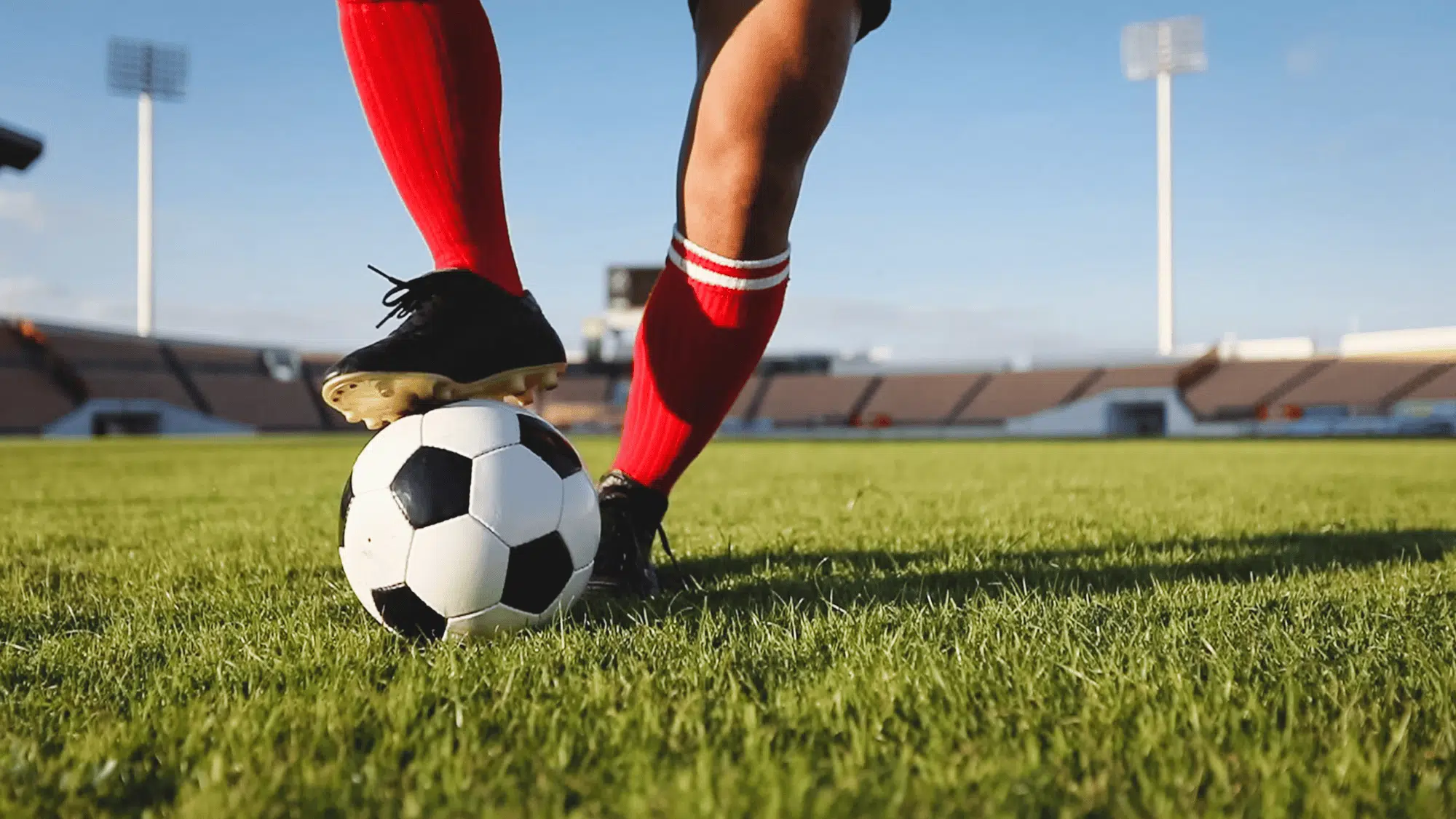
Soccer has a unique timing system. The clock runs continuously for 45 minutes in each half, no matter what happens on the field.
When the ball rolls out of bounds, when players get substituted, or when someone needs medical attention, the clock keeps ticking.
So how does the game stay fair? That’s where stoppage time comes in. The referee keeps track of all these delays and adds extra minutes at the end of each half to make up for lost playing time.
In recent tournaments, especially the 2022 FIFA World Cup, stoppage time has increased dramatically.
Matches that used to add just 2-3 minutes now regularly add 7, 8, or even 10 minutes. This change gives fans more actual soccer action and makes the game fairer for both teams.
How long are soccer games in real time? Most matches take about 1 hour and 50 minutes to 2 hours to complete from start to finish. This includes the playing time, halftime, and stoppage time.
Stoppage Time Explained: Why Added Minutes Matter
Stoppage time (also called injury time or added time) is the extra minutes the referee adds at the end of each half. Think of it as makeup time for all the moments when the ball wasn’t in play.
What Counts Toward Stoppage Time?
- Player injuries that need medical attention
- Substitutions (when players switch out)
- VAR checks (video reviews of controversial plays)
- Goal celebrations
- Time-wasting tactics
- Any unusual delays on the field
Typical stoppage time ranges:
| Half | Traditional Amount | Modern Tournaments |
|---|---|---|
| First Half | 1-2 minutes | 3-5 minutes |
| Second Half | 3-5 minutes | 5-10+ minutes |
Why the increase? FIFA’s top referee, Pierluigi Collina, explained that officials now track stoppage time more carefully.
The goal is to give fans “more show” and make sure teams get the full 90 minutes of actual playing time they deserve.
Real-world example: During the 2022 World Cup, a match featuring the United States Men’s National Team had 9 minutes of stoppage time added to the second half. That’s almost like playing an extra mini-game!
The referee signals stoppage time by holding up an electronic board showing the minimum number of minutes to be added. Notice the word “minimum”; if more delays happen during stoppage time, the referee can extend it even further.
Extra Time: Games Beyond 90 Minutes?
Sometimes 90 minutes isn’t enough to decide a winner. When that happens, the game goes into extra time.
Extra time adds 30 more minutes to the match, split into two 15-minute halves. Just like regular time, extra time also includes stoppage time at the end of each period.
When is Extra Time Used?
- Knockout tournament rounds (like World Cup elimination games)
- Cup finals and semifinals
- Any match where a winner must be determined that day
When is Extra Time NOT Used?
- Regular season league games (these can end in ties)
- Group stage tournament matches
- Friendly matches
So if you’re watching a knockout game that goes to extra time, you’re looking at 120 minutes of soccer plus stoppage time. That can push the total match length to about 2 hours and 20 minutes or more!
How Games Are Decided If Still Tied After 120 Minutes
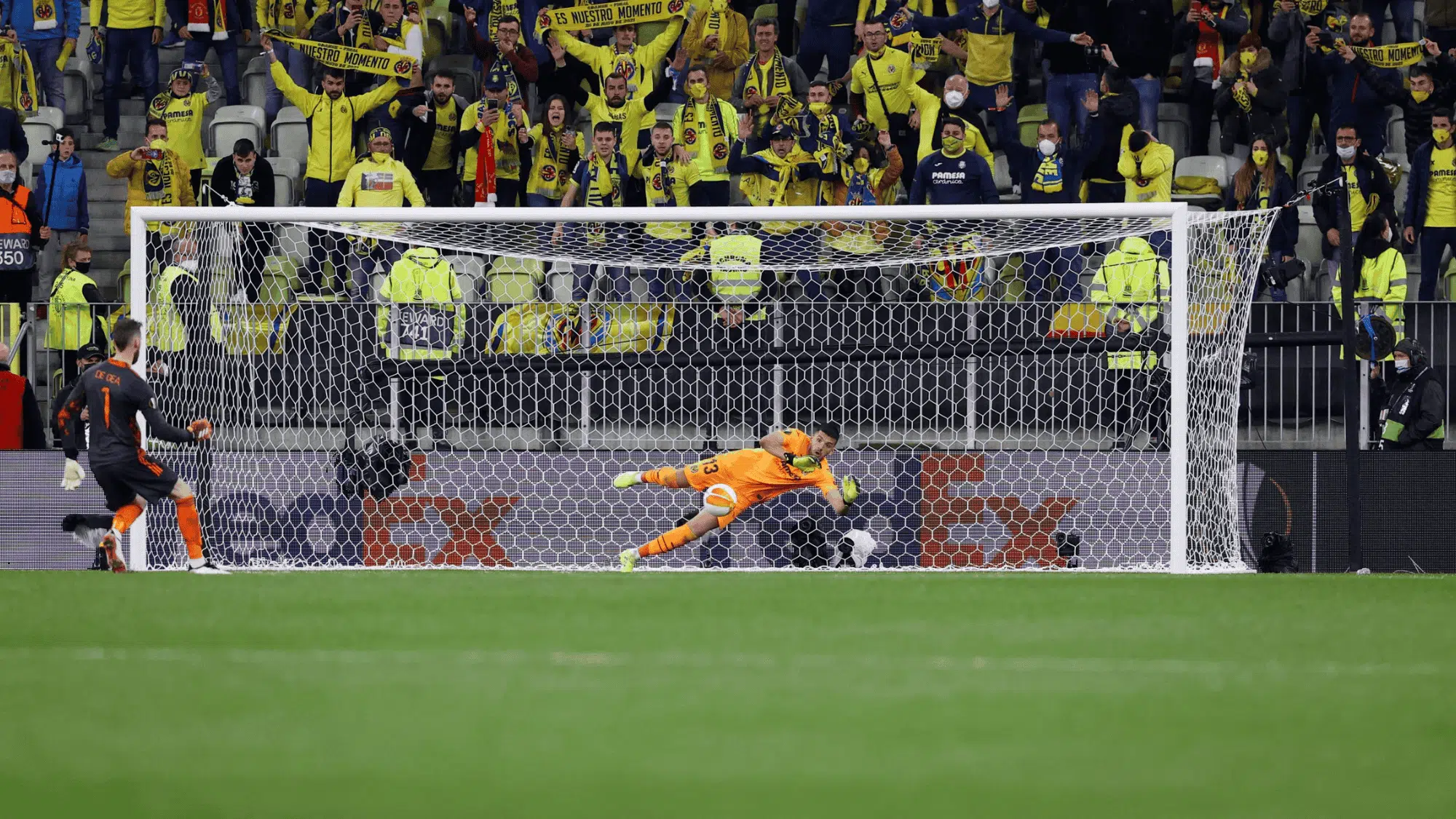
What happens if the score is still tied after 120 minutes? Time for penalties!
A Penalty Shootout Works Like This:
- Each team selects five players to take penalty kicks
- Teams alternate kicks (Team A, then Team B, then Team A, and so on)
- Players shoot from the penalty spot, one-on-one against the goalkeeper
- The team with the most goals after five kicks wins
If it’s still tied after five kicks each? The shootout goes to sudden death. Teams keep taking turns until one team scores and the other misses.
Before penalties begin, there’s a coin toss to decide which team kicks first. The match officials also choose which goal to use for all the kicks.
Penalty shootouts add about 10-20 minutes to the total viewing time, depending on how many rounds are needed.
While penalties are thrilling to watch, they don’t count toward the official match length; the game is still recorded as 120 minutes.
How Long Soccer Games Actually Take to Watch
Let’s talk about real-world watching time. When you sit down to watch a soccer match, how long should you expect to be there?
For a standard 90-minute game:
- Playing time: 90 minutes
- Halftime: 15 minutes
- Stoppage time: 5-15 minutes (varies by match)
Total viewing time: About 1 hour 50 minutes to 2 hours
For games with extra time:
- Regular time: 90 minutes
- Halftime: 15 minutes
- Stoppage in regular time: 8-10 minutes
- Extra time: 30 minutes
- Stoppage in extra time: 3-5 minutes
Total viewing time: About 2 hours 20 minutes to 2 hours 30 minutes
If penalties are needed, add another 10-20 minutes.
What Do Soccer Fans Say?
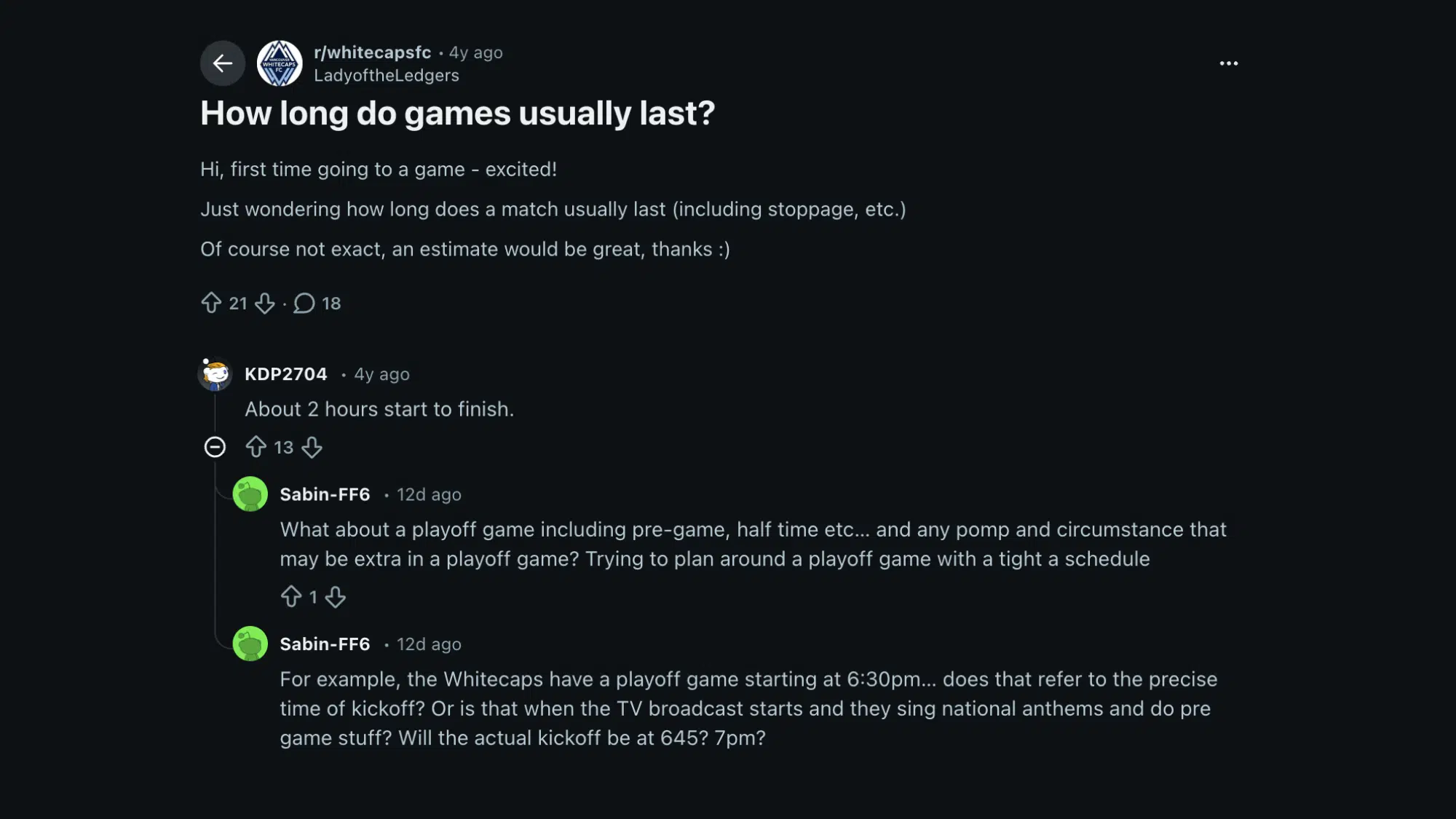
Based on community discussions and fan forums, most experienced viewers plan to watch a match for 2 full hours. This gives enough cushion for commercial breaks (if watching on TV), pre-game coverage, and post-game analysis.
High-stakes matches with lots of VAR reviews or controversial moments tend to run longer. World Cup games and major finals often hit the 2-hour mark or beyond.
One fan said, “A soccer game might be 90 minutes on paper, but in reality, it runs a bit longer. You’ve got a 15–20 minute halftime break, maybe up to 10 minutes of injury time, and the match usually kicks off about 10 minutes late thanks to the anthems and team walkouts. Put it all together, and you’re really setting aside about two hours from start to finish.”
You can join and participate in the discussion here at Reddit.
How Long Are Soccer Games at Different Levels?
Not all soccer games follow the same timing rules. The length varies based on the level of play and the age of the players.
Professional & FIFA Matches
| Component | Duration |
|---|---|
| Each half | 45 minutes |
| Halftime | 15 minutes |
| Total regulation | 90 minutes |
| Stoppage time | Varies (3-10+ min per half) |
| Extra time (if needed) | 30 minutes (2 x 15 min) |
| Penalties (if needed) | Until winner determined |
College Soccer (NCAA)
College soccer only uses overtime during tournament play. Regular-season games can end in ties.
| Component | Duration |
|---|---|
| Each half | 45 minutes |
| Halftime | 15 minutes |
| Total regulation | 90 minutes |
| Overtime (postseason only) | 20 minutes (2 x 10 min) |
High School Soccer
High school matches are shorter to accommodate student athletes who may play multiple sports or have academic commitments.
| Component | Duration |
|---|---|
| Each half | 40 minutes |
| Halftime | 10 minutes |
| Total regulation | 80 minutes |
History of the 90-Minute Soccer Match
Ever wondered why a soccer game lasts 90 minutes? The answer goes back to 1800s England, when teams all played by different rules.
Match lengths were all over the place—some 60 minutes, some 90, and others even longer. In 1866, a well-known game between London and Sheffield pushed both sides to agree on a consistent length.
They settled on 90 minutes, and the Football Association later adopted it as the official standard. As soccer spread around the world, the 90-minute format became the norm everywhere.
Some say it was chosen because it splits neatly into two 45-minute halves, while others think it offered plenty of action without exhausting players. Either way, it’s a tradition that’s lasted for over 150 years.
Longest Soccer Games in History
The longest professional soccer match on record happened in 1946 in England. Stockport County played Doncaster Rovers in a cup match that lasted an incredible 3 hours and 46 minutes!
Back then, the rules were different. The match went through regular time, extra time, and then kept going because officials had to determine a winner that day. There were no penalty shootouts yet, teams just kept playing until someone scored.
Today’s rules prevent such marathon matches. With penalty shootouts as the ultimate tiebreaker, games rarely exceed 2.5 hours total.
How Does Soccer Compare to Other Sports?
Soccer actually moves faster than most other major sports when you compare game time to real viewing time. The continuous clock keeps things flowing, which is part of what makes soccer so exciting to watch.
- Soccer: About 2 hours (90 minutes of game time)
- NFL Football Games: Average 3 hours 12 minutes (despite only 60 minutes of game time)
- MLB baseball games: Average 3 hours (nine innings, no clock)
- NBA basketball games: Average 2 hours 15 minutes (48 minutes of game time)
Conclusion
Soccer games may seem simple at first, but the timing has many layers that make each match exciting.
From the steady game clock to the added minutes, extra periods, and even penalty shootouts, every part helps keep the sport fair and full of energy.
Understanding how long games can really run makes watching them even more enjoyable, especially during big tournaments or close matches.
No matter the level, professional, college, or school, each version has its own rhythm and rules. Now that the timing makes sense, it’s easier to sit back, relax, and enjoy the action from the first whistle to the final moment.
Want more easy sports guides like this? Check out OUR next post!