






MMA and boxing are two tough combat sports that often get compared, and it can be confusing to know what really makes them different.
This guide is here to break it down in simple terms so you can see which style fits your goals.
You’ll learn how boxing focuses on clean punching, sharp footwork, and defense, while MMA mixes striking, wrestling, and ground fighting.
The blog will go over rules, stances, training styles, toughness, and common injuries in each sport.
We will also touch on which one may help more for self-defense and how the rules change who usually wins in crossover fights. By the end, the whole boxing vs MMA debate will feel much clearer.
MMA vs Boxing: The Core Difference
Here’s a quick look at how boxing and MMA differ in skills, strategy, and goals, so each sport’s unique style and mindset makes sense better.
Boxing: The “Sweet Science” Basics

Boxing rewards you for mastering the art of hitting without getting hit. It’s called the “sweet science” for a reason. Here’s what boxers spend years perfecting:
- Footwork and angles: Moving smoothly to create openings and avoid punches
- Head movement: Slipping, rolling, and making opponents miss
- Distance control: Knowing exactly when you’re in range to land shots
- Four main punches: Jab, cross, hook, and uppercut (sounds simple, but the combinations are endless)
- Defense techniques: Blocks, parries, and shoulder rolls that make you hard to hit
A great boxer makes everything look effortless. They’re like a chess player who sees three moves ahead—always setting traps and controlling the rhythm.
MMA: Range Switching Master

MMA fighters train to be dangerous everywhere. If you shut down their punches, they’ll kick you. If you avoid their kicks, they’ll wrestle you down. Here’s what makes MMA training different:
- Multiple fighting ranges: Comfortable throwing strikes, fighting in the clinch, and battling on the ground
- Takedowns and takedown defense: Knowing how to put someone on their back or stay on your feet
- Ground control: Pinning opponents and advancing position
- Submissions: Chokes and joint locks that can end the fight without throwing a punch
- Ground-and-pound: Striking effectively when you’re on top
Here’s the key difference: A boxer is usually way cleaner at boxing. An MMA fighter is trained to change the problem entirely. If they can’t out-box you, they’ll wrestle you instead.
Safety & Injuries
Let’s be real,both sports involve getting hit. Here’s what you should know.
Head Trauma Discussion
Boxing: The repeated head shots over many rounds can lead to cumulative impact concerns. Since you can only punch and you’re aiming for the head/body, boxers absorb a lot of punishment to the head throughout their careers.
MMA: Fewer total rounds in most fights, but includes more brutal strikes like knees and elbows. On the flip side, fights can end by submission without anyone getting knocked out. Referees also tend to stop fights quickly when someone’s clearly hurt.
Common Injuries by Sport
Boxing injuries often include:
- Hand and wrist problems from impact
- Facial cuts (especially around the eyes)
- Concussions from accumulated head shots
- Rib and body injuries
MMA injuries often include:
- Knee and ankle injuries from kicks and wrestling
- Shoulder problems from grappling
- Cuts from elbows and cage contact
- Joint strain from submission attempts
Train smart tips: Always wear proper protective gear (a mouthguard is essential), control the intensity during sparring, work with qualified coaches, and take recovery seriously.
Using quality boxing gloves for training UK fighters rely on can help reduce strain on the hands and wrists during sparring.
Both sports can be trained safely with the right approach.
Rules & Scoring
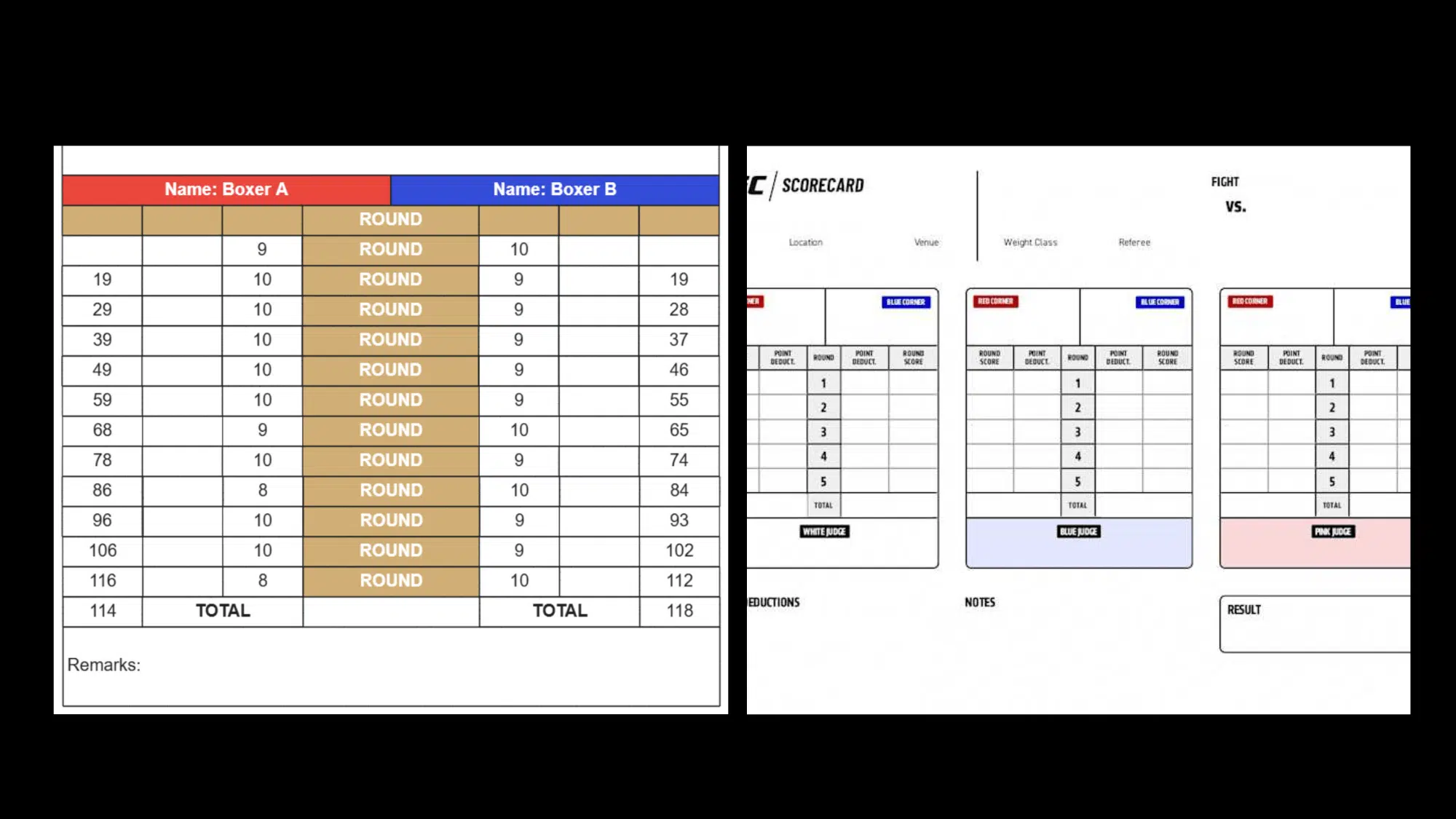
Now that the core styles are clear, this section shows how different rules and scoring systems shape game plans, training focus, and fight outcomes overall.
Boxing Rules (Simple and Strict)
Boxing keeps things straightforward:
- Only punches above the belt count
- If you get knocked down, the referee counts to ten (you need to get up and show you’re okay)
- Judges score each round based on clean punching, ring control, and defense
- No grabbing, kicking, or going to the ground
The simplicity is part of boxing’s beauty. Everyone knows what’s allowed, so fighters can focus entirely on perfecting their craft.
MMA Rules (Looks Wild, But It’s Structured)
MMA might look like chaos, but there are tons of rules:
- You can strike with fists, elbows, knees, and kicks (some targets are illegal, like back of the head)
- Takedowns and ground fighting are allowed
- Submissions are a legit way to win
- Judges score based on effective striking, grappling, control, and damage
Why “real fight” comparisons get messy: Neither sport is a “real fight.” They’re both combat sports with rules, time limits, and referees. The rules shape how fighters train and strategize.
Technique & Stance: Why They Move Differently
Ever notice how boxers and MMA fighters stand differently? There’s a good reason.
Boxing Stance Advantages
Boxers use a narrower, more bladed stance that lets them:
- Generate maximum punching power from rotation
- Move their head quickly to dodge shots
- Keep a tight guard with big gloves protecting their face
- Pivot and angle out smoothly
MMA Stance Advantages
MMA fighters usually have a wider stance because they need to:
- Defend against leg kicks that could knock them off balance
- Sprawl quickly to stop takedowns
- React to threats from more angles
- Work with smaller gloves (can’t hide behind them as much)
If a boxer tried to use their normal stance in MMA, one good leg kick would mess up their whole game plan. If an MMA fighter boxed in their wider stance, they’d be too slow and squared up.
Toughness: Which One Is Harder to Compete In?

Both sports will push you to your absolute limit, just in different ways.
1. Skill Load: Depth vs Breadth
Boxing demands: Years of drilling the same movements until they become instinct. You’re going deep into one skill set. The difference between a good boxer and a great one is incredibly subtle.
MMA demands: Competence in multiple martial arts. You need decent boxing, good wrestling, solid kickboxing, and ground skills. You’re spreading your training time across many disciplines.
2. Conditioning Style
Boxing conditioning: Get ready for repeated high-output bursts. Championship boxing matches can go 12 rounds of three minutes each. That’s 36 minutes of near-constant movement and punching. Your shoulders will feel like they’re on fire.
MMA conditioning: Explosive scrambles mixed with strength-draining positions. Wrestling someone who doesn’t want to be wrestled is exhausting. Add ground-and-pound and submission attempts, and your whole body gets tested.
3. Pain and Pressure Points
Boxing: You’re getting hit in the head and body, a lot. The cumulative effect of eating punches round after round adds up. Hand and wrist injuries are common from throwing hundreds of punches.
MMA: More attack surfaces mean more ways to get hurt. Leg kicks, body kicks, knees, elbows, plus the joint stress from grappling. Submissions can also end your night quickly if you’re not careful.
Fair assessment: Boxing is narrower but demands deeper mastery. MMA is broader and relentlessly tests your ability to problem-solve under pressure. Neither is “easy.”
Training: What a Typical Week Looks Like
| Boxing Training Staples | MMA Training Staples |
|---|---|
| Shadowboxing – Practicing combinations in the mirror (builds muscle memory) | Striking classes – Boxing, kickboxing, or Muay Thai fundamentals |
| Heavy bag work – Developing power and endurance | Wrestling sessions – Takedowns, takedown defense, and controlling position |
| Speed bag and double-end bag – Improving timing and rhythm | Brazilian Jiu-Jitsu (BJJ) – Ground techniques and submissions |
| Pad work with a coach – Learning combinations and defensive reactions | Drilling transitions – Practicing moves like shooting for a takedown or defending one |
| Jump rope – Building footwork and cardio | Positional sparring – Working from specific positions (safer than full sparring) |
| Footwork drills – Getting comfortable moving in stance | Conditioning work – Building the cardio and strength for all ranges |
Self-Defense: Is MMA or Boxing Better?
This is a common question, so here’s a practical take:
Boxing gives you:
- Fast, powerful striking when you need it
- Great distance management and timing
- Confidence to defend yourself standing up
- Conditioning to stay calm under pressure
MMA gives you:
- Everything boxing offers, plus more
- Clinch skills for when someone grabs you
- Takedown defense so you don’t get slammed
- Ground survival if the fight goes there
The honest answer: Training in either is way better than training in neither. But if someone grabs you or tackles you in a real situation, boxing alone won’t have prepared you for that. MMA covers more scenarios.
That said, the best self-defense is avoiding fights altogether—stay aware of your surroundings, de-escalate when possible, and only fight as an absolute last resort.
“Who Wins?” Boxing vs MMA Matchups
This is the million-dollar question, and the answer frustrates a lot of people: it depends entirely on the rules.
In a Boxing Match
The boxer almost always has the advantage. They’ve spent years mastering:
- Stance and footwork specific to boxing
- Working with big gloves
- Punching rhythm and combinations
- Boxing-specific defense
An MMA fighter can compete, but they’re playing the boxer’s game.
In an MMA Match
The MMA fighter almost always has the advantage. They can:
- Take the boxer down (most boxers haven’t trained in wrestling)
- Attack with kicks and knees
- Use the clinch effectively
- Submit the boxer on the ground
A boxer can compete if they train MMA-specific skills, but pure boxing won’t be enough.
The Crossover Lesson
Remember when famous crossover fights happened? They proved one thing clearly: the rules set determine the outcome.
Boxing rules favor boxers. MMA rules favor MMA fighters. It’s not about one being “better”, it’s about specialization.
Final Takeaway
In the end, MMA and boxing are just different ways to solve the same problem: how to fight smart, stay safe, and stay in control under pressure.
Boxing goes deep into the “sweet science” of punches, timing, and defense. MMA spreads your skills across striking, wrestling, and ground fighting, so you can handle more situations.
Neither sport is automatically better, what matters is what fits your body, mindset, and goals.
Want sharp hands and slick defense? Boxing might be your path. Want a well-rounded skill set for all ranges? MMA could be the answer.
Ready to start? Pick one, find a good gym, and take that first class this week