





Ever looked at your local track and thought, “That’s just for sprinters and high school kids”? Think again. For distance runners, the track can be a secret weapon for getting faster, stronger, and more confident on race day.
This blog walks through why track workouts matter, what real runners say about them, and the best sessions for 5K to marathon training.
You’ll see simple breakdowns of 400s, 800s, ladders, tempo intervals, and more. There’s also advice on how to track progress, a sample weekly schedule, and common mistakes to avoid.
By the end, the track won’t feel scary or “too serious” anymore; it’ll feel like your own running lab.
Why Distance Runners Should do Track Workouts
The track is basically a runner’s playground. Unlike road running, where you’re dodging potholes and guessing distances, the track gives you exact measurements every 100 meters.
Want to know if you can hold 90 seconds per 400m? The track will tell you the truth.
Here’s Why the Track Rocks:
- Softer Surface: That rubberized oval is easier on your joints than concrete
- Perfect for Pacing: No more wondering “was that really a 7-minute mile?”
- Builds Your Engine: Improves VO₂ max and lactate threshold (fancy terms for “makes you faster”)
- Mental Toughness Training: When your brain says “stop,” the track teaches you to keep going
- Community Vibes: Tuesday night track sessions with other runners hit different
Plus, there’s something about running in circles that makes you feel like a real athlete. High school track team energy, but with better training knowledge.
Track Workouts for Distance Runners

The track offers structured speed work that builds power, improves pacing control, and sharpens race-day fitness: even if you’re training for a 5K or marathon distance.
What Are RPE and Race Pace?
RPE (Rate of Perceived Exertion) is how hard a workout feels on a scale from 1–10.Easy jog = around 3–4, steady run = 5–6, hard interval = 7–9, and full sprint = 10.
Race pace is the speed you could hold for a specific race, like your 5K pace or marathon pace.So when a workout says “5K pace,” run at the pace you could keep for a 5K race, not a sprint.
1. 400m Repeats: Classic Speed Builder for All Distances
This foundational workout involves running 4–12 repetitions of 400 meters at your 5K to 10K pace, with 200–400 meter easy jogs between efforts.
It develops leg turnover, running economy, and pacing control, essential skills for every distance runner from beginners to advanced athletes.
- Beginner progression: Start with 4–6 repeats at 10K pace, gradually increasing volume and intensity as fitness improves over 6–8 weeks.
- Advanced variation: Run 10–12 repeats at 5K pace with shorter 200m recoveries to maximize cardiovascular stress and lactate clearance adaptations.
- Pacing tip: Use the first two repeats as a warm-up at a slightly slower pace, hitting the target speed from rep three onward.
You can check out this video by BLMR Adventures & Fitness for a better idea of the drill.
2. 800m Repeats: The Fan Favorite for Marathoners
Run 4–8 repetitions of 800 meters at approximately 5K pace or RPE 8/10, with 2–3 minute recovery jogs between intervals.
Distance runners favor this workout because it balances speed and endurance perfectly, building aerobic capacity while maintaining manageable recovery periods.
The famous Yasso 800s concept suggests your 800m time in minutes equals your potential marathon time in hours.
- Yasso 800s protocol: If you can run ten 800m repeats in 3:30 each, you’re potentially ready for a 3:30 marathon finish.
- Recovery adjustment: Newer runners should take full 3-minute recoveries; experienced athletes can tighten to 90 seconds for increased training stimulus.
- Mental benefit: These repeats teach you to maintain pace discipline when fatigued, a crucial skill for late-race marathon surges and finishes.
Watch this video for a visual representation of the workout
3. Mile (1600m) Repeats: Race-Ready Strength for 10K to Marathon
Complete 3–5 repetitions of 1600 meters at your 10K pace or slightly slower, with 2–3 minute jog recoveries between efforts.
This workout improves your ability to hold a strong, sustained pace over extended periods, directly translating to better race performance in 10K through marathon distances.
- Marathon-specific adaptation: Run these at goal marathon pace plus 20–30 seconds per mile to build race-specific endurance without excessive fatigue.
- Volume progression: Begin with 3 miles in early season, building to 5–6 miles during peak training for maximum aerobic benefit.
- Form focus: Use these longer intervals to practice maintaining efficient running mechanics under fatigue, preventing late-race form breakdown.
Check out this video for an in-depth tutorial for the workout.
4. VO₂ Max Workouts: Max Aerobic Power Sessions
These workouts maximize aerobic power through either 4–5 repetitions of 1200m at 5K pace or 3–4 repetitions of 1600m at 10K pace.
Recovery periods range from 2 to 3.5 minutes of easy jogging. Schedule these sessions mid-cycle or during peak training phases when preparing for 5K through half-marathon races.
- Physiological target: These intervals push you to 95–100% of maximum heart rate, expanding oxygen uptake capacity and cardiovascular efficiency.
- Seasonal timing: Introduce VO₂ max work 8–10 weeks before goal races, after setting a solid aerobic base through tempo and long runs.
- Recovery importance: Ensure full recovery between reps; you should feel ready to hit target pace again, not still gasping from previous effort.
Watch this video for VO₂ Max workouts by Adam McDonald.
5. Ladder Track Workout: Gradually Increasing Interval Distance
This progressive session moves from 200m through 400m, 800m, 1200m, and finishing at 1600m, with paces starting at mile pace and gradually slowing to 10K pace as distances increase.
The gradual escalation provides excellent mental focus while teaching smooth acceleration into progressively longer sustained efforts.
- Pacing structure: Run 200m at mile pace, 400m at 3K pace, 800m at 5K pace, then 1200m and 1600m at 10K pace.
- Recovery scaling: Match recovery to effort, take 60–90 seconds after shorter reps, increasing to 2–3 minutes after the 1200m and 1600m intervals.
- Mental training: Each distance increase challenges your ability to reset mentally and maintain pace discipline despite accumulating fatigue throughout the workout.
This video by 3V gives a deeper insight into the Ladder Track Workout.
6. Pyramid Track Workout: Up and Down the Distance “Mountain”
Run a pyramid structure like 400–800–1000–1600–1000–800–400 meters, maintaining approximately 5K race pace or RPE 8/10 throughout all intervals.
This challenging workout teaches you to pick up pace again when already fatigued, a crucial skill for racing with surges and variable terrain.
- Descending benefit: The return down the pyramid forces pace maintenance despite accumulated fatigue, mimicking late-race mental and physical challenges.
- Recovery consistency: Take 2-minute jogs between all intervals regardless of distance to maintain workout rhythm and cardiovascular stress throughout the session.
- Pacing discipline: Resist the urge to hammer shorter intervals; consistent effort across all distances produces better training adaptations than inconsistent pacing.
This video by The Sports Therapy Channel suggests a good Pyramid Track Session.
7. Sprint-the-Straights, Jog-the-Curves: Technique & Turnover Sessionz
Complete 4–8 laps alternating between sprinting the straightaways at 90% effort and jogging the curves at an easy recovery pace.
This low-lactate session develops neuromuscular adaptations, increases cadence, and improves running form through high-speed repetition without excessive fatigue, making it suitable even adjacent to easy training days.
- Cadence development: The short sprint bursts train fast-twitch muscle recruitment and higher stride frequency without long recovery periods between efforts.
- Form reinforcement: High-speed running naturally encourages better posture, arm swing, and ground contact, skills that transfer to all training paces.
- Recovery-friendly: Because curves provide active recovery and straights are short, this workout produces minimal muscle damage compared to traditional interval sessions.
Watch this video by Isaiah G Davis (Ace) for more tips on sprinting straights and walking the curves.
8. Track Fartlek: Speed Play for All Levels
Run 2–3 repetitions of 1200 meters alternating 200-meter segments between fast (RPE 7–8) and easy (RPE 4–5) pacing throughout each interval.
This Swedish “speed play” method teaches effective gear-changing and active recovery skills, essential abilities for racing with surges, hills, and pack dynamics.
- Pace variation benefit: Alternating intensities teaches your body to clear lactate during easier segments while maintaining forward momentum throughout the effort.
- Mental engagement: The constantly changing pace keeps workouts mentally stimulating and prevents the monotony of sustained threshold running at single speeds.
- Race application: This workout directly mimics race situations where you must respond to competitors’ surges, then recover without stopping completely.
Check out this video for a deep insight and tips for Fartlek Workout.
9. Tempo Intervals on the Track: Threshold Builder for Distance Races
Execute either 4–6 repetitions of 1000m or 3 repetitions of 2000m at tempo/threshold pace (comfortably hard, sustainable for 20–60 minutes), with 200–400m jog recoveries between intervals.
This workout raises lactate threshold, the pace you can sustain before significant acidosis, directly improving your “comfortably hard” race pacing for all distance events.
- Threshold definition: Run at the effort where conversation becomes difficult but not impossible, roughly 15–20 seconds slower than 5K race pace.
- Marathon application: These intervals build the sustained pace endurance needed for marathons without the recovery demands of faster speed workouts.
- Volume progression: Start with shorter 1000m reps early season, transitioning to longer 2000m intervals as race day approaches and fitness improves.
This video by Steve Magness gives a great understanding of Tempo Intervals.
10. Combo (Mixed-Pace) Workout: Mimic Race Fatigue & Surges
Run a descending distance ladder with ascending intensity: 1600m at 10K pace, 400m jog, 1000m at 5K pace, 400m jog, then 400m at mile pace.
This complex session develops pace awareness across multiple speeds while teaching you to handle surges and race-specific fatigue patterns that occur in competitive events.
- Race simulation: This workout replicates the feeling of accelerating when already tired, similar to covering moves or finishing strong in actual races.
- Pacing precision: Running three distinct paces in one session sharpens your internal sense of effort calibration across the full racing spectrum.
- Advanced timing: Schedule combo workouts 3–4 weeks before goal races when you’re fit enough to handle multiple pace zones within one session.
Watch this video for more Mixed Track Workouts.
How to Track Your Workouts and Measure Progress
Tracking your workouts helps you see real progress, spot problems early, and stay motivated. A few simple notes each session can transform how you train and improve.
What to write down:
- Lap splits for each repeat
- Average pace and total distance
- How hard it felt (RPE)
- Rest intervals you took
- Weekly mileage
Getting better over time:
- Add 1–2 more reps when the current workout feels manageable
- Shave 2–3 seconds off pace every few weeks
- Reduce rest time by 15–30 seconds
- Increase weekly volume by 10% max
Red flags to back off:
- Constant fatigue even after rest days
- Heart rate is unusually high for the same effort
- Tweaks, niggles, or sharp pains
- Dreading workouts instead of looking forward to them
Sample Weekly Training Schedule
Use this simple weekly plan to balance speed, endurance, and recovery so you build fitness steadily without burning out before race day while feeling strong.
| Day | Workout |
|---|---|
| Monday | Rest |
| Tuesday | VO₂ max intervals or mile repeats |
| Wednesday | Easy 6 miles |
| Thursday | Tempo intervals on track |
| Friday | Easy 4 miles |
| Saturday | Easy 6 miles |
| Sunday | Long run (90–120 minutes) |
What Real Runners Say About Track Workouts
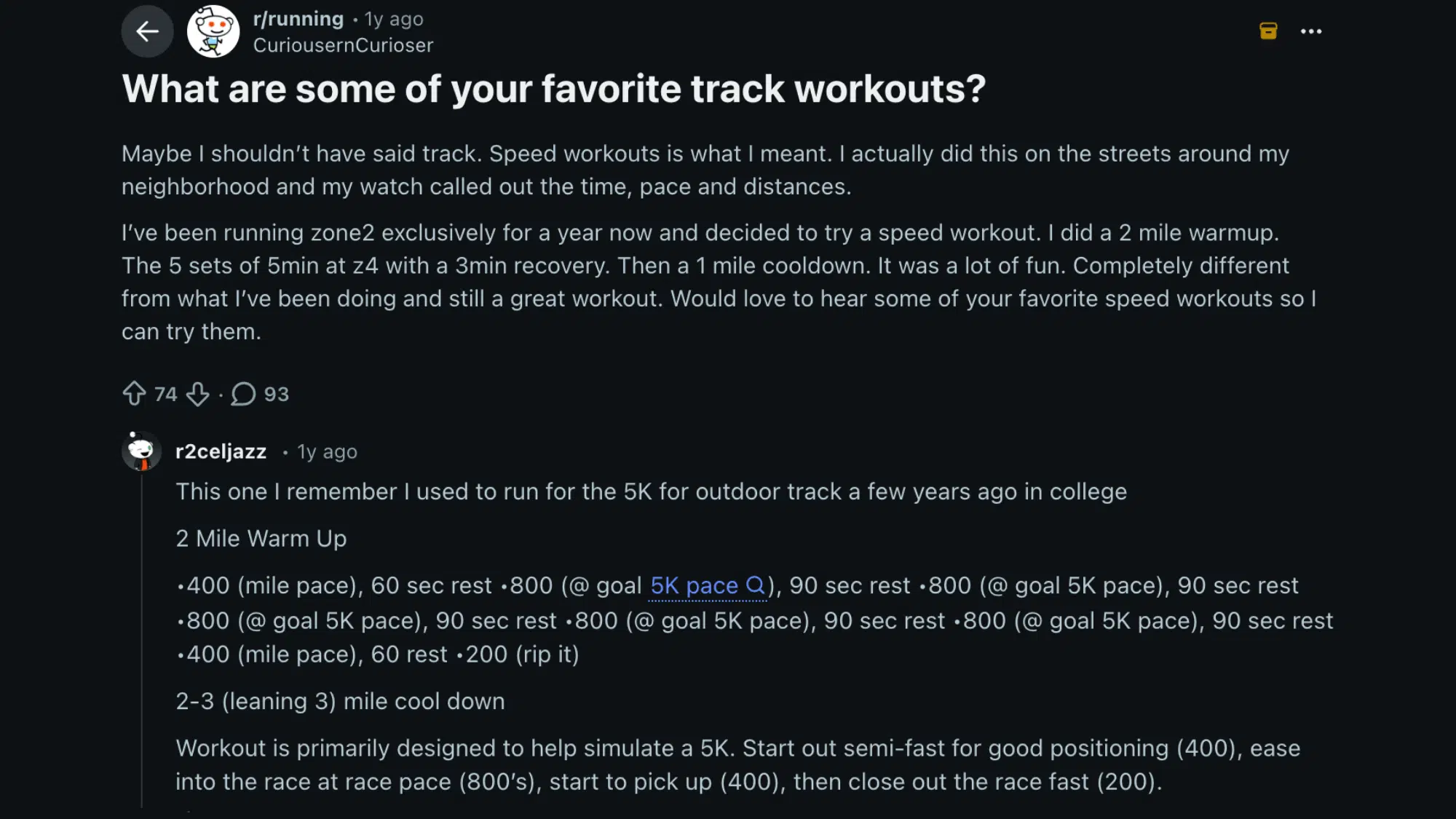
Track sessions don’t just belong to elite athletes; everyday runners use them to get faster, tougher, and more confident.
When you look at what people share online, a common theme pops up: simple but structured workouts that push you just enough without leaving you wrecked for days.
Many runners like mixing short, fast reps with one longer “grind” interval in the middle to simulate late-race fatigue.
Here’s how one runner on Reddit described their favorite track workout (paraphrased):
“I like to start with an easy warmup, then do 4×400 meters, one hard 1000-meter repeat, and another set of 4×400 before cooling down. I keep the rest short, about 45 seconds between the 400s and around 2 minutes before the 1K, and aim to run the reps roughly one minute per kilometer faster than my 5K race pace.”
Workouts like this are tough but controlled, and they train both speed and stamina in a single session.
You can check and participate in the discussion here at Reddit.
Common Mistakes Distance Runners Make With Track Workouts
Let’s keep it real. Here are the mistakes everyone makes at least once:
- Going Usain Bolt on Rep One: Save some energy for the later reps, hero; workouts are marathons, not sprints, so chill early to finish strong later.
- Skipping Warm-Up: Congrats on your future injury; skipping warm-ups tightens muscles, shocks joints, and turns a fun workout into rehab, so enjoy.
- Doing Hard Workouts Back-to-Back: Rest days exist for a reason; adaptation happens while recovering, not while endlessly hammering yourself exhausted between big workout efforts.
- Same Workout Every Week: Your body adapts; mix it up with different paces, intervals, surfaces, and workouts to keep improving consistently over the months.
- Ignoring the Weather: Heat and humidity will humble you; slow down, hydrate more, shorten reps, and respect conditions instead of forcing heroics today.
- Comparing Yourself to Others: That person crushing mile repeats might be training for a totally different race, distance, or goal than you right now.
Final Thoughts
Track workouts stop feeling intimidating once they become part of the routine. Over time, the oval turns into a place to test limits, build confidence, and see real progress in pace, form, and endurance.
With the right mix of intervals, tempo work, and recovery, every runner can use the track to get stronger and smarter on race day.
The goal isn’t perfection, it’s steady growth, wise choices, and learning what the body can do on both good and tough days.
Think of the track as a training lab where each rep teaches something new about pacing and effort.
Ready to put these workouts into action? Lace up, head to the track, and start your next session with purpose. Let the training begin today.